Dataset and Metric Preparation for Traffic Accident Detection
Building reliable systems starts with the right dataset. First, assemble multimodal collections that pair images and text. Also, include video sequences with accurate timestamps. Additionally, gather scene-level annotations that describe events such as a collision, sudden braking, or near-miss. For reference, benchmark studies show that vision-language models improve when datasets contain richly annotated visual and language pairs; one review states that “multimodal vision-language models have emerged as a transformative technology” which stresses careful dataset curation aqui. Next, split data for training, validation, and test. Also, keep separate holdout sets that reflect rare events like multi-vehicle crashes.
Class imbalance is a serious problem. Accident events are rare compared to normal traffic. Therefore, use augmentation to synthesize more examples. Also, apply temporal augmentation such as frame sampling and motion jitter. Moreover, use scene-level paraphrasing of language descriptions to diversify language data. Use synthetic overlays to simulate different weather conditions and lighting. In addition, use targeted oversampling for pedestrian and vehicle occlusion cases. For practical steps, employ techniques from multitask fine-tuning work that improved crash classification by up to 15% compared to baseline models fonte. This supports more robust training data.
Select metrics that match operational goals. Precision, recall, and F1-score remain central for classification and for detection of traffic events. Also, monitor false alarm rate and time-to-alert. For real-world deployments, measure response times and operator verification load. Furthermore, adopt per-class metrics so the system can classify collisions, near-misses, and stalled vehicles separately. Use a clear metric to align stakeholders. Also, include a benchmark for end-to-end latency to support real-time needs. For examples of dataset and metric standards used in the field, consult the ICCV fine-grained evaluation on traffic datasets which reports >90% recognition for key elements like vehicles and signals estudo.
Finally, maintain audit logs for training data and labels. Also, tag sources and annotators. This helps align models with compliance requirements, especially for on-prem solutions. visionplatform.ai, for example, keeps data and models on-site to ease EU AI Act concerns. In addition, integrate tools for forensic search to support post-incident review and human verification busca forense.
Vision Language Model and vlms: Architecture and Components
VLM architectures blend vision encoders with language heads. First, a visual encoder ingests frames. Then, a language model consumes language descriptions. Also, a fusion module aligns visual and textual features. Typical pipelines use convolutional neural networks or vision transformers as an encoder. Furthermore, transformer-based language heads provide flexible natural language outputs. This end-to-end approach allows systems to generate language descriptions of a scene and to classify events. In practice, designs borrow from CLIP and ViLT, while traffic-focused vlms adapt to scene dynamics.
Pre-training matters. Large vision-language corpora teach models general alignment across images and captions. Then, fine-tuning on domain datasets sharpens the model for traffic use. Also, pre-trained models reduce the need for vast labelled traffic data. For example, researchers have reported that combining large language model components with vision backbones improves adaptability and reasoning in traffic contexts referência. In addition, fine-grained evaluation studies show high recognition rates for vehicles and signals when models are properly pre-trained and fine-tuned ICCV.
Architectural choices vary. CLIP-style dual encoders offer faster retrieval workflows. ViLT-style single-stream models yield compact computations. Also, custom adapters can be added to handle signage and weather changes. For traffic, specific modules parse language descriptions of lanes, signage, and pedestrian intent. In addition, lightweight vlm variants target edge GPUs for on-device inference.
When building an on-prem vlm, consider latency, privacy, and integration. visionplatform.ai implements on-prem models to keep video local and to accelerate incident response. Also, the platform supports custom classifier training, which lets teams classify site-specific events and improve robustness. For real-world testing, integrate vision transformers or convolutional neural networks for the encoder, then couple them with a transformer language head. Also, use a deep neural network for downstream decision support. Finally, balance computation and accuracy with model pruning or quantization to accelerate inference for edge deployments.

AI vision within minutes?
With our no-code platform you can just focus on your data, we’ll do the rest
Real-time Detection with VLMs in Traffic Monitoring
A live pipeline requires precise orchestration. First, ingest RTSP streams from cameras. Then, decode frames and pass them to the visual encoder. Also, run lightweight preprocessing to crop and normalize. After that, fuse visual and language features to produce an output. This output can be a short language description or a class label for events like a crash. For real-time detection, keep per-frame latency below one second for most urban deployments. Edge deployments use GPU-accelerated inference to meet this target.
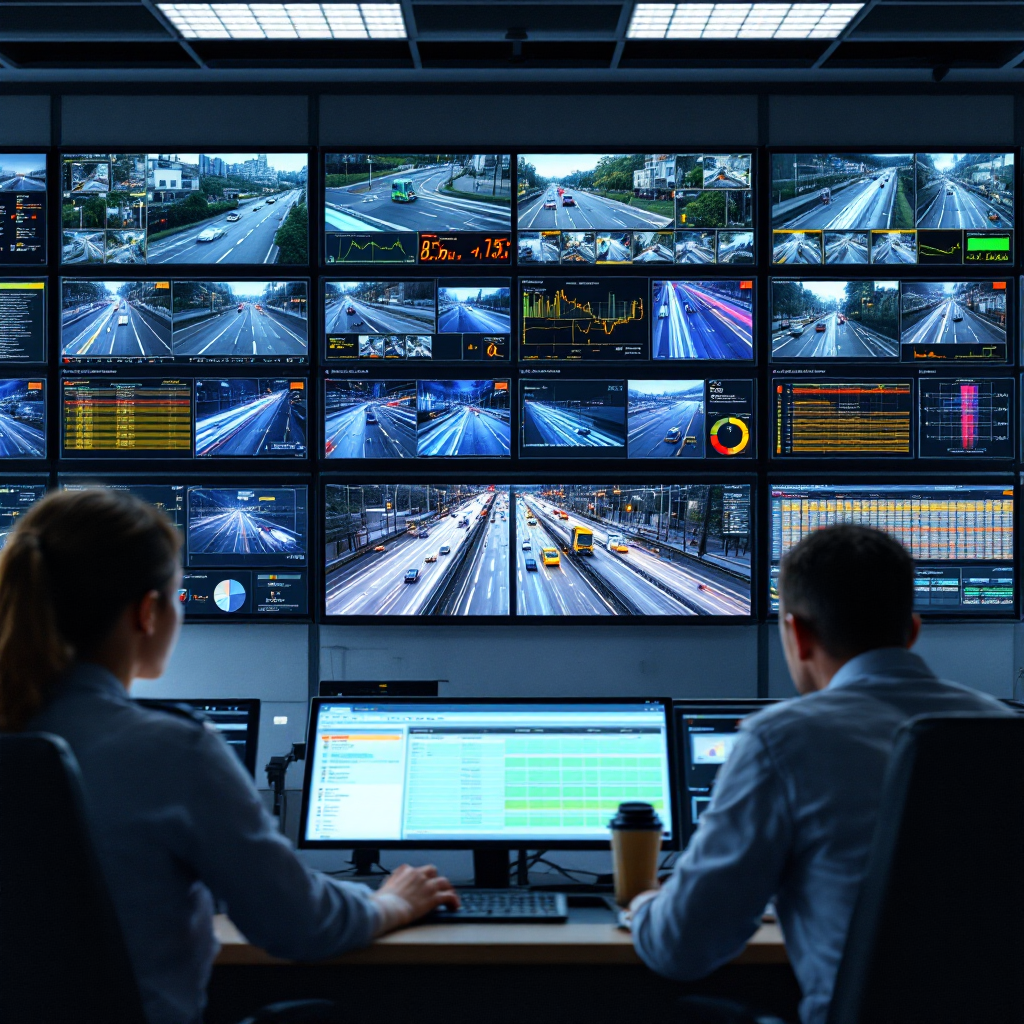
Latency is critical. Therefore, optimize model size and batching. Also, use frame skipping when traffic is light. In addition, pipeline parallelism can accelerate processing. Deployments on devices such as NVIDIA Jetson boards are common. visionplatform.ai supports edge and server deployments, which helps control rooms get quicker context rather than raw alarms. Additionally, the platform reduces operator load by turning detections into searchable language descriptions and structured events.
Operational accuracy matters as much as speed. Benchmark trials in urban scenarios report 90%+ accuracy in detecting collisions and sudden braking events when models are fine-tuned on relevant datasets estudo MDPI. Also, adding temporal models and optical flow improves the detection and classification of multi-step incidents. Furthermore, pairing visual modules with language prompts helps to resolve ambiguous frames by leveraging context from preceding seconds.
For reliability, monitor drift and retrain with new training data. Also, apply continuous evaluation on live feeds. Use alert throttling to reduce false positives. In addition, maintain an operator feedback loop that lets human reviewers flag misclassifications. This human-in-the-loop strategy improves robustness. Finally, integrate with control room systems for automated incident reporting, which improves response times and supports public safety objectives.
Language Model Integration in Intelligent Transportation System
Text embeddings extend visual context. First, map language descriptions of weather, signage, and events into the same embedding space as images. Then, query scene states using natural language prompts. Also, produce structured incident reports that include a short textual summary, timecodes, and confidence scores. These capabilities enable an intelligent transportation system to automate alerts and route decisions. For example, operators can query a camera archive in plain language and retrieve relevant clips quickly. visionplatform.ai supports such search and reasoning features to move beyond raw detections.
Integrating language data improves richness. Also, add contextual tags like signage type or road condition. In addition, harness LLM elements to summarize multi-camera views. For controlled environments, deploy a pre-trained language model that is fine-tuned on transportation safety terminology. This approach helps to classify events more accurately and to generate clearer language descriptions for incident reports.
Automated alert generation requires careful thresholds. Therefore, combine classifier confidences and cross-camera corroboration. Also, include operator validation steps for high-severity incidents. In addition, feed structured outputs to dashboards and to traffic management centres. visionplatform.ai exposes events via MQTT and webhooks so that control room dashboards and third-party systems can act without manual copying. Also, link incident summaries to archival video to support investigations and forensics busca forense.
Finally, ensure interoperability. Use standard APIs and clear schemas. Also, align event taxonomies across vendors to support city-wide deployments. In such cases, an intelligent transportation system benefits from consistent metrics and from language-enabled search. For further operational features, see vehicle analytics and detection capabilities such as detecção e classificação de veículos, which translate well to road traffic scenarios.
AI vision within minutes?
With our no-code platform you can just focus on your data, we’ll do the rest
Autonomous Driving and Autonomous VLM Perception
End-to-end perception is central for autonomous driving systems. Models must sense, describe, and predict. First, the perception stack uses cameras, LiDAR, and radar. Then, vision and language processing layers generate language descriptions and structured outputs. Also, these outputs feed path-planning modules. In practice, coupling a vlm with motion planners improves hazard anticipation. For example, adding language descriptions about occluded pedestrians helps planners to adopt safer trajectories.
Real-world trials show gains. Researchers observed better hazard anticipation under low-light and occluded conditions when multimodal perception was used pesquisa da NVIDIA. Also, these systems often rely on vision transformers and convolutional neural networks for robust feature extraction. Furthermore, safety validation protocols include scenario replay, edge-case injection, and regulatory compliance checks. Such steps help certify on-board systems for production vehicles.
Validation must be rigorous. Therefore, include simulated scenarios and annotated highway trials. Also, measure performance on image classification and object detection tasks as proxies for scene understanding. In addition, enforce continuous safety monitoring in deployments to detect model drift. This supports transportation safety and public safety alike.
Regulatory alignment matters. Therefore, document model behavior, datasets, and training processes. Also, ensure that on-board systems can provide explainable outputs that operators or auditors can review. Finally, pair autonomous perception with operator override paths and with robust communication to traffic centres. visionplatform.ai‘s approach to explainability and agent-ready outputs illustrates how detection can evolve into reasoning and actionable support for control rooms.
Transportation Systems: Performance Metric and Future Trends
Standardisation of metrics will accelerate adoption. First, cities and vendors must agree on shared metrics for cross-vendor benchmarking. Also, adopt a clear metric for time-to-alert and for per-class F1-scores. In addition, record AR metrics and operational response times so that planners can compare systems fairly. For example, ICCV evaluations offer benchmark protocols that can guide municipal testing benchmark.
Emerging reinforcement learning approaches will enable continuous adaptation. Also, online learning can help models adjust to new road layouts and signage. In addition, agent-based modeling combined with large language model elements supports adaptive traffic simulations research. These methods improve robustness to previously unseen conditions and reduce manual retraining cycles.
Ethics and privacy remain priority topics. Therefore, push for on-prem processing to keep video inside controlled environments. Also, anonymize personal data and minimize retention. In addition, ensure compliance with EU AI Act-style regulations. visionplatform.ai advocates for on-prem, auditable deployments that align with these requirements by design.
Looking ahead, multimodal fusion and continual learning will shape future transportation systems. Also, tools that let operators search video with natural language will accelerate investigations and decision-making. For example, a control room that can classify an incident, search related footage, and produce a concise report will reduce time to resolution. Finally, emphasize open benchmarks, shared datasets, and transparent models. Such practices will accelerate safe and scalable deployment of VLMs across highways, urban networks, and public transport.
FAQ
What datasets are commonly used for traffic accident research?
Researchers use multimodal collections that combine images, video, and annotated text. Also, traffic-focused benchmarks and fine-grained datasets from recent studies provide ready testbeds for model evaluation ICCV.
How do vision language models improve accident detection?
They fuse visual and textual cues so models can reason about context and intent. Also, language descriptions enrich scene understanding and reduce ambiguity in frames where visual cues alone are insufficient.
Can these systems run on edge devices?
Yes. Edge deployment is possible with optimized encoders and pruning. Also, platforms such as visionplatform.ai support deployment on GPU servers and edge devices for low-latency processing.
What metrics matter for real deployments?
Precision, recall, and F1-score are core metrics for classification tasks. Also, operational metrics like response times and time-to-alert are crucial for control rooms.
Are privacy concerns addressed?
On-prem solutions and anonymization help. Also, keeping video and models inside an organization reduces the risk of data exfiltration and supports regulatory compliance.
How often should models be retrained?
Retraining schedules depend on data drift and incident rates. Also, continuous evaluation and human feedback loops help decide when to update models.
Do VLMs work at night or in bad weather?
Performance drops with poor visibility but improves with multimodal inputs and temporal modeling. Also, augmenting training data with weather variations increases robustness.
Can VLMs distinguish between a crash and a traffic jam?
Yes, when trained with detailed labels and temporal context. Also, combining cross-camera corroboration improves classification between collision and congestion events.
How do control rooms interact with VLM outputs?
VLMs generate structured alerts and language descriptions that feed dashboards and AI agents. Also, operators can search archives using natural language to expedite investigations busca forense.
What future trends should practitioners watch?
Watch reinforcement learning for continuous adaptation and standards for cross-vendor benchmarks. Also, expect improvements in multimodal fusion and explainability that will accelerate deployment across transportation systems.