bosch video management system overview with vision-language models
Bosch Video Management System (BVMS) serves as a modern VIDEO platform for integrated security and operations. It handles camera streams, recording, event routing, and operator workflows. BVMS ties together hardware, user interfaces, and analytics so teams can monitor sites, investigate incidents, and respond faster. For many sites, the core value comes from turning raw streams into actionable context. To introduce that context, recent research shows that combining VISION and language yields human-like summaries for frames and clips. These VISION LANGUAGE models allow operators to query scenes in plain English and get precise results.
Leading language models in this space include CLIP and Flamingo, both proven on large datasets and useful for zero-shot tasks. CLIP pairs images with text and supports strong visual-text retrieval. Flamingo fuses multi-modal inputs and demonstrates cross-modal reasoning. Their capabilities allow BVMS to perform SEMANTIC search, natural-language interaction, and quick incident summaries. Industry benchmarks report image-text retrieval accuracies above 80% on standard datasets, which indicates a substantial improvement in comprehension when VISION and language are combined (state-of-the-art benchmarks).
Integrating these models into a commercial SYSTEM brings clear benefits. First, operators can ask for events using plain phrases and find relevant footage without knowing camera IDs. Second, the SYSTEM can generate descriptions that reduce time-to-verify. Third, semantic indexing enables faster forensics and better decision support. For example, our platform pairs an on-prem VISION model with an AI agent so control rooms move from raw detections to reasoning and action, which helps reduce cognitive load. For practical guidance on building forensic search from descriptions, see our forensic search in airports resource (forensic search in airports).
Dr. Anil Jain summed up the trend: “The fusion of vision and language models is transforming how surveillance systems interpret complex scenes” — a quotation that highlights both COMPREHENSION and operational potential. These models demonstrate how BVMS can enable operator-centric workflows, while respecting local privacy and scalability needs (operational CCTV use in traffic centers).
video data pipeline and AI-driven analytics in BVMS
A robust VIDEO pipeline starts at CAPTURE. Cameras stream encoded feeds to edge encoders or central servers. From there, the SYSTEM archives compressed footage while metadata and events flow to analytics services. Typical steps include capture, encode, transport, store, index, and present. Each step benefits from efficient design and clear SLAs. For example, footage destined for rapid queries should use keyframe indexing, compact descriptors, and textual summaries so retrieval stays fast. For airports and busy facilities, use cases such as people detection or vehicle classification demand both throughput and low latency. See our people detection in airports page for applied examples (people detection in airports).
Edge-based processing reduces latency. When analytics run on-site, alerts and semantic descriptions can appear within a few hundred milliseconds. Local inference keeps sensitive VIDEO inside the environment, which helps with compliance. Conversely, cloud-based processing provides elastic scale and centralized model updates. Choose an approach based on privacy, cost, and required response time. For many critical sites, a hybrid approach works best: run real-time filters at the edge and heavier forensic indexing in a central cluster.
Hardware requirements vary by throughput. A typical 1080p stream needs 200–500 ms per frame on optimized GPUs for advanced VISION models, while lightweight DNNs can operate on Jetson-class devices. Large deployments require distributed processing and an orchestration layer. Bosch deployments in transportation centers show that scalable VIDEO ARCHIVAL and distributed analytics form a reliable foundation for incident response (transportation management center guidance).
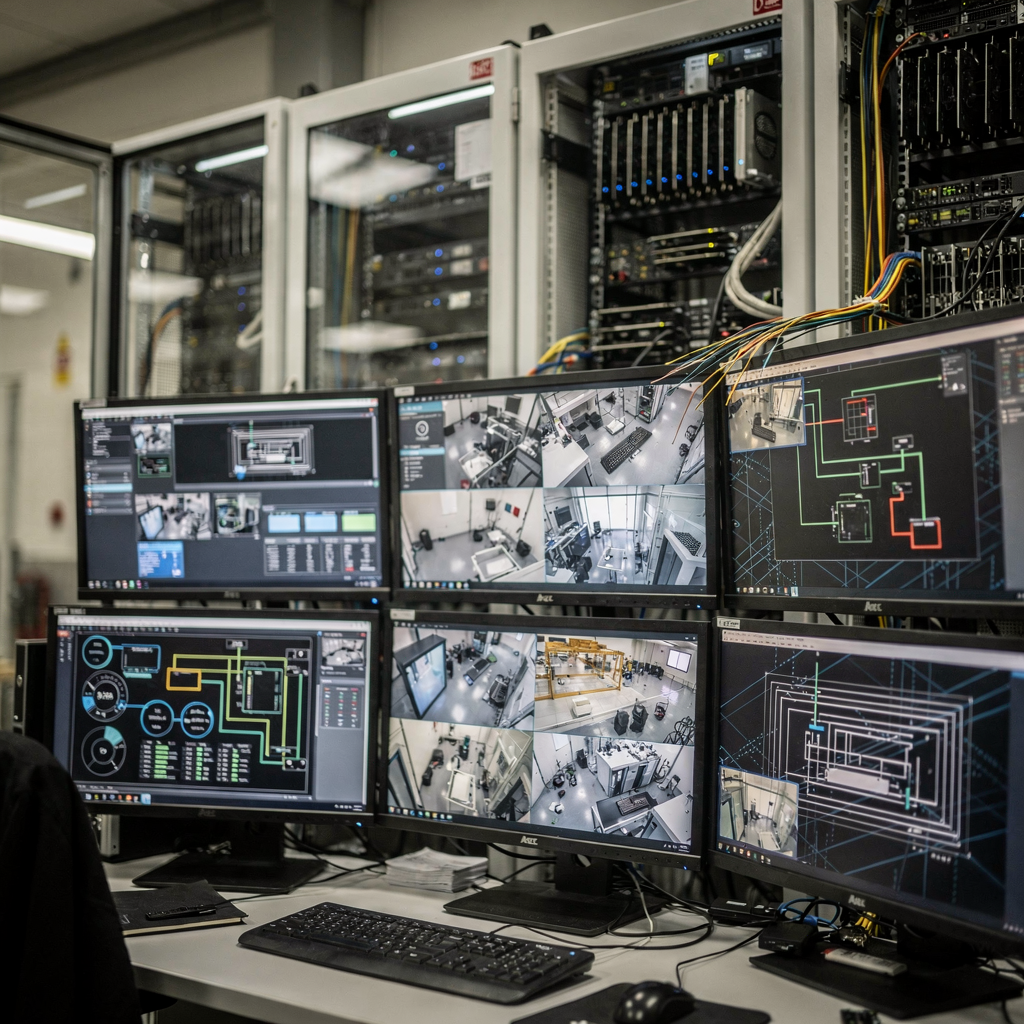
Operationally, throughput benchmarks guide design. For high-density monitoring, plan for parallel model instances and failover. Use MQTT and webhooks to stream events to downstream systems. Our software design favors on-prem VISION models and AI agents so that the SYSTEM enables fast, explainable alerts while keeping video local. For vehicle-focused analytics, refer to our vehicle detection and classification resource (vehicle detection and classification in airports).
AI vision within minutes?
With our no-code platform you can just focus on your data, we’ll do the rest
object detection and vehicle perception for autonomous monitoring
Object DETECTION is the foundation of automated monitoring. Fine-tuning models for vehicles, trucks, and PEDESTRIAN classes enhances site-specific accuracy. Teams collect labeled clips, apply augmentation, and retrain backbones. This targeted approach reduces false positives and raises precision for classes that matter on a site. A well-tuned MODEL can reach high detection accuracy while keeping false alarm rates low. Typical evaluation uses mean average precision and tracking metrics to measure both detection fidelity and persistence across frames.
Multi-object TRACK and multi-camera calibration improve end-to-end perception. When cameras cover the same area, multi-view fusion resolves occlusion and ID switches. Multi-camera calibration also supports longer-term tracks for trajectory analysis and PREDICTION of suspicious movement. Track continuity helps with behavior analytics such as loitering, perimeter breach, and unsafe loading at docks. For examples of detection tailored to airport workflows, see our ANPR and LPR solutions and related detection suites (ANPR/LPR in airports).
Performance metrics matter. Industry systems show per-frame inference latency in the 200–500 ms range on optimized hardware for complex VISION models. False-positive rates vary by environment; typical targets aim below 5% for high-confidence operational rules. Multi-object tracking uses identity preservation scores to measure reliability over time. Behavioural analysis uses rule-based or learned models to flag patterns such as tailgating, sudden stops, or illegal turns.
Model ADAPTATION is key. You must fine-tune with local data to handle unique markers, vehicle liveries, and camera angles. Use incremental training and validation for continuous improvement. The goal is a ROBUST pipeline that can serve both security and OPS teams. That same pipeline can also support autonomous driving testing by providing labeled roadside footage for AUTONOMOUS VEHICLE perception research. The approach enables safer deployments and faster validation in complex environments.
description and transcript generation for semantic search
Generating human-readable DESCRIPTION and TRANSCRIPT data converts frames into searchable knowledge. Language MODELS convert detections and visual cues into concise sentences. For example, a clip might be summarized as “Red truck enters loading bay at 21:12 and remains for two minutes.” Such descriptions power natural-language queries and forensic search. Our VP Agent Search turns textual summaries into a searchable index, so operators find incidents without knowing camera IDs or timestamps.
Automatic TRANSCRIPT creation helps too. The pipeline extracts key events, timestamps them, and attaches short descriptions. This makes history searchable by phrases like “person loitering near gate after hours.” Operators then search over descriptions and transcripts rather than scanning video manually. This reduces time-to-incident by a substantial margin.
Language MODELS and VISION backbones must be aligned. Fusion models produce better semantic labels when they are trained with paired visual and textual data. When on-prem privacy is required, keep both models and video local. That enables the same level of functionality without exporting footage. For forensic-style workflows, see our forensic search in airports link (forensic search in airports), which demonstrates natural language queries over indexed descriptions.

Use cases include rapid incident retrieval, evidence preparation, and cross-camera correlation. Transcripts also help AI agents reason over context, which leads to fewer false alarms and clearer incident narratives. The combination of DETECTION, TRANSCRIPT, and semantic indexing elevates VIDEO ANALYTICS from alerts-only to decision support. It also enables richer reporting and automated incident reports that save operator time.
AI vision within minutes?
With our no-code platform you can just focus on your data, we’ll do the rest
real-time update workflows and alert triggering
Reliable ALERTS depend on controlled model UPDATE and metadata refresh processes. First, create a CI/CD pipeline for models. Validate new weights on hold-out sets and run shadow testing before production. Second, automate metadata refresh so descriptions and transcripts stay synchronized with archives. Third, implement version control and rollbacks so operators always know which model produced an alert.
Real-time alert generation must balance speed and reliability. Low-latency alerts arrive in under 500 ms on optimized edge hardware. For high-assurance sites, design a two-stage workflow: a fast, conservative detector runs on edge, then a second semantic verification stage confirms the event. This reduces false alarms and improves operator trust. Monitor pipeline health with metrics such as inference latency, event throughput, and false alarm rate.
Best practices include clear audit logs, periodic recalibration, and graceful rollout of new models. Use canary deployments to evaluate changes on a subset of streams. Record both model versions and event evidence to support compliance and incident reviews. Our VP Agent Reasoning feature correlates descriptions, VMS events, and external procedures so alerts carry context and recommended actions. That approach reduces manual steps and helps teams operate more efficiently.
Version control is essential. Store artifact metadata, training data lineage, and evaluation results. Operators need transparent explanations when alerts are verified or suppressed. This improves reliability and builds confidence in AI-driven automation. The same workflow supports scheduled retraining and deployment cycles, whether for routine improvement or urgent patches.
bosch integration challenges and future update strategies
Integrating advanced VISION models into BVMS raises practical challenges faced by many teams. Data privacy and GDPR compliance top the list. Keep VIDEO and models on-prem when legal constraints require it. That reduces risk from moving footage offsite. Our architecture emphasizes on-prem processing and auditable logs to support EU AI Act obligations and local regulations.
Scalability is another concern. Large sites require a distributed approach and robust orchestration. Plan capacity for peak loads, design failovers, and automate health checks. Maintenance includes retraining, recalibration, and validation. For transport deployments, lessons from field reports show the need for modular components that can upgrade independently (scalability and maintainability guidance).
Future directions include explainability, multilingual support, and better integration with operational workflows. Explainable outputs help operators understand why an alert fired. Multilingual descriptions help global teams. Integration with autonomous driving and AUTONOMOUS VEHICLE testing workflows can provide labeled roadside datasets for perception research. For reference on operational CCTV in transport centers, review practical guidance (transportation camera operations).
Practical advice: start with clear objectives, select target classes such as VEHICLE and PEDESTRIAN, and iterate with site-specific data. Use robust validation and include stakeholders early. Our VP Agent Suite connects VMS events to AI agents so teams can move from detection to reasoning and action. This SUITE keeps video local while enabling AI-assisted workflows. Finally, ensure you plan for human oversight, audit trails, and a path to full autonomy only when reliability and policy allow. For related detection tools and examples, explore vehicle detection resources (vehicle detection and classification in airports).
FAQ
What is a vision-language model and why is it useful for BVMS?
A vision-language model fuses VISUAL inputs and natural language to describe scenes. It is useful for BVMS because it enables semantic search, natural-language queries, and human-friendly summaries that reduce time-to-verify.
Can these models run on-premises to meet privacy rules?
Yes. On-prem deployment keeps VIDEO and model artifacts inside your environment. That approach supports GDPR and EU AI Act compliance and reduces risk from cloud exports.
How does edge processing compare with cloud processing for latency?
Edge processing delivers lower latency and preserves privacy because inference happens near CAPTURE. Cloud processing offers elastic scale and centralized updates but may add transit latency and compliance concerns.
What performance metrics should I track for detection and tracking?
Track mean average precision for detection, ID preservation scores for tracking, inference latency, and false-positive rate. These metrics help you evaluate operational reliability and guide retraining.
How do transcripts improve forensic search?
Transcripts convert events into searchable text, which allows operators to use natural-language queries rather than manual playback. This speeds investigations and reduces the hours needed to locate evidence.
How often should models be updated in production?
Update cadence depends on data drift and operational changes. Use canary deployments and shadow testing so you validate updates before full rollout. Keep versioned artifacts and audit logs for traceability.
How does BVMS handle multi-camera tracking?
Multi-camera tracking uses calibration, re-identification, and cross-view fusion to maintain track continuity. This reduces identity swaps and improves long-term movement analysis across a site.
Can the system support autonomous vehicle research and testing?
Yes. The same perception stacks that detect vehicles and pedestrians can serve AUTONOMOUS VEHICLE labeling and validation. On-prem collection provides high-quality data without exposing raw footage.
What safeguards prevent an increase in false alarms after deploying AI?
Combine fast edge detectors with semantic verification stages and human-in-the-loop review. Also use feedback loops to retrain models on false positives so overall reliability improves.
How do I get started integrating vision-language capabilities into my BVMS?
Start by identifying high-value classes and workflows, collect labeled site data, and run pilot deployments on a subset of cameras. Use staged rollouts, performance metrics, and clear rollback plans to minimize operational risk.