Application of AI in the Meat Production Process
AI transforms each stage of the production process in meat production. First, AI systems monitor slaughtering, cutting and packaging lines with cameras and sensors. Then, machine learning models run on edge devices to score cuts, predict yield, and direct robotic handlers. The combination lets teams automate repetitive tasks while keeping teams focused on exceptions. The application of AI covers simple counting and complex decisions. For example, a vision system detects cut orientation and guides robots to reduce trim loss. Also, AI enables faster decision loops that previously depended on manual measurement and recalls. In practice, processors report throughput increases of up to 30% when they integrate computer vision and automation, and error reduction follows as a direct result (review of robotic and automated systems). This statistic shows real value for meat processors who seek operational gains.
AI tools such as classification networks and real-time analytics tag each carcass or cut as it moves down the line. These tags then feed the traceability chain and the plant dashboard. AI enables predictive maintenance as well. Sensors and AI detect vibration, temperature changes, or motor strain and they schedule service before downtime occurs. For processing lines where speed matters, this reduces stoppages and keeps throughput high. Process control improves when models learn from in-plant variations and from operator feedback. A single, on-premise deployment can leverage existing CCTV to create a sensor network, so plants avoid expensive new cameras. Our team at Visionplatform.ai turns existing CCTV into an operational sensor network. We detect people, PPE and custom objects in real time, and we stream events to business systems so teams can act on video events without copying raw footage offsite.
Integration of machine learning with sensor data supports real-time decision making and improves safety and quality at the same time. The integration of AI into the production line uses both cameras and other sensors to evaluate temperature and weight alongside visual cues. This combination helps to measure meat quality parameters and to flag issues earlier. Operators can then automate corrective actions, such as redirecting a cut for rework. Overall, AI lowers variability and increases yield. Finally, this shift supports industry 4.0 objectives in the meat and poultry sector and aligns plants with modern, data-driven operations.
Traceability and Food Safety in Meat Production
Traceability moves from paper and post-fact audits to continuous, machine-driven records. AI-enabled traceability combines IoT sensors, blockchain ledgers, and analytics to track each batch from farm to fork. Systems powered by AI collect location, temperature, and handling events and then link them to barcodes or RFID tags. This data flow creates a tamper-evident trail and it strengthens food safety and quality assurances. Studies show AI-enabled traceability systems can reduce food safety incidents by up to 30% through earlier detection of contamination or fraud risks (research on AI in the food industry). Those reductions matter for processors, retailers, and consumers alike.
AI also improves recall efficiency. For example, a processor cut recall times by about 25% when they adopted an AI-based tracing approach that linked batch images, sensor readings, and shipment records (AI’s role in food safety). This faster identification narrows the scope of recalls and lowers waste. The traceability system supports compliance with EU rules and local regulations because automated audit trails prove where every item passed. Natural language processing can augment traceability by parsing supplier documents and by matching textual certificates with sensor feeds. In effect, AI reduces ambiguity between paper records and digital sensor logs.
When you combine AI-driven blockchains with edge analytics, you limit data exposure while keeping provenance verifiable. For meat processors, that approach helps maintain GDPR and EU AI Act readiness by keeping sensitive video and training data on-premise. It also lets teams create consumer transparency portals that show origin, handling, and temperature history for a given meat product. These portals reinforce trust, and they align with consumer demand for more visible safety and quality practices. In short, traceability that uses AI not only reduces food safety risk; it creates a clear, auditable path from farm to table while improving operational efficiency.
AI vision within minutes?
With our no-code platform you can just focus on your data, we’ll do the rest
AI for Visual Inspection and Quality Assessment
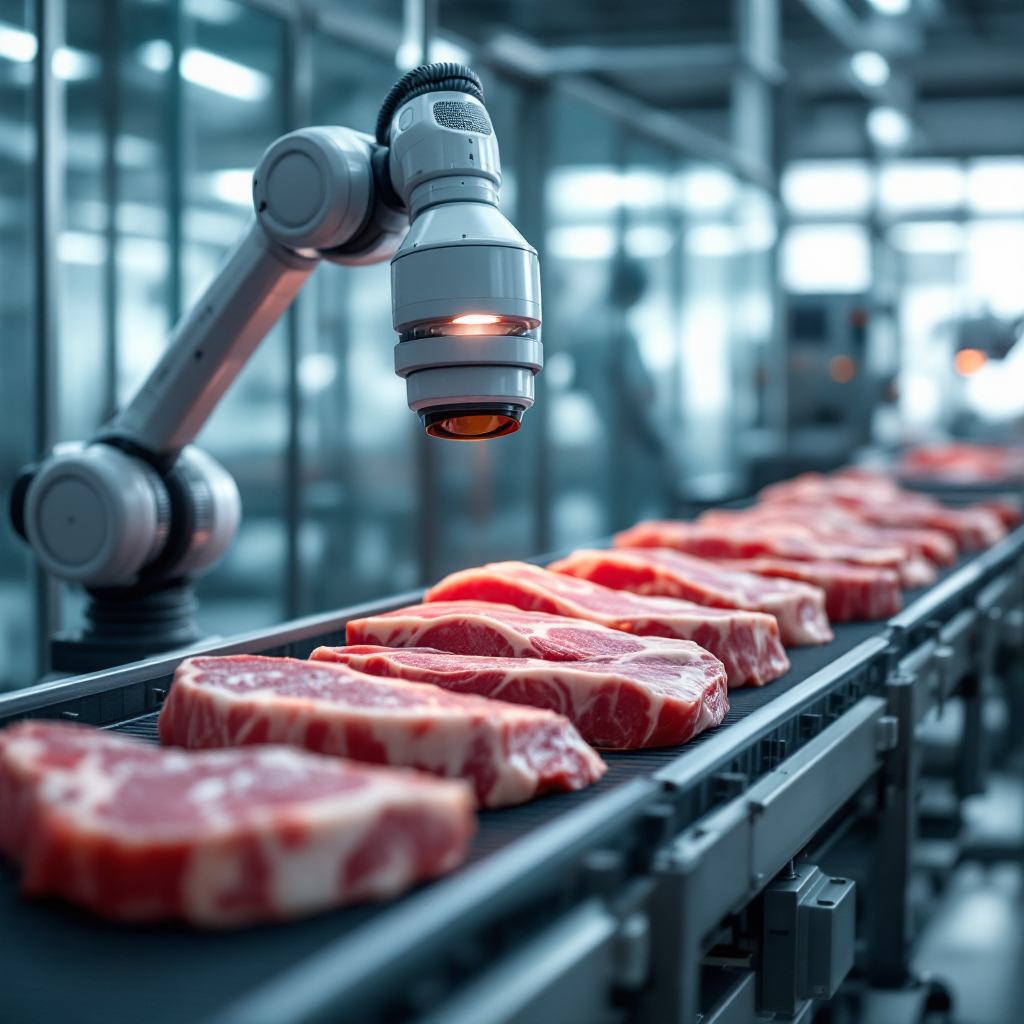
Computer vision now drives many quality assessment tasks that were once manual. Cameras mounted over conveyor belts capture hundreds of images each minute. AI algorithms then evaluate colour, marbling, fat distribution and surface defects. These vision system models can classify meat cuts with accuracy rates exceeding 90% in trials, and they often outperform manual inspection speeds (review of AI in meat processing). A study that combined computer vision and machine learning reported over 92% accuracy for meat colour classification, a clear boost for consistent grading (classification accuracy study). As a result, processors gain objective, repeatable results for meat quality assessment.
AI inspects at a scale humans cannot sustain. Systems spot subtle bruises, blood spots, or skin defects that are easy to miss at high belt speeds. Also, cameras feed images into models that score marbling and texture, which helps with price segmentation and product quality decisions. Inspectors then focus on exceptions suggested by the AI. This workflow improves inspection throughput and reduces human fatigue. It also ensures consistent grading across shifts and plants. For meat and poultry processors, these protections support both safety and product quality goals.
Vision systems integrate with plant control to tag and sort cuts. For example, a conveyor-belt camera spots tiny defects and triggers a sorter to divert affected pieces for rework or disposal. That capability lowers rework rates and reduces waste. Combined with a traceability system, each flagged item retains a record linking the visual defect to supplier, batch, and handling events. Finally, applying artificial intelligence to measure meat in this way supports broader food quality and safety programs, and it aligns with modern meat quality evaluation methods based on data rather than sampling alone.
Automate Quality Control for Meat Processors with AI
Robotics and AI together automate inspection, sorting and grading without fatigue. Robotic arms guided by AI vision pick and place cuts precisely. They adapt to variation in size and shape. This combined approach helps processors automate repetitive tasks and to keep human workers focused on complex decisions. When plants automate quality control, processing time can drop by as much as 40%, and throughput rises while standards remain steady (robotics review). Those gains improve the economics of meat processing and support higher product quality.
Practical considerations matter. Sensor durability in wet, cold, and high-speed environments can limit deployments. Cameras and thermal sensors must tolerate washdowns, grease, and low temperatures. Edge computing helps because it keeps models close to the cameras and reduces network strain. Visionplatform.ai, for instance, deploys models on-premise so video data and model training stay within the plant environment. This approach enables processors to own their data and to meet EU AI Act expectations while they automate shop-floor analytics.
When AI automates visual grading, it also supports consistent quality inspection across shifts. Automation reduces subjective variability in grade calls, and it records the basis for each decision. In addition, AI algorithms can learn continuously from operator feedback. That continuous learning loop improves accuracy for rare defects and for local market preferences. For processors that wish to scale, AI-based traceability and automated grading create a reliable pipeline from incoming carcasses to packaged products. The result is higher efficiency in meat, safer outputs, and measurable uplift in product quality.

AI vision within minutes?
With our no-code platform you can just focus on your data, we’ll do the rest
AI in Food Safety: Building Consumer and Regulatory Trust
AI offers predictive insights that protect food safety and build trust. Predictive models flag unusual patterns in temperature, handling, and batch lineage so teams can act before problems escalate. These models also detect potential fraud or adulteration by cross-checking lab results with supply chain metadata. For example, AI-based traceability can reconcile supplier claims with sensor records and alert inspectors to mismatches. This capability reduces food safety incidents and protects brand integrity.
Automated audit trails help with compliance. In the EU and elsewhere, regulators expect transparent records of handling and hazards. AI captures events and logs them in a way that inspectors can review quickly. This reduces the burden of paper audits and simplifies regulatory reporting. A robust traceability system also supports consumer transparency portals that show origin and safety data for a given meat product. Such portals help consumers verify freshness and safety and they create a measurable linkage between product quality and brand trust.
At the same time, processors must design AI with privacy and data governance in mind. On-premise solutions that keep video data local meet GDPR and EU AI Act concerns more readily than cloud-only options. Systems that allow model retraining on-site help processors maintain control while improving accuracy for plant-specific conditions. Tools that stream structured events, not raw video, integrate into operational dashboards and enterprise systems so teams can use the data for safety and for production metrics. Overall, the integration of AI helps the food industry and consumers by improving transparency, lowering food safety risk, and by providing auditable evidence of safety and quality practices.
Challenges and Future Prospects of Artificial Intelligence in the Meat Industry
Challenges remain despite strong advances. First, data quality and volume limit model performance. AI models need diverse, well-labeled images and sensor logs to learn rare defects and to handle different meat cuts. Second, harsh plant environments make sensor deployment and maintenance difficult. Cameras and sensors must resist moisture, cold, and repeated cleaning. Third, regulatory and privacy constraints require careful system design so plants keep control over training data and event logs.
That said, advances in edge computing and robust sensors will expand capabilities. Edge devices allow processors to run AI without sending raw video to external clouds. This approach improves latency and preserves data privacy. For meat and poultry operations, edge AI lets teams implement real-time inspection that triggers local actuators and sorters. Continuous learning loops mean models improve as they see more examples in a specific plant. In the future, processors will use advanced robotics, improved vision system lenses, and multimodal sensors that combine thermal, spectral and RGB inputs to assess freshness and safety more accurately.
Research suggests that AI’s potential depends on integration and data stewardship. When processors adopt integrated AI that includes traceability, inspection, and analytics, they can implement end-to-end food quality and safety programs. Implementing artificial intelligence to measure meat quality and to monitor supply chains will require collaboration between plant engineers, meat scientists, and data teams. In the long run, AI enables sustainable meat industry practices by reducing waste, improving yield, and by ensuring consistent food quality and safety. For processors ready to adopt, practical pilots that validate ROI and that test sensor robustness create the path forward. If teams pair AI with clear governance and operator training, the meat industry will continue to modernize under industry 4.0 principles.
FAQ
What is the role of AI in meat production?
AI automates visual inspection, supports traceability, and guides robotics to improve throughput and consistency. It provides real-time alerts and builds auditable records that help with regulatory compliance.
How does AI improve traceability?
AI links sensor data, images, and batch records to create a continuous trace from farm to fork. This reduces recall scope and speeds root-cause identification, lowering food safety risk.
Can AI detect contamination in meat?
AI can flag anomalies in temperature, handling, or visual defects that may indicate contamination risk. Combined with lab testing, these early warnings reduce the chance of large-scale incidents.
Are automated inspections better than manual inspection?
Automated inspection provides consistent, repeatable scores and operates without fatigue. Human inspectors still handle nuanced judgments, while AI handles scale and speed.
What practical hurdles exist for deploying AI in plants?
Plants must manage sensor durability, data labeling, and integration with existing control systems. On-premise deployments help address privacy and compliance concerns.
How do processors start with AI safely?
Start with targeted pilots that solve a single problem, such as defect detection or line balancing. Use local data for model training and keep raw video on-premise to meet regulatory needs.
Will AI replace workers in meat processing?
AI automates repetitive tasks and supports workers by reducing manual strain. It shifts human roles toward exception handling, maintenance, and higher-skill oversight.
How does AI support regulatory compliance?
AI generates structured, timestamped event logs that simplify audits and reporting. These records help demonstrate adherence to safety and handling standards.
What are common metrics to measure AI success?
Key metrics include defect detection accuracy, throughput improvement, reduction in rework, and decreased recall times. ROI can also consider reduced waste and labor savings.
How can Visionplatform.ai help meat processors?
Visionplatform.ai turns existing CCTV into an operational sensor network, enabling on-premise detections and event streaming for dashboards and BI. This approach helps processors automate inspection and integrate vision events into operational systems while keeping data in their control.