Importance of warehouse security in modern warehouse operations
Warehouses are often the storage hubs for valuable assets, and so they face real risks from theft, sabotage, and cyber attacks. For operators, ensuring the safety of inventory and records is a top priority. As a result, the importance of warehouse security rises with scale. Modern warehouse operations rely on integrated workflows that link logistics, automation, and human teams. Therefore, a lapse in protection can disrupt the whole supply chain and drive high replacement and downtime costs.
First, warehouses hold high-value stock and sensitive data. Second, they connect to transport, ERP, and cloud services. For these reasons, warehousing locations attract both physical intruders and attackers who target industrial control systems. The perimeter around a facility must be treated as the first line of defense. In fact, market data shows investment in that layer is increasing quickly: the global perimeter intrusion detection system market is projected to grow from $19.36 billion in 2024 to $22.97 billion in 2025, which reflects rising demand for perimeter security in logistics and industrial sites.
Threat types include external break-ins, vandalism, and insider risks. Staff with access can accidentally expose systems, or they can deliberately enable unauthorized access. Also, IIoT devices and automated handling equipment expand the attack surface. For that reason, combining physical security and digital protection matters. This blend of controls supports a security posture that stops quick intrusions and delays attackers while alerting responders.
Security management for warehouses now covers CCTV, access control systems, network monitoring, and analytics. A balanced security system for your warehouse should match scale, budget, and compliance needs. For example, Visionplatform.ai converts existing CCTV into an operational sensor network so teams can detect people, vehicles, and custom objects in real-time while keeping models and data on-prem. This approach helps protect assets and ensures GDPR and EU AI Act readiness where relevant.
To summarise the importance of warehouse security: asset protection, continuity of warehouse operations, and compliance with regulations all depend on a strong security foundation. Consequently, planners must treat security as a core part of operations. Regular security reviews and risk assessments help keep systems aligned to changing threats.
Perimeter security and alarm system: safeguard against intruder threats
Perimeter security begins with visible barriers and extends to electronic sensors and active monitoring. Fences and gates form a deterrent, and then motion sensors and infrared beams add detection. A layered perimeter reduces blind spots and forces intruders into areas covered by surveillance and alarm triggers. When sensors detect movement, systems can notify security personnel instantly and start response procedures. This flow helps protect assets before an intruder reaches storage zones.
An alarm system is the critical connector between detection hardware and response. Alarms generate clear alerts, and modern alarm systems stream event data to dashboards, mobile teams, and police where required. For instance, AI-driven video analytics have been shown to reduce incident response times by about 30%, which shortens the window an intruder has to act. Such analytics review feeds in real-time and flag anomalous behaviour, so responders get precise cues rather than generic motion alarms.
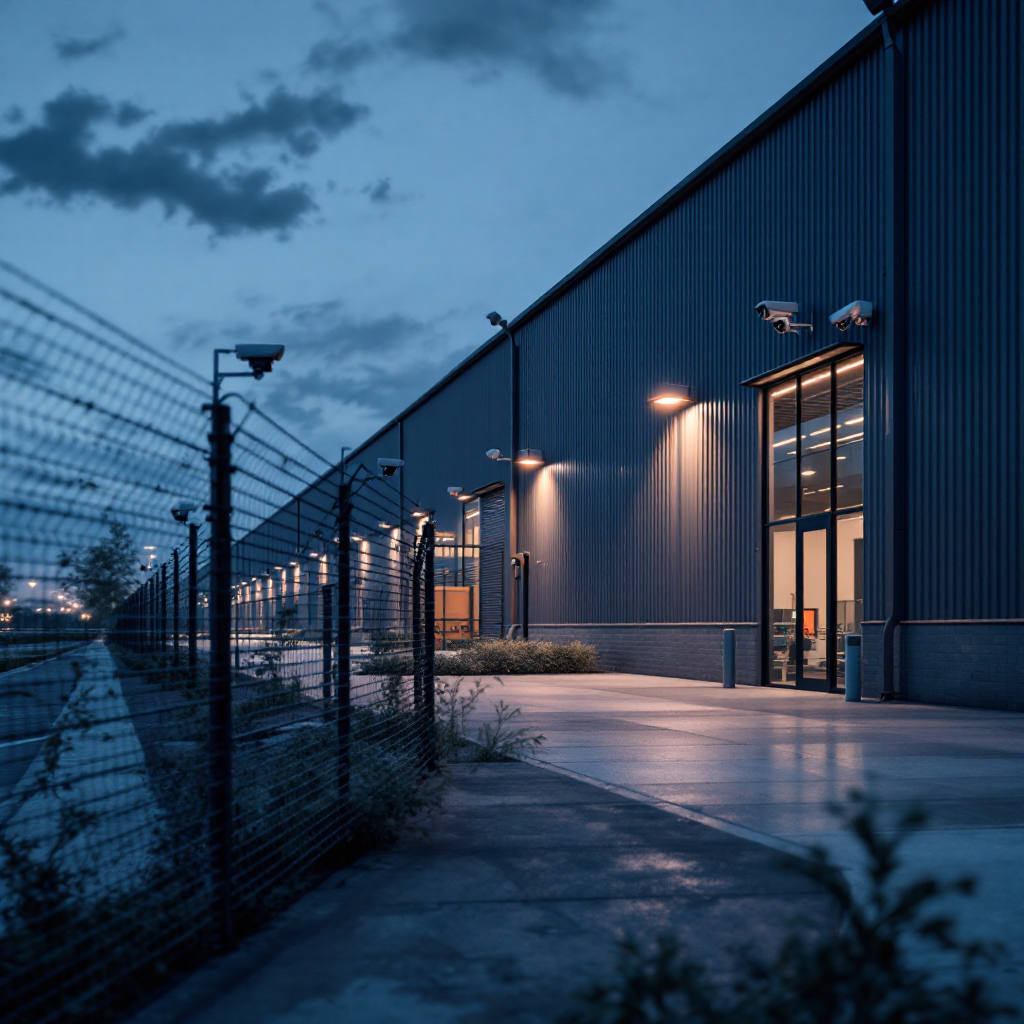
To safeguard access points, combine motion detectors, door contacts, and a detector on vehicle gates. Then link them to a central alarm system that triggers recorded video capture and live alerts. Automated lockdown procedures can also close internal doors and isolate zones. For example, if an external breach is detected at night, doors can lock automatically to limit movement. This arrangement helps minimise damage and protects staff when they arrive.
Perimeter security works best when sensors and surveillance are tuned to site conditions. False alarms waste resources, so systems must filter environmental triggers such as wildlife, weather, or large trucks. Vendors and integrators tune sensitivity and use analytics to keep false positives down. A good security solution ties alarm feeds to management systems. That way, operators can see an alarm, view the camera clip, and dispatch teams from a single interface. This streamlined workflow supports effective intrusion response and helps maintain a strong security posture for the site.
AI vision within minutes?
With our no-code platform you can just focus on your data, we’ll do the rest
Intrusion detection system and detection systems: choosing the right security system for your warehouse
Choosing the right mix of detection systems requires comparing physical and cyber layers. Physical IDS include sensors, CCTV, and access control systems that stop unauthorized access to buildings and storage. Cyber intrusion detection focuses on network monitoring and anomaly detection to protect automation, PLCs, and inventory databases. Both layers must work together. If they do, teams can correlate an access event with a network anomaly and resolve incidents faster.
Machine learning and deep learning models boost detection accuracy. Studies report ML and DL-based IDS can improve accuracy by 15–20% over signature-based methods, which decreases false positives and increases confidence in alerts (systematic review). This improvement helps teams act on real threats instead of chasing noise. For cyber protection, behavioral models can spot unusual traffic patterns and lateral movement. For video, AI models flag loitering or forbidden access in restricted zones.
To pick a security system for your warehouse, follow a simple guide to warehouse security systems. First, assess risks and list your security requirements. Next, set a budget and choose scalable hardware and software. Then, evaluate integration options so new components work with existing security cameras and VMS. Also, check data policies and whether analytics can run on-prem or at the edge to meet privacy rules. Finally, pick vendors who allow customization and local model improvements—this reduces vendor lock-in and false alarms.
Practically, start with a pilot that covers a high-risk area. Measure false alarm rate and response time. Then scale up while tuning sensors and analytics. A balanced mix typically includes perimeter detectors, CCTV with analytics, network IDS, and access control systems. In addition, include periodic staff training to prevent insider risks. A good security solution will let you expand from alarms to operational use cases. For instance, Visionplatform.ai can stream structured events to MQTT so CCTV data supports operations beyond simple alarms. This capability helps teams unify security monitoring and operational KPIs, and it turns cameras into a flexible sensor layer.
Comprehensive security: commercial intrusion detection systems and security solution integration
Commercial intrusion detection systems form the backbone of a mature security ecosystem. These systems include alarm panels, sensors, analytics platforms, and integrations with access logs. Their value comes from combining components that work together to provide centralised visibility. When systems operate in a coordinated way, operators can see sequence-of-events and act faster. For example, when an external gate breach is detected, integrated CCTV captures video while access control systems log door events, and trained security teams get a single alert with context.

A comprehensive security solution ties IDS to access control, CCTV, and cloud platforms. This combination supports incident workflows and audit trails. Cross-system correlation uses security data from video, sensors, and networks to reduce investigation time. Research shows that big data analytics across systems can speed incident resolution and improve threat detection by identifying subtle patterns across logs (ensemble classification study). This analysis helps close gaps that single systems miss.
For warehouse environments, integrations should support operational use cases too. For example, event streams can feed business dashboards to measure delivery dock turnaround or to flag unexpected vehicle movements. This approach turns security cameras into operational sensors and reduces the total cost of ownership. Systems are designed to be flexible, so they support both security and operations. A robust security system will include APIs, webhooks, and MQTT for event distribution and for tying alerts into ticketing or dispatch tools.
Finally, ensure your commercial intrusion detection systems comply with local regulations and data policies. Keep data ownership clear and choose platforms that allow on-prem processing when required for compliance. Centralised security with local control improves overall security while protecting privacy. Regular integration tests and staged drills validate that the system in place performs under stress.
AI vision within minutes?
With our no-code platform you can just focus on your data, we’ll do the rest
Enhancing security and effective security through AI-driven IDS
AI-driven IDS bring proactive capabilities to warehouse security. AI and ML models can identify patterns that humans would miss, and then they predict potential threats. Dr Anil Kumar explains that “The integration of AI and machine learning into intrusion detection systems is revolutionizing warehouse security. These technologies enable proactive threat identification, moving beyond reactive measures to predictive analytics that can anticipate and mitigate attacks before they occur.” His view highlights how predictive analytics change response strategies (Dr Anil Kumar source).
Edge computing further enhances real-time detection. By processing video and sensor feeds on-site, edge devices reduce latency and keep data inside the facility. That approach supports real-time alerts and helps meet privacy obligations. Also, edge processing prevents network congestion and maintains continuous operation when cloud links fail. For many warehouses, real-time detection at the edge is a must for fast response and for running models that are customised to site-specific conditions.
Ensemble classification and optimisation algorithms are active research directions that improve accuracy and efficiency. These methods combine multiple models to balance speed and precision. For example, lightweight models run on edge devices to flag events, and heavier models in a central server refine decisions. This tiered design reduces false positives and preserves compute resources. As a result, teams get more useful alerts and fewer distractions.
From a practical standpoint, deploy AI models that can be retrained on your site data. Tools that allow model selection, local retraining, and audit logs are invaluable for maintaining performance and for regulatory compliance. Visionplatform.ai supports on-prem model strategies and streams structured events to business systems. This capability enables teams to use video detections for security and for operations, and it helps keep data under customer control. By combining AI, edge computing, and integration, warehouses can achieve effective intrusion detection and stronger overall security.
Improved security: additional security measures for a robust warehouse security system
To round out a robust security system, add multiple advanced security solutions beyond basic alarms. Biometric access controls reduce credential sharing and improve auditability. Drone patrols can supplement fixed surveillance to cover large exterior areas quickly. Mobile response units with live-video links and GPS tracking can close incidents fast. Together, these additional security elements create depth and agility in response.
Also consider advanced safeguards such as ANPR/LPR at entry gates and PPE detection in restricted zones. Such capabilities support safety and security at the same time. Training remains essential too: trained security staff and regular drills ensure that procedures work when incidents occur. For example, practiced lockdown and evacuation routines reduce confusion and limit damage.
Research points to future directions like ensemble classification, optimisation algorithms, and edge-based IDS as ways to improve detection accuracy and speed (ensemble classification). Edge deployment is especially promising because it keeps detections real-time and protects sensitive security data. For organisations that want custom analytics without cloud exposure, on-prem or edge solutions are preferred.
To maintain effective security, update models, firmware, and policies on a schedule. Threat actors evolve, and so must defenses. Regular security audits, penetration testing, and firmware patching reduce the risk of security breaches and help meet compliance requirements. Finally, integrate security monitoring into daily operations so that CCTV and sensor data support both safety and business goals. This aligned approach protects stock, supports continuity, and strengthens the security posture for warehouses over time.
FAQ
What is intrusion detection in warehouses?
Intrusion detection in warehouses refers to the combined use of sensors, video analytics, and monitoring to detect unauthorised access or suspicious activity. It covers both physical entry attempts and anomalous network behaviour that affect automation systems.
How does perimeter security protect a warehouse?
Perimeter security uses fences, gates, motion sensors, and surveillance to detect and deter intruders before they reach storage areas. When paired with an alarm system, it enables real-time alerts and faster response to incidents.
What is the difference between physical IDS and cybersecurity IDS?
Physical IDS focus on sensors, CCTV, and access controls to prevent unauthorised access, while cybersecurity IDS monitor network traffic and device behaviour for anomalies. Together, they provide a layered defence for modern warehouse environments.
How much can AI-driven video analytics reduce response times?
AI-driven video analytics can reduce incident response times by approximately 30% according to recent studies, as analytics provide precise event context alongside alarms (source). Faster responses limit losses and speed recovery.
What should I look for when choosing a security system for my warehouse?
Assess risk, choose scalable hardware, confirm integration with existing security cameras and VMS, and prefer on-prem or edge analytics if privacy is a concern. Piloting a solution helps validate performance before a full rollout.
Can existing CCTV be used for intrusion detection?
Yes. Systems that convert CCTV into an operational sensor network can detect people, vehicles, and custom objects in real-time. This approach adds detection capabilities without replacing cameras and supports operational use beyond alarms.
Are edge-based IDS better than cloud-only systems?
Edge-based IDS offer lower latency, continued operation during network outages, and stronger data locality for compliance. Cloud systems add centralised compute, but hybrid designs often deliver the best balance.
How do ensemble classification methods improve IDS?
Ensemble classification combines multiple models to balance speed and accuracy, reducing false positives and improving overall detection performance. Recent research highlights these methods as promising for industrial settings (study).
What additional security measures should warehouses consider?
Consider biometric access controls, ANPR/LPR at gates, drone patrols, and mobile response units. Regular training for security personnel and scheduled audits further strengthen defenses.
Where can I learn more about perimeter and intrusion detection implementations?
Industry reports and academic reviews provide market trends and technical options. For practical examples of video-based detection and integration with VMS, see resources on perimeter breach detection and unauthorised access detection to understand how systems operate in comparable environments (perimeter breach detection, unauthorized access detection, intrusion detection).