manufacturing: Challenges and the Need for People Detection
Manufacturing environments combine heavy machinery, fast-moving lines, and complex workflows that raise the stakes for workplace safety. In such settings a supervising system must reliably track who is where and when, so operators and safety teams can act fast. Traditional manual checks strain supervisors and often miss near-misses that later cause accidents; human error still ranks high among root causes in incident reports. Many manufacturing facilities operate with fixed CCTV that never becomes a true sensor network. That gap creates blind spots around specific zones and hazardous areas like robot cells, presses, and ovens. Automated monitoring that can detect human presence and risky behavior fills those gaps, and it reduces the need for continuous manual patrols and headcount checks.
Modern shops also face practical obstacles that reduce detection performance. Dust on lenses, bright reflections from metal, and uneven lighting across a factory floor obscure features and confuse models trained only on clean datasets. Small items such as badges or tiny PPE reflectivity also challenge small-object classifiers. In response, manufacturers are adopting mixed approaches: BLE beacons, RFID tags, and badge readers for coarse location data, and computer vision for posture, hands-free cellphone alarms, and fall recovery detection. BLE beacons and bluetooth tags can help when cameras lose line-of-sight, and RFID proves useful at workstation gates or tool cribs. Tooling these inputs together lets operators track movement while minimizing intrusive employee tracking.
Regulatory pressure and insurance costs multiply the need for automated people-aware systems. Firms that can automatically log incidents, produce an evidence-backed incident log, and identify bottleneck trends often gain lower premiums and faster regulatory sign-off. For example, clear zone demarcation and unauthorized entry alerts for restricted areas shift enforcement from reactive to proactive, which helps the manufacturer meet obligations while keeping the workforce safer and more productive.
detection and computer vision: AI Techniques, Models and Performance Metrics
Computer vision and modern AI models form the backbone of contemporary people detection on the factory floor. Popular object detectors such as YOLO families and pose-based frameworks like MediaPipe enable systems to detect posture, head orientation, and hands-free cellphone use. A recent study showed YOLOv8 reaching a Mean Average Precision (mAP50) of 49.5% for cellphone usage detection in busy shop-floor scenarios, demonstrating the model’s ability to find small, human-held objects in cluttered scenes YOLOv8 cellphone detection study. Likewise, fall detection work that pairs YOLO and MediaPipe achieved strong precision and F1-scores for rapid alarm generation in live settings YOLO and MediaPipe fall detection.
Performance is measured with mAP, precision, recall, and F1-score, and those numbers matter for operational acceptance. Industry examples show that image-based quality inspection systems can hit 99.86% accuracy on controlled casting images, which implies similar gains are realistic for human-centered tasks when the dataset mirrors the real site quality inspection accuracy report. That said, achieving high scores requires carefully curated dataset samples that include occlusions, glare, and workers in PPE. A good algorithm will also combine rule-based filters with learned models to automatically detect context — for instance, differentiating between a phone held for a work task versus a personal call. This blended strategy reduces false positives and preserves trust among employees.
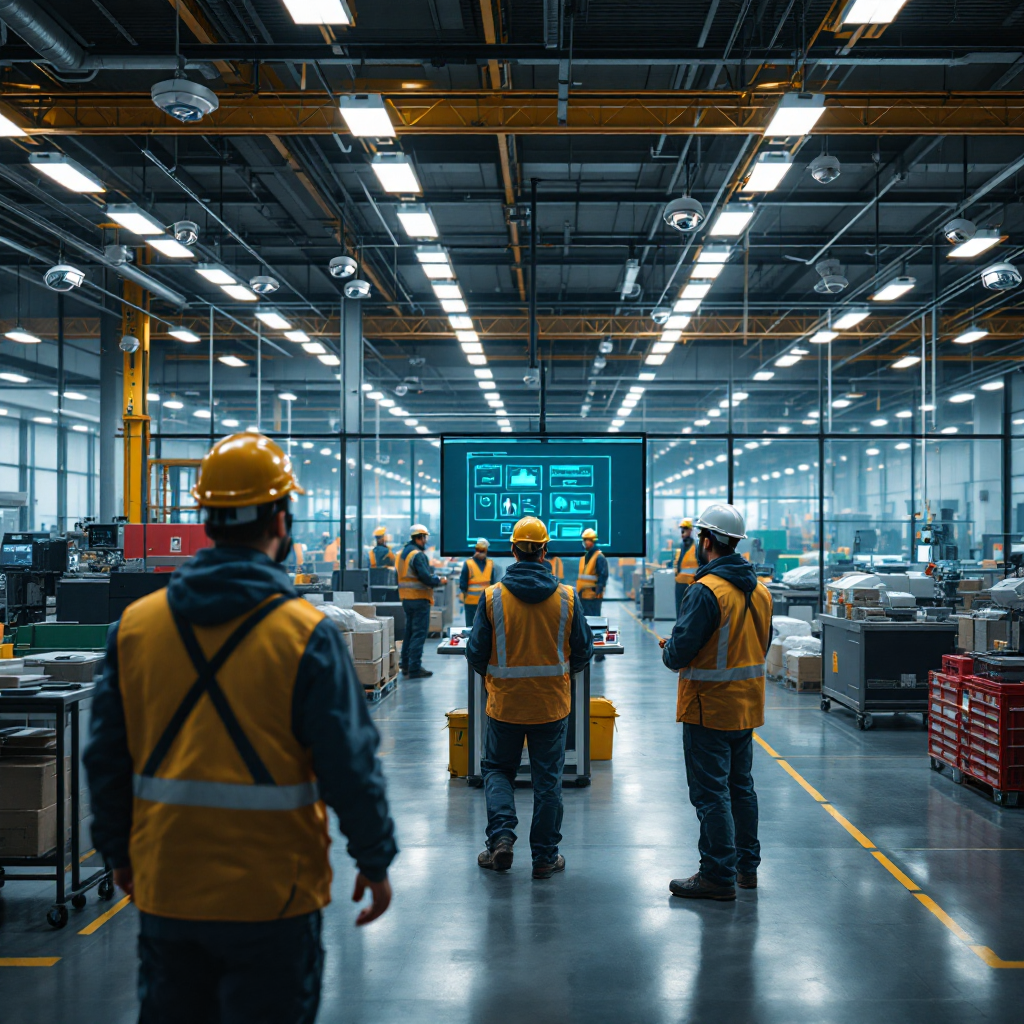
Organizations should choose models that match their constraints: edge-capable networks for low latency, or GPU servers for high throughput. For real-world adoption, operations teams value explainable outputs such as confidence scores and bounding-box visualizations that feed into analytics. When a system yields timely, actionable insight, managers can identify bottleneck processes and allocate staff smarter. Linking vision outputs to dashboards turns passive video into analytics that directly optimize production processes and worker safety.
AI vision within minutes?
With our no-code platform you can just focus on your data, we’ll do the rest
real-time: Tracking Systems and Infrastructure
Real-time responses require a stack that spans cameras, on-site compute, and resilient wireless links. High-speed cameras capture motion blur-free frames; edge devices running optimized AI can infer within milliseconds and then publish events over MQTT or the company’s message bus. Integration with Industrial IoT platforms creates a single source of truth: events from vision, PLCs, and badge readers combine so supervisors get a consistent view of who was where and what happened. This kind of integration reduces latency and helps teams act on a live alert instead of sifting through hours of footage.
Wireless connectivity choices shape where workloads run. Wi‑Fi and private 5G links let factories stream many channels to a local server, while BLE beacons provide triangulation for noisy camera views. For precise location tracking near robots, a hybrid approach blends camera-based localization with beacon-assisted corrections to deliver accurately tracking coordinates within a few meters. Those coordinates then feed an employee tracking system that timestamps entry to a workstation and records task switching for later analysis. Event logs created this way support auditors and enable data-driven maintenance and staffing decisions.
Scalability still demands trade-offs. Sending full video to the cloud increases bandwidth and costs, whereas on-prem inference keeps data inside the site but requires investment in edge hardware. Systems that allow flexible deployment—edge for latency-sensitive rules and server for batch analytics—work best. Visionplatform.ai, for example, focuses on using existing CCTV to turn cameras into operational sensors that stream structured events without shipping raw video off-site, which meets many EU and GDPR expectations IIoT and anomaly detection trend. Properly engineered, a track-and-alert architecture enables real-time visibility and reduced mean time to respond for safety incidents.
people tracking in manufacturing: Applications to improve safety
People tracking in manufacturing adds specific capabilities that directly improve safety outcomes. Zone-based monitoring prevents unauthorized entry into dangerous areas by combining virtual zone overlays with access credentials from badge readers. When an employee crosses a protected zone near a press or robot, the system can raise an alert and log the event for review. This approach enforces restricted areas without stopping production, and it keeps a complete log that helps supervisors and safety teams perform root-cause analysis after incidents.
Fall detection systems that merge pose estimation and object detection provide rapid alarms when a worker collapses, and they can also trigger a prioritized alert that reaches first responders and floor supervisors. Similarly, automated detection of hands-free cellphone use reduces distraction-related risk; one industrial study specifically targeted cellphone usage on shop floors and quantified detection performance under cluttered conditions cellphone detection study. Zone enforcement and wearable integration also help with lone-worker safety, while analytics on headcount and time spent in hazardous areas create evidence for safety committees and compliance teams.

Combining camera vision with beacon or RFID triggers offers a layered defense. BLE beacons and rfid tags can signal proximity to a machine even when cameras are occluded, while visual models verify posture and PPE. These layered detections reduce false positives and give supervisors clarity: was the worker authorised, in the correct posture, and wearing the required PPE? When teams can automatically detect such conditions, they can enforce safety rules without manual checks and improve workplace safety metrics.
AI vision within minutes?
With our no-code platform you can just focus on your data, we’ll do the rest
optimize and efficiency: Boosting Productivity and Workforce Management
Beyond safety, tracking people enables measurable efficiency gains. Movement heatmaps and visualization of the factory floor identify where employees move and where task switching adds waste. By analyzing time spent at specific workstations and the sequence of steps across production processes, managers can identify bottleneck operations and optimize task allocation. Some adopters report throughput improvements after deploying vision-based analytics; case studies show up to 15% throughput gains after rebalancing staff and reducing unnecessary travel between stations.
A data-driven approach to workforce management uses headcount and location data to balance lines dynamically. An employee tracking solution that respects privacy can still provide aggregate metrics such as average time at a station, frequency of task switching, and peak congestion periods. Those metrics help planners reduce idle time, reassign workers with the right skills, and minimize task switching that slows the line. With better visibility into who does what and when, teams can optimize cycle times and reduce downtime related to hand-offs.
Integrating these outputs with maintenance schedules creates additional gains. When an operator is present and a machine begins to degrade, combined alerts can schedule a short maintenance window before a failure causes longer stoppages. That automation helps teams optimize resources while keeping production steady. Visionplatform.ai’s architecture, which streams structured events to MQTT, illustrates how cameras can power performance dashboards and directly support continuous improvement and optimization efforts across the site smart inspection research. These insights let manufacturers make targeted changes that increase productivity while preserving safety.
compliance: Ethical, Regulatory and Data Privacy Considerations
Any deployment that tracks people must handle privacy and legal obligations carefully. Under GDPR and similar laws, firms must justify video use, minimize retained personal data, and provide transparency to employees. Consent mechanisms, signposting, and clear policies help maintain trust; transparency reduces pushback and supports the human side of technology adoption. Compliance teams expect auditable logs that show why an alert fired, what model version produced it, and which dataset informed the decision.
Secure data practices are equally important: encrypt streams, limit access, and keep models and training data on-prem when laws or company policy require it. Ethical AI guidelines ask teams to test models for bias and to use balanced datasets so that one group of workers is not inadvertently flagged more often. For companies in the EU or those preparing for the EU AI Act, approaches that keep training and inference local reduce regulatory risk while maintaining operational control. Visionplatform.ai provides options to own data and models on edge or on-prem servers, which helps satisfy auditors and keeps sensitive footage within the facility.
Finally, involve workforce representatives early. Co-designing alert thresholds, retention policies, and use cases with unions or supervisors creates a workable program. When employees understand the purpose — to improve workplace safety and not to micromanage — adoption improves and the system delivers actionable, compliant, and ethically sound benefits for both safety and continuous improvement.
FAQ
What is people detection in manufacturing and why does it matter?
People detection identifies human presence and behavior on the factory floor using cameras and sensors. It matters because it helps improve workplace safety, reduce human error, and provide evidence for incident reviews.
How does computer vision detect people and their actions?
Computer vision uses trained models to find human figures, estimate poses, and classify gestures or objects like phones. Models combine spatial and temporal cues to automatically detect risky actions such as falls or unsafe proximity to machinery.
Can these systems work in challenging factory lighting and dusty conditions?
Yes, but success depends on training data and sensor choices. Combining cameras with beacons or RFID and using augmented datasets that include glare and occlusion improves robustness.
Are there real-time options for triggering emergency alerts?
Systems can run on edge hardware to provide sub-second inference and trigger real-time alerts when a hazard appears. Integration with IIoT platforms or MQTT streams ensures alerts reach supervisors and safety systems quickly.
How do companies balance privacy with employee tracking?
Balancing privacy requires transparency, minimization of personal data, and retention limits. Keeping models and video on-prem and providing auditable logs helps meet GDPR and similar legal requirements.
What performance metrics should we expect from people detection models?
Relevant metrics include precision, recall, F1-score, and mAP for object tasks. Benchmarks such as mAP50 help compare models on specific detection tasks like cellphone usage.
How do visual analytics improve production efficiency?
Visual analytics produce heatmaps, time-at-station metrics, and visualization of task switching that help identify bottleneck stations. Teams can then optimize staffing and reduce cycle times for measurable throughput gains.
Can old CCTV systems be used for people detection?
Yes, existing cameras can often be repurposed as sensors with the right edge software and model tuning. This approach reduces cost and avoids unnecessary camera upgrades while enabling operational alerts and logs.
What integrations are needed for a complete monitoring solution?
Typical integrations include VMS platforms, MQTT or webhooks, badge systems, and maintenance or BI tools. These links let teams combine vision events with operational data for richer insight.
How do I start a pilot for people tracking in my facility?
Begin with a small zone that has clear risks, define success metrics, and collect a representative dataset for training. Engage supervisors and employees early, run a short pilot, and iterate based on results and feedback.