AI in Surveillance: The Shift from Traditional Security to AI-Powered Video Surveillance
AI in surveillance transforms how organizations maintain situational awareness and respond to incidents. Traditional security relied on human guards, manual patrols, and passive camera recording. By contrast, AI-powered systems analyse streams and surface actionable events. This change means fewer hours of continuous watching, faster threat triage, and clearer evidence trails.
AI automates threat detection by running models on video footage to spot people, vehicles, and unusual behaviour. For example, AI labels images and sends alerts in seconds so teams can act rapidly. A study showed that semi-automated CCTV systems reduce operator workload when they include confidence information, allowing staff to focus on true alarms rather than watching every frame Semi-automated CCTV surveillance: The effects of system …. That result underlines why many operators adopt AI tools.
Adoption has grown quickly. Over 60% of large organisations planned pilots or deployments of AI agents by 2025, reflecting strong interest in operational gains 26 AI Agent Statistics (Adoption Trends and Business Impact). Meanwhile, the market for these solutions is expanding at a rapid rate, driven by demand for automated detection across many camera sites.
AI-powered video surveillance goes beyond alerts. It supports search in video archives, automates compliance reporting, and links events to access control workflows. For sites with many cameras, AI reduces time-to-find and improves security effectiveness. Visionplatform.ai builds on this model by turning existing CCTV into an operational sensor network. We detect people, vehicles, ANPR/LPR, PPE, and custom objects in real time, and stream events into your security stack so teams can use camera data beyond alarms.
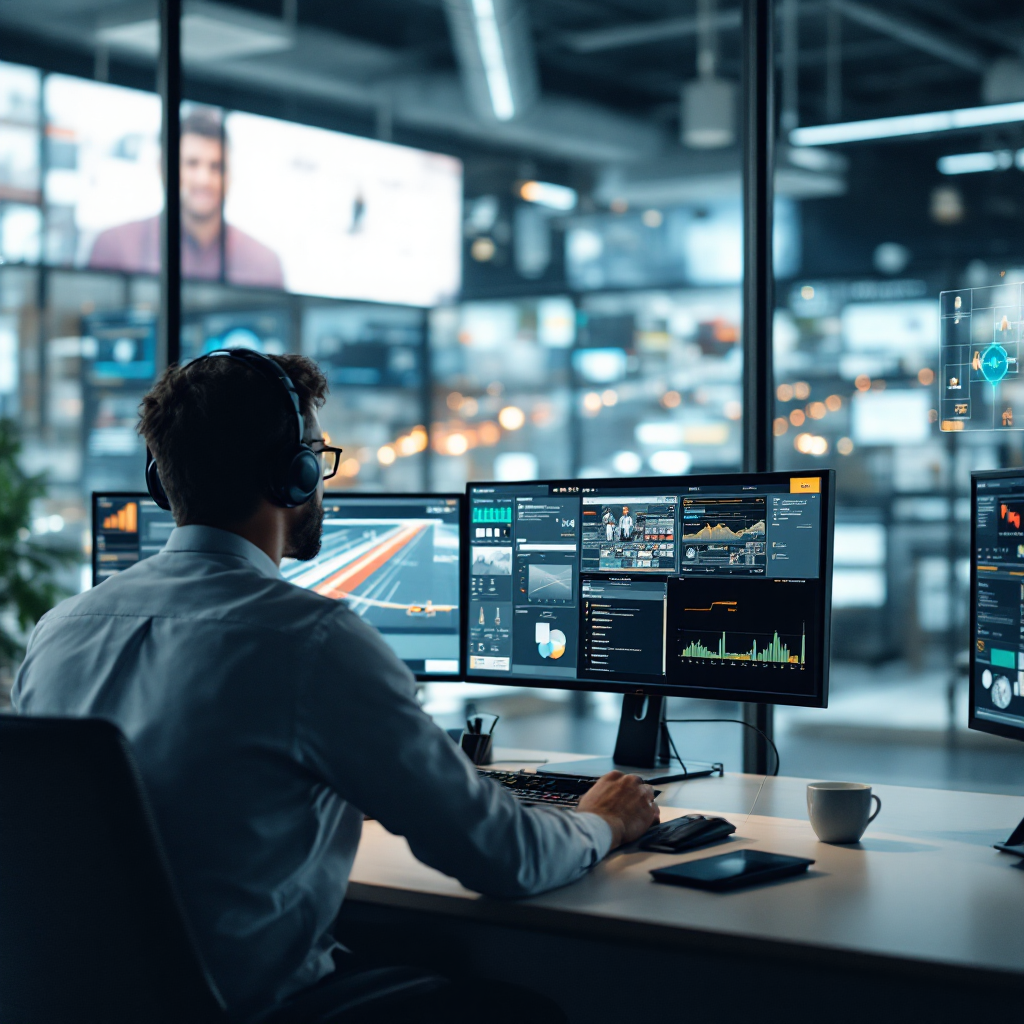
Early adopters report measurable gains. For instance, AI agents can raise detection accuracy by up to 40% over manual monitoring, which cuts false positives and speeds responses 80+ AI Agent Usage Stats for 2025 | Zebracat. Therefore, organisations aiming to improve security coverage now consider AI a core part of their strategy for modern security.
Real-Time Security Monitoring: How AI Agents Enhance CCTV Control Rooms
In a control room, AI agents perform continuous analysis across multiple video streams. An AI agent flags events, ranks them by confidence, and routes critical alerts to the right responder. This workflow reduces noise and helps security personnel concentrate on incidents that matter. In practice, that means fewer distractions and faster resolution of potential security breaches.
AI agents integrate with the camera system and VMS to ingest video feeds and produce structured events. These events include labels, confidence scores, and metadata that the operator can verify quickly. Because operators receive extra context, they act with more certainty. As Dr. Jane Smith explains, “The future of CCTV control rooms lies in semi-automated systems where AI agents provide reliable confidence metrics, allowing operators to prioritize their attention effectively.” Semi-automated CCTV surveillance.
Real-time monitoring benefits include faster alerts and fewer false positives. AI models run analytics for object recognition, removed-object detection, and loitering. They also detect access control events and integrate those with camera views. A field example shows AI-enabled camera traps create instantly labelled images and push alerts with metadata in real time, which shortens the time to respond Real‐time alerts from AI‐enabled camera traps.
Case studies show meaningful workload reduction. When semi-automated confidence scores are available, operator performance improves and fatigue drops. Consequently, security teams report better situational awareness and higher security effectiveness. Visionplatform.ai helps by keeping data on-prem and aligning analytics to site rules. That approach preserves privacy and supports compliance while delivering actionable detections for the operator.
To maintain strong coverage, teams choose a mix of edge and server processing. Edge AI reduces latency and bandwidth, while central servers handle heavy analytics and historical searches. This balance ensures the control room receives timely, ranked alerts and that video systems remain resilient under load.
AI vision within minutes?
With our no-code platform you can just focus on your data, we’ll do the rest
Smart Video: Video Analytics and AI Video Integration in Modern Monitoring System
Smart video builds on classical video analytics and adds modern AI models for richer insights. Traditional video analytics detected motion or line-crossing. Intelligent video analytics use deep learning for object classification, pose estimation, and behaviour recognition. This evolution increases detection accuracy and reduces nuisance alarms.
Core video analytics capabilities now include object recognition, pattern analysis, and behavioural flags. Object recognition differentiates people from vehicles and identifies custom objects. Pattern analysis spots abnormal flows in a crowd or unusual stopping. Behavioural flags highlight potential security situations before they escalate. By combining these capabilities, a monitoring system provides continuous, actionable intelligence for security teams.
AI video pipelines transform raw video into structured events and searchable video archives. This makes video footage usable across security and operational contexts. For example, facilities can tie detections to access control systems and business dashboards. Visionplatform.ai publishes events via MQTT so cameras serve as sensors for operations beyond alarms, such as occupancy metrics and OEE.
Smart video also supports fast forensic search. Instead of manually scanning hours of footage, analysts query events and jump to relevant clips. This reduces investigation time and helps to recreate security incidents precisely. Because intelligent models can be trained on local video, they fit site-specific security needs and reduce false detections.
Moreover, smart video scales. Platforms that process thousands of camera streams can run models at the edge and orchestrate workloads centrally. This architecture minimises latency and keeps critical video data in your environment, matching data governance goals and existing security infrastructure. In short, smart video turns passive cameras into active sensors that strengthen comprehensive security and video security across sites.
AI Surveillance Software and AI Surveillance Systems Powered by AI: Building an Efficient Monitoring System
Choosing between AI surveillance software and AI surveillance systems comes down to flexibility, scale, and control. AI surveillance software often integrates with existing VMS platforms and offers modular analytics. AI surveillance systems combine hardware, software, and management tools for turnkey deployments. Both approaches can scale across many camera streams when designed correctly.
Solutions powered by AI should support on-prem processing to protect sensitive video data. For many organisations, on-prem or edge processing reduces risk and helps with EU AI Act compliance. Visionplatform.ai positions itself as EU AI Act aligned by design: models run on-prem, datasets remain customer-controlled, and logs stay auditable. That configuration helps teams keep control of video archives and training data.
When you scale to thousands of feeds, architecture matters. Use edge devices for basic detections and central servers for heavy analytics and long-term storage. This prevents bottlenecks and preserves real-time performance. Also, ensure the platform supports integrations with access control systems and enterprise tools. Linking detections to access control events streamlines investigations and helps respond to security threats quickly.
Data governance is essential. Organisations must define retention policies, model governance, and who can access video data. Good governance reduces risk and avoids vendor lock-in. It also allows teams to customise models to site-specific needs, improving accuracy and reducing false positives.
Finally, evaluate interoperability. An AI camera system that supports ONVIF/RTSP and integrates with your VMS lets you reuse existing investments. Workflows that stream events to dashboards and SCADA systems help security and operational teams derive broader value from camera data. That unified security ecosystem increases security coverage and supports both security and operational objectives.

AI vision within minutes?
With our no-code platform you can just focus on your data, we’ll do the rest
Operator Support with AI Assistant: Reducing Workload and Improving Security Operations
An AI assistant in security monitoring acts as a triage partner for the operator. It highlights prioritized alerts, suggests responses, and provides quick context. When alerts are accompanied by confidence scores and explanations, trust grows. Operators then verify events faster and make informed decisions.
Operators benefit when AI provides transparent confidence metrics. Studies show that semi-automated systems that report model confidence reduce workload and improve performance Semi-automated CCTV surveillance. In real operations, means that security personnel can focus on verified incidents and on complex scenarios that need human judgement. That combination of AI and human oversight raises security effectiveness.
To gain trust, training matters. Operators need hands-on sessions with the AI assistant to learn how it ranks alerts, how to tune thresholds, and how to review false positives. Workflows should include feedback loops so models improve on local video. Visionplatform.ai supports model retraining on-site, which reduces false detections and aligns analytics to specific security needs.
Design workflows that keep operators in control. For example, AI can auto-tag and queue events for review, but humans must confirm high-impact responses. This preserves accountability and ensures that AI acts as an augmentative tool rather than a replacement. Also, tie AI outputs to incident management systems and access control events. That integration speeds incident handling and creates audit trails for compliance.
Finally, measure outcomes. Track reductions in response time, drops in false alarms, and changes in operator workload. These metrics help refine thresholds and justify further AI adoption. Over time, the AI assistant learns from operator feedback and improves. As AI gets smarter, operators gain more time to manage complex security situations and to plan proactive measures.
Future of AI: How AI Gets Smarter and Security Leaders Transformed Our Security Operations
The future of AI in surveillance points to self-learning models, edge intelligence, and predictive video analysis. Self-learning models adapt from operator feedback and labelled video, improving accuracy without lengthy retraining cycles. Edge AI keeps latency low and allows analytics to run near the camera, which helps with privacy and compliance.
Predictive security uses patterns in video and telemetry to forecast potential security incidents. For example, models can detect crowd build-ups or abnormal flows that precede security breaches before they occur. Analytics for real-time prediction will guide patrols and automated responses in the near term, raising overall security.
Security leaders have already transformed many large sites by adopting AI. These leaders combine AI agents with process change, aligning AI outputs to SOPs and incident response. They also insist on data governance, so video data and models remain auditable. As a result, they reduce false alarms, improve response times, and demonstrate measurable ROI from their video systems.
Generative AI will also influence security operations by creating better incident summaries and by automating routine report writing. Yet, safeguards must prevent misuse and protect privacy. Organisations should follow best practices for model governance and retention policies to address genuine security concerns.
Looking ahead, a unified security ecosystem will connect AI analytics, access control systems, and operational dashboards. This integration supports both security and operational teams and turns cameras into sensors for wider business intelligence. For teams interested in specialised detections, Visionplatform.ai offers tailored models for people detection, ANPR/LPR, PPE detection, and more. Explore related resources on people detection and PPE detection to see how detectors can fit airport and enterprise scenarios (for example, people detection in airports and PPE detection in airports).
FAQ
What are AI agents in CCTV control rooms?
AI agents are software models that analyse video streams to detect objects, behaviours, and anomalies. They generate alerts with metadata so human operators can prioritise and respond faster.
How do AI agents reduce operator workload?
AI agents filter low-value alerts and rank events by confidence, so operators review fewer false positives. This focus reduces fatigue and improves decision quality.
Can AI work with existing camera systems?
Yes. Many AI solutions integrate with existing VMS and camera setups using ONVIF or RTSP. This reuse helps organisations avoid rip-and-replace projects and saves cost.
How does AI protect privacy and compliance?
On-prem and edge processing keeps video and training data within your environment, supporting GDPR and EU AI Act readiness. Model logs and auditable events further help governance.
What is the difference between AI surveillance software and AI surveillance systems?
AI surveillance software typically integrates analytics into your current VMS, while AI surveillance systems bundle hardware and managed software for turnkey deployment. Choose based on scale and control needs.
How accurate are AI detections compared to manual monitoring?
Studies report improvements in detection accuracy; some deployments show up to a 40% increase over manual monitoring for certain tasks 80+ AI Agent Usage Stats for 2025. Accuracy varies by model and site conditions.
What training do operators need to work with AI assistants?
Operators need practical training on interpreting confidence scores, tuning thresholds, and providing feedback for model improvement. Regular exercises and reviews help build trust and optimise workflows.
How do AI agents integrate with access control systems?
AI events can be linked to access control events so that camera detections complement badge reads and door sensors. This integration speeds investigations and automates security protocols.
Can AI detect complex scenarios like loitering or tampering with equipment?
Yes. Modern models identify loitering, attempts to tamper with security equipment, and other complex behaviours when trained on relevant video. Custom classes can be added for site-specific security needs.
Where can I learn more about specific detections like people or PPE detection?
Visionplatform.ai provides detailed pages on specialised models, including people detection in airports and PPE detection in airports, which explain deployment and performance for these use cases. For more, see people detection in airports and PPE detection in airports.