AI-Powered Search Matters in Video Surveillance
Search matters when CCTV and control rooms face mountains of video data every day. First, surveillance cameras in smart cities generate petabytes of footage, and operators cannot manually review all recordings. Second, manual review eats time and attention, so teams miss events of interest. Third, AI adds scale and speed. AI-powered indexing, object detection, and person re-identification turn recorded video into searchable metadata, and they let operators find exactly what they need.
For example, deep-learning person search systems now achieve accuracy improvements above 80% when matching people across multiple views, and this improves response times for investigations [Person search over security video surveillance systems using deep learning]. Also, video summarisation research highlights that smart retrieval is essential to transform passive archives into an active resource [From video summarization to real time video summarization in smart cities]. Therefore, AI reduces hours of manual review and turns hours of video into a concise set of clips in seconds.
However, gains come with challenges. False positives must shrink, and system latency must fall so that teams can act within seconds. Also, privacy and compliance are non-negotiable; solutions must limit data export and support on-prem models to align with EU requirements [A Survey of Video Surveillance Systems in Smart City]. In practice, security teams need tools that index metadata reliably, tag objects and people, and expose that index through a powerful search interface. Visionplatform.ai focuses on that gap by keeping video on-prem, converting detections into rich descriptions, and offering a VP Agent that helps operators locate a missing person or verify an alarm without sending video to the cloud.
Finally, a shift from raw detections to context matters for both efficiency and safety. AI helps reduce false alarms, and it makes security systems more actionable. Consequently, teams regain time, and they can focus on prevention rather than endless playback. For more on person detection for airports and real-time analytics, see visionplatform.ai’s resources on people detection in airports people detection in airports.

Real-World AI Video Search Use Cases
Real-world deployments show why AI matters. First, airports use AI to rapidly locate persons of interest across terminal cameras. For instance, integrated ANPR/LPR and person detection help teams trace movements and confirm identities quickly; operators then correlate events with access logs and flight data ANPR and LPR integration for airports. Second, retail loss prevention systems match customer behaviour patterns to alert thresholds and reduce shrinkage. Third, smart-city monitoring uses crowd density analytics and traffic incident detection to manage public safety and mobility crowd detection and density.
Beta testing of conversational search modes showed practical gains. In a trial with 90 participants, users reported a roughly 30% improvement in search efficiency when natural language queries complemented keyword search [Natural Language Understanding in Library Research Platforms – Findings]. Also, AI video search helps investigators reduce time per case. For example, forensic search tools let teams instantly search recorded video for a blue backpack, a vehicle entering a loading dock, or a person in a restricted area. This ability to find specific frames across multiple cameras changes workflows dramatically.
Moreover, integration matters. Systems that expose events via APIs allow security and operations teams to automate incident reports, trigger an alert, or pre-fill case files. Visionplatform.ai’s VP Agent Search illustrates this approach by letting operators use free-text prompts like “Person loitering near gate after hours” to find video clips in seconds forensic search in airports. Therefore, AI-powered systems not only speed investigations; they also improve situational awareness and reduce losses in high-traffic environments.
Finally, these solutions scale. They work across multiple sites and video streams and they integrate with existing video management systems. As a result, organisations can leverage the same platform for perimeter breach detection, vehicle tracking, and slip, trip and fall analytics without rebuilding infrastructure.
AI vision within minutes?
With our no-code platform you can just focus on your data, we’ll do the rest
Natural-Language Context-Aware Video Search
Natural-language search unlocks a simpler way to search CCTV. It lets an operator type a plain-English prompt such as “Show the person in a red jacket at 3 pm” and then instantly find matching timestamps and video clips. The approach combines natural language processing with computer vision to interpret queries, to map text to visual attributes, and to return relevant video quickly. This linkage means the system understands natural language requests and translates them into filters like time, location, and object type.
At the core are transformer-based language models and vision models that generate descriptive metadata for every scene. These models create human-readable captions for recorded video so an operator does not need camera IDs or precise timestamps. In practice, a query like “find a delivery truck at the loading dock yesterday evening” becomes a multi-step search across object detection, vehicle classification, and timeline indexes. The system then ranks the best matches and surfaces clips in a searchable timeline.
Handling ambiguity requires context-aware design. For example, regional terms, slang, or multi-lingual requests must be disambiguated. Strategies include clarifying follow-ups, confidence scores, and multilingual model support so that a system can interpret “blue backpack” or a local phrase. Also, systems should let users add constraints via quick filters for license plates or restricted area violations, and they should expose a tag list for faster refinement.
Visionplatform.ai’s on-prem Vision Language Model demonstrates how this works in a control room. The VP Agent turns detections into descriptions and then allows operators to search video footage using natural language queries without exporting video. This design keeps data private, reduces cloud dependency, and speeds investigations. In short, advanced natural language video search helps security teams find relevant footage and to act on it with clearer context.
Finally, to be practical, the interface must be forgiving. It should accept imperfect prompts, offer suggested refinements, and highlight why a result matched. That transparency reduces hallucination risk and helps operators trust AI outputs.
Smarter AI Search Across Industries
AI extends beyond security. In manufacturing, vision analytics flag process anomalies and allow engineers to find specific events on the line. In healthcare, patient monitoring systems can find a fall or a long inactivity period so clinicians can respond. In logistics, automated tracking helps teams find an individual pallet or to trace a vehicle across a yard. These cross-sector examples show the value of building a unified, interoperable search layer that works across industries.
Interoperability is critical. Systems that integrate with existing video management systems and that expose APIs let organisations reuse cameras and workflows. For instance, integrating ANPR/LPR for vehicle detection classification and linking with VMS events reduces time to investigate a security breach, and it supports automated workflows that file incident reports. Visionplatform.ai designs agents to interface with Milestone VMS data and other telemetry so that the same agent can act for both security and operations.
Measurable outcomes include reduced investigation time, improved compliance, and lower operational costs. For example, faster search yields clearer audit trails and quicker resolution of claims. Also, trained custom models improve accuracy in domain-specific tasks, which reduces false positives and improves operator focus. Pilot programmes often begin with a limited camera set, basic use cases like perimeter breach detection or object-left-behind detection, and clear performance benchmarks to prove ROI.
Finally, industry decisions require balancing accuracy, cost, and regulation. Organisations must plan custom model training, evaluate vendor certifications, and consider on-prem vs cloud processing. Built to scale solutions let teams expand from a handful of cameras to thousands, and they preserve control over data and models. Consequently, organisations achieve faster search and better outcomes without sacrificing compliance or operational continuity.
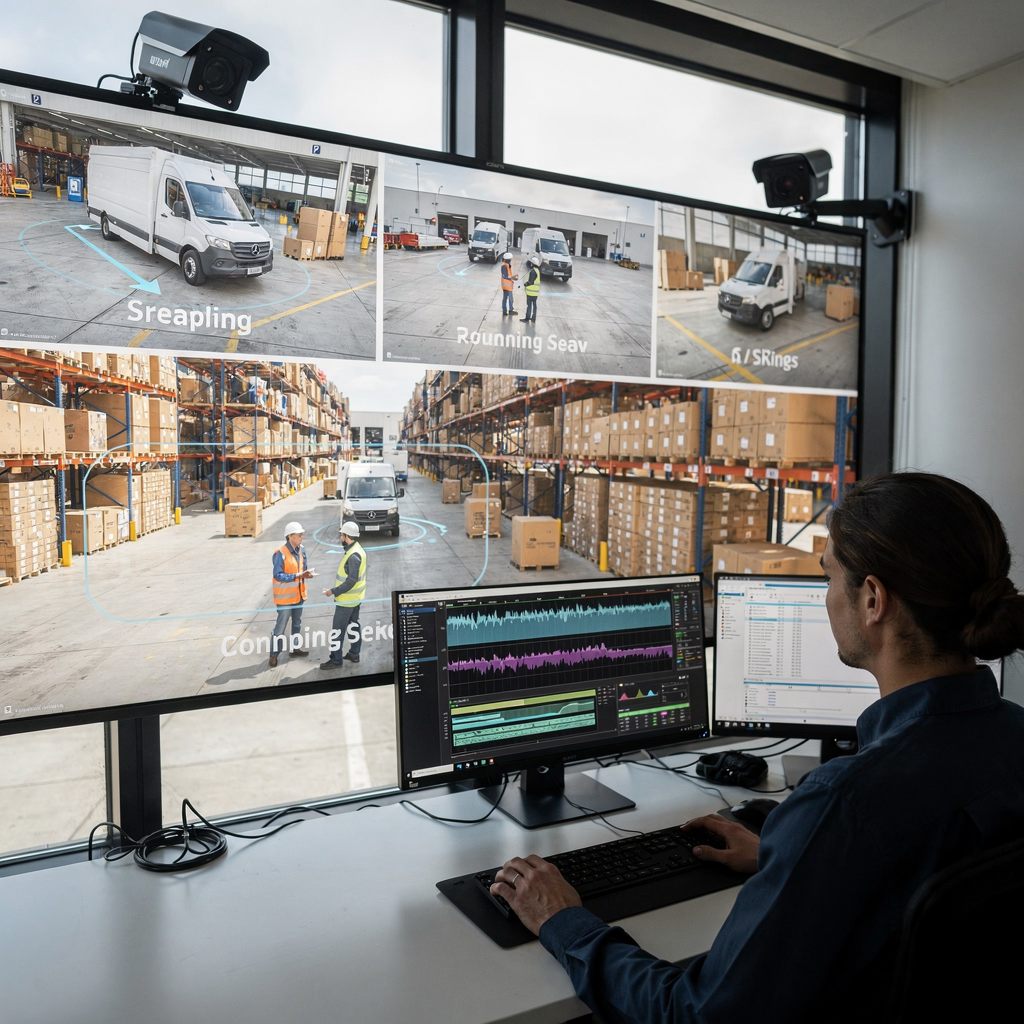
AI vision within minutes?
With our no-code platform you can just focus on your data, we’ll do the rest
Smart Search and Natural Language Search Integration
Combining filters and conversational queries creates a smarter workflow. Smart search panels provide precise control with object type filters, time sliders, and tag lists. Meanwhile, natural language queries provide a fast, intuitive entry point. Users can switch between the two modes, and they can refine results by adding constraints. This hybrid model offers the best of both approaches.
User journeys often begin with a short prompt. For example, an operator might type “vehicle stopped at loading dock” and then use the filter panel to narrow by vehicle color or time. The interface shows thumbnails, timestamps, and confidence scores so an operator can quickly verify results. This allows teams to find video clips in seconds and to build an investigation timeline without playing back hours of footage.
Feedback loops are essential. When users correct a match or confirm an outcome, that feedback becomes training data. As a result, the models improve. Also, logging why a suggested clip was chosen helps auditors assess reliability. Visionplatform.ai’s VP Agent Reasoning and VP Agent Actions illustrate how verification and suggested workflows reduce cognitive load. The agent explains detections and then recommends next steps, thereby turning a raw alert into an actionable explanation.
Practically, this integration improves situational awareness and speeds incident triage. Security teams gain a powerful search interface that understands context-aware constraints, and they can use voice or typed prompts depending on the situation. Over time, continuous model refinement reduces false positives and increases the precision of results. In short, combining a smart search panel with conversational natural-language capabilities gives operators both control and speed.
Future of Security: AI-Powered Natural Language Insights
The future brings low-resource language support, on-device inference, and federated learning. These trends help expand coverage to diverse regions while preserving privacy. For example, federated approaches let sites improve models locally and then share only model deltas. Also, on-device inference reduces latency and the need to stream video offsite.
Ethical frameworks and privacy-by-design principles must guide deployments. Agencies and vendors should adopt transparent logging, explainable models, and data minimisation. Europol highlights the need for careful governance when AI supports policing and public safety [AI and policing – Europol]. Therefore, compliant architectures that keep video on-prem and that document decisions are priorities for many operators.
Real-time summarisation and automated alerting are the next frontier. Systems will surface short, credible summaries of incidents so that operators can act faster. Also, improved benchmarks and public evaluation will reduce hallucination risk and strengthen trust. Researchers note that robust benchmarking matters as AI models can hallucinate on certain queries [AI on Trial: Hallucination findings].
Finally, adoption requires pilots, measured KPIs, and vendor transparency. Organisations should run limited pilots, measure time saved, and then expand. Visionplatform.ai supports this path with on-prem Vision Language Models and VP Agent Suites that keep video local while enabling AI agents to reason over VMS data. As a result, cameras no longer just trigger alarms; they become sources of understanding that let you instantly find relevant footage and to act with confidence.
FAQ
What is natural language search for CCTV?
Natural language search lets operators type plain queries to find relevant video without needing camera IDs or timestamps. It uses language models and vision analytics to interpret the request and to return matching video clips.
How does AI improve video search efficiency?
AI extracts metadata such as objects, people, and activities, and then indexes that data for fast retrieval. This reduces hours of manual review and lets teams find a specific video moment within seconds.
Can these systems work with existing video management systems?
Yes. Many solutions integrate with leading video management systems and expose events via APIs so operators can maintain current workflows. For example, Milestone integration allows agent-driven reasoning over VMS data.
Are these searches private and compliant?
They can be when deployed on-prem and configured to keep video local. Privacy-by-design, auditing, and transparent logs support regulatory compliance in sensitive environments.
What is the difference between smart search and natural-language queries?
Smart search refers to filter panels and exact controls for precise queries, and natural-language queries are conversational prompts. Combining both gives operators fast entry and fine-grained refinement.
How accurate are person search models in security contexts?
Modern person search models show substantial improvements, often exceeding 80% accuracy for multi-camera tracking in research, which helps reduce investigation time. However, site-specific training further improves results.
Can AI agents recommend actions after a match?
Yes. AI agents can verify detections, explain why a clip matched, and recommend or automate actions, such as creating incident reports or notifying teams. This reduces cognitive load during busy shifts.
What industries benefit from AI video search besides security?
Manufacturing, healthcare, logistics, and retail all benefit. Use cases include process anomaly detection, patient monitoring, pallet tracking, and loss prevention, which improve safety and operational efficiency.
How do systems handle ambiguous or colloquial queries?
They use clarification prompts, confidence scores, and multilingual models to disambiguate requests. Continuous user feedback also trains the system to handle local language and slang better.
What are the first steps to adopt AI video search?
Start with a pilot that defines clear KPIs and a small camera set. Evaluate accuracy, latency, and compliance, and then scale while keeping data and models under control.