ai and milestone: ai capabilities in milestone systems video management
First, this chapter explains the role of AI agents within Milestone. Milestone sits at the center of many modern control rooms. It provides the core XProtect platform that connects cameras, devices, and operators. visionplatform.ai extends this by adding reasoning, search, and actions. Together they move video from raw detections to assisted decision-making. For example, AI can flag safety violations and reduce manual oversight by up to 70%, so operators focus on real incidents. Next, Milestone XProtect acts as the event hub. It exposes camera events, metadata, and device information through well-documented APIs. This lets an AI agent ingest live feeds and VMS data for context. Then the agent reasons over events and suggests actions, reducing time spent per alarm.
AI capabilities here include detection, classification, tracking, and context building. The vision language model and VLM convert video into searchable text. As a result operators can use natural queries to find events. In addition, the system supports on-prem deployment to address data sovereignty concerns. This matters in enterprise and critical infrastructure environments where sending video to third-party services is not acceptable. Milestone Systems leaders describe AI as the semantic brain of modern surveillance, and that quote reflects a shift to proactive security Milestone Systems.
Also, visionplatform.ai provides an agent suite that works on top of Milestone. The VP Agent Suite converts detections into explanations. It supports VP Agent Search, VP Agent Reasoning, and VP Agent Actions. These elements let a control room verify an incident, then act. Finally, AI and Milestone together reduce false positives, accelerate incident management, and make the control room more resilient. For operators who need specific examples, see the PPE detection work that shows how automated rules improve compliance PPE detection.
milestone xprotect and visionplatform.ai: real-time video analytics
Milestone XProtect and visionplatform.ai combine to deliver real-time analytics at scale. First, Milestone XProtect acts as the VMS backbone. Then visionplatform.ai attaches an orchestration layer that reasons over events. This pairing supports real-time detection of people, vehicles, ANPR/LPR, PPE, and intrusions. For example, a visionplatform.ai detector can watch a dock gate and detect missing PPE. It then streams structured events into the XProtect event bus. As a result, operators receive fewer meaningless alarms and more verified incidents.
In practice, a real-time workflow looks like this. Cameras send video streams to Milestone XProtect. Next, visionplatform.ai ingests the streams and runs models on-prem. Then the VP Agent translates visual detections into descriptions using a vision language model. The agent publishes events and context into XProtect. Operators see summarized incidents in the Milestone XProtect Smart Client. They can jump to the relevant clip or trigger an action. This real-time chain preserves data sovereignty by keeping processing local, while still enabling advanced reasoning.
For live use cases, consider PPE compliance and threat identification. PPE compliance monitors helmets, vests, and safety zones. An AI agent flags violations, auto-generates a report, and records the event. You can read more about depot PPE analytics and how detection reduces manual monitoring by as much as 70%. For threat spotting, visionplatform.ai correlates motion, loitering, and access control events to form an explained incident. Milestone XProtect provides the central event log and archive for forensic review. Also, if your site needs tailored detectors, the platform supports custom model workflows, so models fit site-specific reality and improve over time.
AI vision within minutes?
With our no-code platform you can just focus on your data, we’ll do the rest
ai agent and access control: alert and forensic search in milestone xprotect smart client
The AI agent continuously monitors access control points and flags breaches. First, it listens to door contacts, badge readers, and camera motion. Then it correlates these signals with video. For example, when an access control reader shows a forced-entry and the camera shows a mismatch, the agent creates a verified incident. The incident includes the clip, a textual explanation, and recommended next steps. This reduces operator guesswork and supports assisted decision-making on top of the existing VMS.
Alert configuration is straightforward in the Milestone XProtect Smart Client. You can map agent outputs to alarm types, set escalation rules, and define delivery channels. The agent exposes structured access to events so control room software can trigger voice announcements, SMS, or incident tickets. For example, an alert can populate an incident form, attach the best camera clip, and notify the relevant team. This workflow links operations to evidence and shortens response times.
For forensic search, the VP Agent Search feature converts video into human-readable descriptions and lets operators search across recordings in natural language. An investigator can run queries such as “person loitering near gate after hours” and get matching clips without knowing camera IDs. This search across cameras and timelines speeds investigations. In tests, forensic search reduced investigation time by about 40% when compared to manual scrubbing and camera-by-camera review forensic search. The agent supports queries, filters, and export of evidence. Finally, integration points include connecting the agent to access control systems and building management systems, so video and badge logs are correlated in a single timeline.
milestone ai: video management and management systems integration
Milestone AI extends video management into enterprise workflows. First, the architecture places Milestone XProtect as the central recorder and archive. Then an orchestration layer exposes events, camera states, and device information through the Milestone API. This lets AI agents reason over live video and operational databases. As a result, operators can integrate VMS data with ERP, PSIM, and building management systems for richer context.
Integration points are flexible. You can stream events via MQTT, webhooks, and APIs. This connects Milestone to ticketing, incident management, or command dashboards. The agent provides structured access to events so external management systems can act automatically. For example, a detected perimeter breach can create a work order in a maintenance system and alert security. The combined stack reduces false alarms and consolidates control. It also supports industrial and enterprise use cases in critical infrastructure environments.
Benefits include fewer false positives, faster response, and centralized control. Milestone AI plus visionplatform.ai enables operators to interact with video in meaningful ways. They receive explanations, recommended actions, and one-click evidence exports. Also, keeping models and processing on-prem addresses data sovereignty worries. This design aligns with EU AI regulations and the need for auditable logs. For teams that require vendor flexibility, Milestone’s open platform supports third-party integrations and partner portals such as Arcules for VSaaS scenarios. Finally, the combined approach turns video management systems into true decision-support platforms for control rooms by adding reasoning and orchestration.
AI vision within minutes?
With our no-code platform you can just focus on your data, we’ll do the rest
ai and milestone xprotect video management: agent orchestration
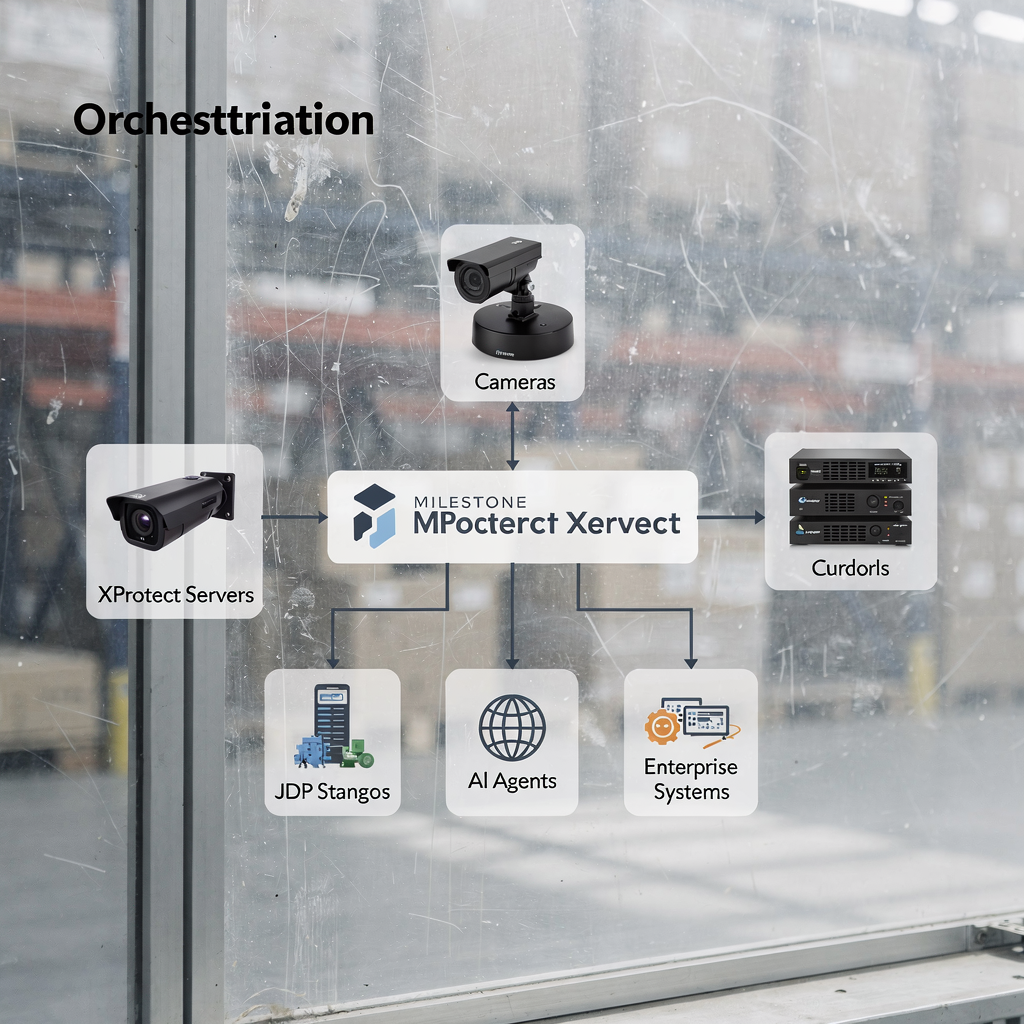
Deploying multiple AI agents in a Milestone XProtect environment requires planning. First, assign agents to tasks: detection, reasoning, search, or actions. Next, ensure resource allocation for inference so latency stays low. Milestone XProtect manages camera streams and archive. visionplatform.ai agents handle model inference and the visionplatform.ai control room AI agent coordinates actions. Together they form an orchestration layer that moves from detection to response.
Automated workflow orchestration covers detection to ticketing. For instance, an intrusion detected at night triggers verification by a reasoning agent. Then an action agent either escalates to an operator or automatically notifies emergency services based on policy. The agent suite for Milestone XProtect supports this flow and can connect with incident management or control room software. Device information through the Milestone APIs enriches events so the agents know which door, which badge, or which sensor was involved.
Performance metrics matter. Milestone XProtect processes thousands of cameras worldwide and handles millions of video streams daily with low latency Milestone XProtect. In deployments, agents and on-prem AI capabilities maintain sub-second detection times for many events. Visionplatform.ai scales from single-site setups to distributed control rooms using GPU servers or edge devices. Also, the VP Agent Auto concept plans autonomous, low-risk operations that reduce operator workload while maintaining human oversight. Finally, this orchestration achieves centralised control, consistent responses, and measurable reductions in operator time per incident.
video analytics: advanced access control and forensic search with visionplatform.ai
Advanced video analytics from visionplatform.ai enhance access control and forensic capabilities. First, sophisticated modules perform object classification, behavior detection, and ANPR/LPR. These outputs feed into access control rules that go beyond badge reads. For example, the system can verify that a person who swiped a badge is actually at the door and wearing required PPE. This reduces tailgating and unauthorized access. In addition, visionplatform.ai supports compliance reporting and audit trails that are useful for security and operations teams.
Forensic search uses the VLM to convert recordings into descriptive text, enabling natural language queries. Operators can find events by describing what they remember, instead of guessing camera names. This capability proved valuable in airport environments, where quick evidence retrieval is essential; see detailed examples of people detection and ANPR deployments across airport pages such as the people detection and ANPR/LPR case studies. The search across cameras and timelines shortens investigations and supports audits. In real deployments, forensic search reduced investigation time by about 40% when it replaced manual scrubbing.
Visionplatform.ai also addresses operational challenges like integration with access control systems and building management systems. The platform transforms video and audio into contextual data so operators receive recommended actions. It supports on-prem AI, maintaining full control over models and data. Finally, the visionplatform.ai agent suite for Milestone makes XProtect a richer operational tool. The combination elevates video management systems to true decision-support platforms for control rooms. For teams focused on airport safety, the PPE detection and intrusion examples show practical impact and measurable gains.
FAQ
What is an AI agent in the context of Milestone?
An AI agent is an autonomous software component that consumes video and VMS metadata to reason and act. It can verify detections, provide explanations, and recommend or trigger responses within a Milestone environment.
How does visionplatform.ai integrate with Milestone XProtect?
visionplatform.ai connects to Milestone XProtect via APIs and event streams. It ingests live video streams, runs on-prem models, and returns structured events and explanations into XProtect for operator use.
Can forensic search find events without camera IDs?
Yes. The VP Agent Search converts video into descriptive text and supports natural language queries. Operators can search across cameras and timelines without needing exact camera IDs or timestamps.
Does this solution support on-prem deployment for compliance?
Yes. visionplatform.ai supports on-prem AI and keeps video and models local to maintain data sovereignty. This helps meet EU AI Act requirements and internal policies.
How do AI agents reduce false alarms?
AI agents reason across video, access control, and historical context to verify incidents before escalation. This multi-source verification lowers false positives and reduces operator workload.
What happens after an agent raises an alert?
An alert can trigger workflows in the Milestone XProtect Smart Client, create tickets in incident management, or notify teams based on predefined rules. The agent can pre-fill reports to speed response.
Can the system handle thousands of cameras?
Yes. Milestone XProtect is proven at scale, and visionplatform.ai scales with GPU servers or edge devices. The architecture supports many cameras and millions of video streams with low latency.
Is it possible to customize detection models?
Yes. The platform supports pre-trained models, fine-tuning with site data, or building models from scratch. This ensures detections match site-specific realities.
How does access control integration work?
Agents correlate badge reads, door sensors, and video to create a single timeline. This helps verify events like tailgating or forced entries and supports automated actions and reports.
Where can I read examples of deployments?
visionplatform.ai publishes case studies and deployment pages such as people detection, PPE detection, and forensic search in airports. These pages show real use and measurable benefits.