benchmark for vlm vs video analytics: object detection metrics
Object detection sits at the heart of many security and retail systems, and so the choice between a vlm-based system and classic video analytics depends largely on measurable performance. First, define key metrics. Accuracy measures correct detections and classifications per frame. FPS (frames per second) shows throughput and real-time ability. Latency records the delay between video input and a decision or alert. Precision, recall, and mean average precision (mAP) also matter in many benchmarks. These metrics give operators a clear way to compare systems and to set thresholds for alarms and responses.
When comparing published results, vlm-based systems often score higher on multimodal reasoning tasks and on questions that require context across frames and language. For example, state-of-the-art Vision-Language Models can reach over 85% accuracy on complex visual question answering tasks, which reflects strong reasoning capabilities across modalities. Classic video analytics, by contrast, excel at optimized, low-latency detection for well-scoped tasks such as people counting or ANPR. The global market data also reflects deployment focus: the video analytics market reached about $4.2 billion in 2023 and continues to grow rapidly.
In real-world deployments the trade-offs become clear. City surveillance needs continuous detection at low latency and high FPS for multiple cameras. Classic video analytics pipelines are tuned for this and often run on edge hardware. Retail cases, however, benefit from richer descriptions and multimodal summaries. A vlm can generate a textual summary after a customer interaction and then feed that description to an operator or to search. In practice, operators find that adding a vlm increases the time needed per inference but improves the quality of alarms and reduces false positives when used with smart verification.
For city-scale surveillance, the typical metric targets are above 25 FPS per stream on a dedicated GPU and single-digit millisecond latency for event flagging. Retail systems may accept lower FPS but demand richer outputs such as captions and timelines. Integrators like visionplatform.ai combine real-time video analytics with an on-prem vlm to balance throughput and interpretability. This approach lets an operator get fast detections and then richer textual verification, which reduces time spent per alarm and improves decision quality. A careful benchmark plan should include both raw detection metrics and human-centric measures such as time-to-verify and false-alarm reduction.
vision language model and language model fundamentals in vision language tasks
A vision language model links images or video with natural language so a machine can describe, answer, or reason about visual scenes. At its core a vision language model ingests pixel data via a vision encoder and aligns that representation with a language model that generates textual outputs. The visual encoder extracts features from image and video frames. The language model then conditions on those features and produces captions, answers, or structured text. This chain of vision encoder plus language model enables tasks that require both perception and language understanding.

Common vision language tasks include image captioning and visual question answering (VQA). For image captioning the system must create concise image captions that capture the main actors, actions, and context. For VQA the model answers specific questions like “How many people entered the store?” or “Was the truck parked in a loading bay?” For both tasks the quality of image-text pairs in the dataset matters strongly. Training on diverse datasets of image-text pairs improves robustness and reduces hallucinations. In practice, a large language model component brings fluency and coherence, while the vision encoder supplies the grounding in pixels.
The language model component is crucial. It must accept visual features and convert them into textual form. Designers often use a transformer-based large language model that has been adapted to multimodal inputs. The adaptation can be straightforward binding of visual tokens to the model’s context window, or it can use a dedicated multimodal head. A good language model improves natural language output and supports downstream tasks like summarization, forensic search, and report generation. For operators this means they can query video with free-text prompts and receive human-readable descriptions.
In enterprise control rooms these capabilities change workflows. visionplatform.ai uses an on-prem vision language model so video, metadata, and models remain inside the customer environment. This allows operators to search recorded footage with natural language and to retrieve concise summaries that reduce verification time. When using a vlm, teams should measure both language fidelity and detection accuracy. Benchmarks for VQA, caption quality, and end-to-end response time give a clear picture of real-world readiness.
AI vision within minutes?
With our no-code platform you can just focus on your data, we’ll do the rest
llms, vlms and key use case distinctions
LLMs excel in language processing, and vlms expand that strength into multimodal reasoning. A large language model handles text, and so it is ideal for tasks such as document summarisation, policy drafting, and natural language generation. A vlm combines visual understanding with language generation, and thus it supports tasks that require both visual context and textual output. The distinction matters when choosing tools for specific use cases.
Typical vlms use case examples include visual search, automated reporting, and forensic search over recorded footage. For instance, a security operator might search a past shift for “person loitering near gate after hours” and get matched clips plus a timeline. visionplatform.ai’s VP Agent Search demonstrates this by converting video into descriptions that are searchable with natural language, which reduces manual browsing time. In retail, vlms can summarize customer flows and create captions for customer interactions, enabling faster incident review and richer analytics.
In contrast, llm-only applications include document summarisation, chatbot customer support, and policy compliance tools that do not need visual inputs. These systems shine where language understanding and generation are primary. For text-only tasks, the llm can be fine-tuned or prompted to achieve high-quality output quickly. When you need multimodal context, however, a vlm is the correct choice because it links visual information to language and reasoning capabilities.
Operationally, teams benefit from a hybrid approach. Use an llm for heavy language processing and a vlm when visual grounding is required. That said, integrating both needs care. Prompt design matters here; effective prompts let the vlm focus on the right visual attributes and let the llm handle complex summarization or decision text. Many deployments run a fast video analytics detector first, then run a vlm on short clips to generate captions and verification text. This layered design reduces cost and keeps latency low while providing richer outputs for operators and ai agents.
video understanding and vision models: workflow in analytics systems
Video understanding in an analytics pipeline follows a clear path: capture, pre-process, infer, and act. Capture takes camera feeds or recorded clips. Pre-process normalizes frames, extracts regions of interest, and handles compression and frame sampling. Infer runs detection, tracking, and classification models to label objects and events. Act triggers alerts, logs, or automated actions based on policy. This simple chain supports both real-time operations and post-event investigation.
Vision models in analytics systems include CNNs and transformer variants. CNNs remain useful for many optimized detection tasks because they are efficient and well understood. Transformer architectures now power many vlms and large vision encoders, and they often improve cross-frame reasoning and long-range context. In practice, systems use a mix: a small, optimized neural network for real-time object detection and a larger vision encoder for downstream description and reasoning. This split saves runtime costs while enabling richer outputs when needed.
Mapping system stages shows how components interact. Data ingestion collects video input and metadata. Model inference uses both a detector and a vision encoder; the detector raises initial events while the vision encoder creates a richer representation for the language model. Alert generation takes detector outputs and vision language descriptions and forms an explained alert for an operator. For example, an intrusion alarm can carry both a bounding box and a textual summary that says who, what, and why the alarm matters. This reduces cognitive load.
Use cases such as people counting and perimeter detection rely on robust detection at scale. For people counting in busy areas, sampling strategies and tracker stability matter. visionplatform.ai integrates real-time detection with on-prem VLM descriptions so that operators get both counts and contextual summaries. This approach supports forensic search, and it reduces false alarms by enabling ai agents to cross-check detections with rules and historical context. Overall, a well-designed pipeline balances FPS, latency, and interpretability to meet operational needs.
AI vision within minutes?
With our no-code platform you can just focus on your data, we’ll do the rest
fine-tuning vlm on nvidia GPUs for performance boost
Fine-tuning a vlm on NVIDIA GPUs often gives a substantial boost for domain-specific tasks. In many projects teams adapt a base vlm to their environment by training on a smaller, curated dataset of image-text pairs that reflect the site, camera angles, and object classes. This fine-tuning aligns visual tokens and prompts to the site vocabulary, which improves both detection relevance and the quality of textual descriptions. Practical tuning reduces false positives and improves the model’s reasoning capabilities for specific events.
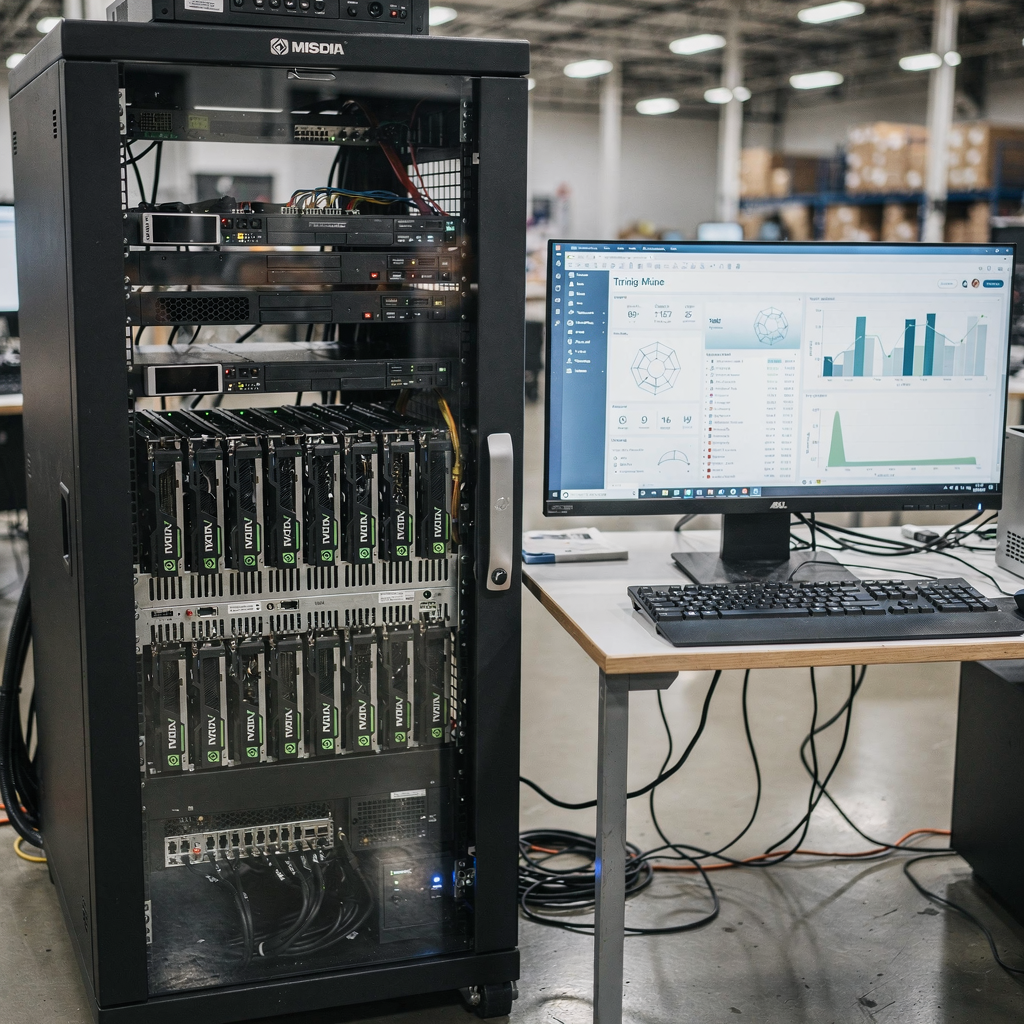
NVIDIA hardware provides CUDA support and tensor cores that accelerate transformer and encoder workloads. For many vlm fine-tuning jobs, a single high-end NVIDIA GPU or a small cluster can cut training time from days to hours. Teams typically use mixed precision and distributed optimizer strategies to make the best use of tensor cores. Typical configurations for practical projects include RTX A6000-class GPUs or NVIDIA DGX nodes for larger datasets. Training times vary: a focused fine-tuning run on a site dataset of tens of thousands of image-text pairs can finish in a few hours to a day on dedicated hardware, whereas larger re-training can take several days.
Fine-tuning methods range from full weights updates to adapter layers and prompt tuning. Adapter layers let you keep the base vlm frozen while training small modules. Prompt tuning modifies the model’s prompts or soft tokens and often needs far fewer training iterations. Each method has trade-offs. Adapter-based fine-tuning usually yields higher accuracy with limited training data, while prompt tuning is faster and lighter on hardware.
Engineering around hardware matters. NVIDIA drivers, optimized libraries, and containerized deployments help teams replicate results and maintain consistent runtime behavior. For on-prem deployments where cloud processing is not permitted, NVIDIA Jetson or similar edge GPUs allow local fine-tuning and inference. visionplatform.ai supports edge and on-prem options so customers keep video and models inside their environment, which helps with compliance and reduces cloud dependency while still using GPU acceleration.
integrating object detection and multimodal vision language in future workflow
Future workflows will combine fast object detection with multimodal vision language reasoning to give operators both speed and context. The integration pattern is straightforward. First, a detector scans each frame to flag candidate events such as a person entering a restricted zone. Next, those flagged clips feed a vision encoder and a vlm that produce captions and an explainable summary. Finally, an AI agent or operator reviews the explained alert and decides what action to take. This pipeline gives the best of both worlds: scalable, low-latency detection and rich textual context for decision support.
Object detection outputs feed vision language modules in two main ways. For short clips a detector can crop and send regions of interest to the vision encoder. For longer sequences the system can sample key frames and then run the vlm on an aggregated representation. This reduces compute while preserving the essential context. The textual output can then be used for searchable logs, automated report generation, or as inputs to ai agents that perform procedures or call external systems.
Envision a unified workflow that starts with detection, continues with captioning, and ends with decision support. An explained alarm contains bounding boxes, a textual caption, and a confidence score. An AI agent can cross-check the caption with access control data, historical patterns, and procedures, and then recommend or execute actions. visionplatform.ai already applies this pattern in its VP Agent Reasoning and VP Agent Actions, where events are verified against policies and enriched with contextual text to reduce false alarms and to speed up operator response.
Challenges remain. Synchronisation of streams and resources is non-trivial when many cameras must be processed. Optimising resource allocation, batching requests, and prioritising critical events help control compute costs. Another issue is prompt design: effective prompts reduce hallucination and keep the vlm focused on specific events. Finally, teams should monitor post-deployment performance and plan for iterative updates and fine-tuning so the system stays aligned with operational needs and evolving threats.
FAQ
What is the main difference between a vlm and traditional video analytics?
A vlm combines visual processing with a language model so it can generate textual descriptions and answer questions about images or clips. Traditional video analytics focuses on detection, classification, and tracking with an emphasis on real-time throughput and alerting.
Can a vlm run in real time for city surveillance?
Running a full vlm in real time across many streams is resource intensive, and so deployments often use a hybrid approach that pairs fast detectors with vlms for verification. This gives low-latency detection and richer explanations when needed.
How does fine-tuning improve vlm performance?
Fine-tuning on site-specific datasets aligns a vlm to the camera views, terminology, and event types that matter to operators. It reduces false positives and improves textual accuracy, and it can be done efficiently on NVIDIA GPUs using adapter layers or prompt tuning.
What hardware is recommended for fine-tuning and inference?
For fine-tuning, high-memory NVIDIA GPUs or DGX-class nodes provide the best performance due to CUDA and tensor cores. For edge inference, NVIDIA Jetson devices are a common choice when on-prem processing is required.
How do vlms help with forensic search?
vlms convert video into searchable textual descriptions, enabling operators to find incidents using natural language rather than camera IDs or timestamps. This reduces time-to-find and supports better investigations.
Are vlms compliant with data protection rules?
On-prem deployments and careful data governance help keep video and models inside the customer environment for compliance. visionplatform.ai focuses on on-prem solutions that minimize cloud transfer and support auditability.
Can llms and vlms work together?
Yes. An llm handles complex language processing such as summarization and policy reasoning, while a vlm provides visual grounding for those summaries. Together they form a powerful multimodal stack for operations.
What role do ai agents play in these systems?
AI agents can reason over detected events, vlm descriptions, and external data to recommend or take actions. They automate repetitive decisions and support operators with context and next steps.
How much training data is needed to adapt a vlm?
Adaptation can work with surprisingly small datasets if you use adapter layers or prompt tuning, but larger and diverse datasets of image-text pairs yield more robust results. The exact amount depends on the domain complexity and variability.
What metrics should I track for deployment success?
Track detection accuracy, FPS, latency, false alarm rates, and operator time-to-verify. Also measure business outcomes such as reduced response time and fewer false positives to prove operational value.