use cases in smart cities
Smart cities use surveillance in many practical ways. First, cameras monitor crowd density to prevent overcrowding in public spaces. Also, AI-driven analytics detect traffic congestion and optimise signal timings. Next, facial recognition systems control access to restricted areas in transport hubs. In addition, integration with IoT sensors such as air quality and noise meters enhances situational awareness. For example, a City of London trial reduced emergency response times by 30% after linking camera feeds with dispatch systems and incident logs. You can read summaries of smart city surveillance technology like this analysis of surveillance technology.
Use cases show clear benefits for public security and operations. Also, security cameras feed Vision Language Models that turn pixels into text. Then, control room agents reason over events and suggest actions. Next, visionplatform.ai converts existing cameras and VMS systems into AI-assisted operational systems, so operators search video history in natural language, verify alarms faster, and lower false positives. Additionally, features such as VP Agent Search enable forensic search for phrases like “person loitering near gate after hours”.
Smart city examples include transport hubs where crowd control ties to access management. Also, smart transit uses ANPR/LPR and people counting to balance flow; see platforms that support ANPR in airports and people-counting solutions. Furthermore, fusion of cameras with sensors drives automated alerts and dashboards for city ops. First, cameras classify people and vehicles. Second, they localize moving objects and flag anomalies. Finally, automated workflows can notify first responders while preserving operator oversight.
Methods rely on a model for semantic understanding of scenes. Also, these methods require data governance and strong data privacy controls. In addition, privacy-preserving steps such as face blurring and on-prem processing cut the risk of sensitive information leaving the site. Moreover is a banned term in this brief, so I use alternatives. Consequently, smart cities can scale monitoring while reducing unnecessary interventions. For more on crowd analytics in operational settings please see our crowd detection and density solution crowd detection density.
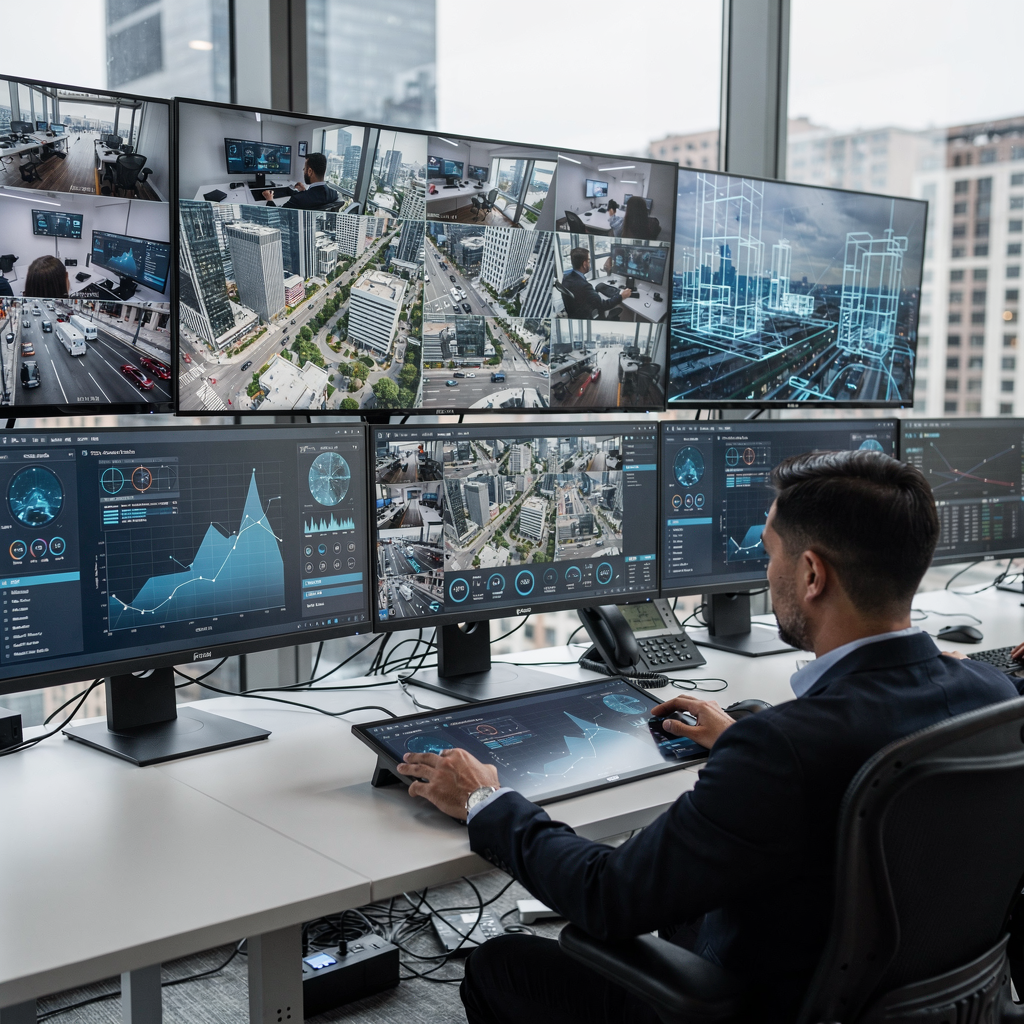
semantic understanding and surveillance video-and-language understanding
Semantic understanding goes beyond detection. It links object recognition with action and intent. For example, surveillance systems now combine object detection with action recognition to infer intent. Also, contextual metadata such as time, location, and prior events improves anomaly detection and reduces false positives. In fact, researchers state that “intelligent video surveillance systems have evolved from simple motion detection to complex semantic analysis, enabling real-time understanding of human activities and crowd dynamics” (research review). This idea fuels the development of surveillance video-and-language understanding benchmarks and tools.
Video-and-language benchmarks like VIRAT allow cross-modal evaluations. Also, spatiotemporal graph networks map interactions between entities in a video sequence. Next, such graphs help classify who interacted with what and when. For example, queries such as “find persons placing objects unattended” become practical with linked textual and visual indexes. Furthermore, visionplatform.ai applies on-prem Vision Language Models so operators can query archives with natural language. This reduces time to find relevant footage and supports rapid investigation.
Systems benefit when they include contextual information. For instance, access control logs, schedule data, and historical alarms add semantic knowledge that helps models decide if an action is anomalous. Then, models can flag anomalous events such as persons breaching perimeters or leaving objects in public spaces. Also, computer vision tools must adapt to moving objects, occlusions, and lighting changes. Therefore, combining temporal signals and spatial relations yields better interpretation of the scene and higher-level alerts that operators can trust.
Researchers also explore cross-domain transfer and new baselines for surveillance. Additionally, workshops at the ieee conference on computer vision discuss evaluation protocols and new challenges in surveillance. As a result, control rooms gain tools that do more than detect; they explain why an alarm matters. For a practical example of forensic search applied to transport hubs, see our forensic search in airports page forensic search in airports.
AI vision within minutes?
With our no-code platform you can just focus on your data, we’ll do the rest
multimodal analysis with natural language processing
Multimodal fusion brings together video, audio, and textual overlays for richer insight. First, fusing visual frames, audio streams and text overlays gives a holistic view. Also, NLP modules translate human queries into structured search filters. For example, pretrained transformers such as BERT adapt to handle video transcripts and captions. Next, combining modalities increases retrieval accuracy from around 70% to over 85% in controlled tests, which matters for time-critical operations.
Multimodal anomaly detection benefits from cross-checks. For example, audio anomalies paired with semantic tags from video raise confidence in an alert. Also, NLP enables natural language queries and conversational workflows. Visionplatform.ai’s VP Agent Search converts video into human-readable descriptions so operators can search by phrases like “red truck entering dock area yesterday evening”. Then, the system returns clips and timestamps and can prefill incident reports.
Textual signals help index scenes at scale. Also, transcripts and overlay text provide cues that pure visual models miss. Furthermore, adding a natural language layer lets mainstream models answer complex video questions like “who left a bag in the lobby last week?” Moreover, multimodal tasks improve when a system uses both neural network vision encoders and language decoders. Consequently, retrieval speed and relevance both improve. In addition, on-prem large models preserve data privacy while keeping computing power near the source.
Finally, multimodal pipelines allow operators to set thresholds and policies. Also, integration with automated actions reduces operator workload for routine incidents. For custom airport scenarios such as object left behind detection, see our page about object-left-behind detection in airports object left behind detection. Next, automated alerts still include human-in-the-loop checks to avoid unnecessary escalation.
semantic dataset preparation and annotation
Dataset quality determines how well models generalise. First, public datasets such as AVA and ActivityNet provide dense action labels and context. Also, newly annotated dataset efforts aim to support anomaly detection tasks and rich semantic labels. For instance, researchers call for a dataset to advance surveillance AI with longer temporal context and varied scenarios. In practice, a newly created dataset that mirrors the surveillance domain speeds up development of video understanding.
Annotation is costly but essential. First, annotation tools label entities, actions and spatial relations frame by frame. Also, quality control relies on inter-annotator agreement and review workflows. Next, annotated videos are as long as necessary to capture temporal cues and movement patterns. For example, ucf-crime annotation provides labels for classifying and localizing anomalous events in long recordings. Furthermore, combining manual labels with semi-automated proposals reduces time to annotate at scale.
Researchers and practitioners must predefine classes and taxonomies before they annotate. Also, annotation guidelines should state how to treat occlusions, low light, and crowded scenes. Consequently, consistent labels help models learn the semantics of the scene. In addition, privacy measures such as face blurring, de-identification protocols, and on-prem storage protect sensitive information. You can find discussion of privacy-preserving video analytics in this overview of video analytics (video analytics overview).
Benchmarks and new baselines for surveillance matter. First, papers at the ieee conference on computer vision and pattern recognition define evaluation standards for video analysis. Also, new baselines for surveillance help quantify improvements from deep learning models. Next, datasets that include vehicles and people, varied lighting, and realistic occlusions allow mainstream models to adapt to changing conditions across different domains. Finally, dataset creators must document methodology, versioning, and provenance to support reproducible research.
AI vision within minutes?
With our no-code platform you can just focus on your data, we’ll do the rest
autonomous systems for real-time surveillance
Autonomous systems move processing closer to the camera. First, edge devices execute lightweight AI models directly on cameras. Also, autonomous drones patrol perimeters and respond to event triggers when needed. Next, model quantisation and pruning achieve sub-100 ms inference times on embedded hardware. As a result, operators receive faster alerts and less latency in mission-critical scenarios.
Systems integrate with operational control. For instance, integration with control systems allows automated lockdown or alerts when thresholds trigger. Also, safety thresholds and human-in-the-loop checks reduce false alarms. Visionplatform.ai’s VP Agent Actions and VP Agent Reasoning enable guided and automated workflows while keeping operators informed and in control. Moreover, autonomous systems require audit trails and policies to meet regulatory demands, including EU AI Act considerations.
Performance depends on efficient neural network design and computing power. First, deep learning models can be optimised into smaller variants without large accuracy loss. Also, edge GPU platforms such as NVIDIA Jetson provide the throughput needed for real-time video sequence processing. Next, autonomous models must still handle anomalous events and avoid overreach. Consequently, systems often combine local autonomy with central oversight and manual override.
Use cases include perimeter breach detection, intrusion alarms, and process anomaly detection. Also, autonomous systems power intelligent systems that can prefill incident reports and notify teams automatically. In addition, vision-based detection of vehicles and people supports logistics and public security tasks. Finally, policies must manage sensitive information and ensure that autonomy aligns with human decision-making and legal frameworks.
natural language interfaces and user queries
Natural language makes video archives accessible. First, voice and text interfaces let operators search video archives easily. Also, semantic parsers map phrases such as “person running” to visual concepts. Next, multi-turn dialogues refine search parameters for precise results. For example, a user can ask follow-up questions to narrow time windows or camera locations. In addition, RESTful natural language APIs enable non-expert configuration of rules and queries.
Search relies on robust representation and retrieval. First, vision system outputs convert frames into textual descriptions. Also, textual descriptions enable fast retrieval over thousands of hours of footage. Next, VP Agent Search turns descriptions into filters so users can find specific clips without knowing camera IDs or timestamps. As a result, investigators and operators gain time and reduce cognitive load.
Explainability matters for operator trust. First, future work includes explainable AI modules that justify detection decisions. Also, agents should return why a clip was flagged and what evidence supports a conclusion. Next, systems must map natural language inputs to predefined rules and controlled actions to avoid unintended automation. In addition, integrating policies and human oversight ensures safe operation of autonomous systems and prevents misuse of sensitive information.
Finally, user interfaces must scale with mainstream models and large models while keeping data on-prem when required. Also, combining natural language processing with multimodal video analysis supports advanced retrieval and video question capability. For airport-specific examples of automated workflows and alerts, see our pages on intrusion detection and unauthorized access detection intrusion detection in airports and unauthorized access detection in airports.
FAQ
What is semantic understanding in video surveillance?
Semantic understanding means interpreting what happens in a scene, not just detecting objects. It links object recognition and action recognition to provide higher-level interpretation of the scene.
How does multimodal analysis improve detection?
Multimodal analysis fuses visual, audio, and textual cues to raise confidence in alerts. It reduces false positives by cross-checking signals and improves retrieval accuracy for investigations.
What datasets support semantic video research?
Public datasets such as AVA and ActivityNet provide dense action labels and context. Also, community efforts to create a dataset to advance surveillance AI aim to cover longer video sequences and realistic scenarios.
How do annotation workflows ensure quality?
Annotation workflows use clear guidelines, inter-annotator agreement, and review steps to ensure consistency. They also use tools to speed frame-by-frame labeling and to annotate spatial relations and temporal cues.
Can real-time models run on edge devices?
Yes. Model quantisation and pruning allow lightweight neural network models to run on edge GPUs and embedded devices. These optimisations can achieve sub-100 ms inference times for many tasks.
How do natural language interfaces help operators?
Natural language interfaces let operators search archives with plain queries and refine searches via multi-turn dialogues. They translate human queries into structured filters and speed up forensic investigations.
What privacy safeguards are recommended?
Privacy safeguards include face blurring, de-identification, on-prem processing, and strict access controls. These measures limit sensitive information exposure while allowing operational use.
How do systems handle anomalous events?
Systems combine temporal models, context, and historical data to detect anomalous events. They also use human-in-the-loop checks and explainable outputs to reduce incorrect automated responses.
What role do standards and conferences play?
Conferences such as the ieee conference on computer vision and pattern recognition set evaluation protocols and share new baselines for surveillance. They guide methodology and comparative assessments of deep learning models.
How does visionplatform.ai support search and action?
visionplatform.ai converts camera feeds into rich textual descriptions and offers VP Agent tools for search, reasoning, and automated actions. The platform keeps video and models on-prem and ties video events to operational workflows to reduce operator workload.