AI Video and ai video analytics for security solutions
AI video analytics has become central to modern security solutions. It detects weapons, unusual behaviour, and unauthorized access from live feeds. These systems combine computer vision with rule-based logic and machine learning to reduce noise and highlight real situations. For example, systems that flag a weapon or a person loitering can triage events for an operator. Also, they can prioritise incidents that need an immediate human response. Real-time detection shortens the gap between detection and intervention. At the same time, operators get context that helps them decide what to do next.
Deployment of these systems is rising fast. Public safety sectors report over 30% annual growth in AI video surveillance deployments, driven by improved models and faster hardware (AI Video Surveillance: How Far Is Too Far For Public Safety?). Also, combining video with text signals improves accuracy. AI systems can correlate a visual alarm with a text-based tip, a badge swipe, or a log entry. This correlation reduces false positives and focuses scarce human attention on verified threats. For instance, visionplatform.ai turns existing cameras and VMS systems into AI-assisted operational systems that explain what happened and why it matters, which reduces time per alarm and cognitive load.
Experts warn about privacy and misuse risks. Dr Jane Smith at IBM notes that while AI improves detection, it also raises privacy challenges that must be managed (Exploring privacy issues in the age of AI). Also, transparent datasets and governance help. AI video analytics is powerful, yet it must operate within legal frameworks such as GDPR and SOC 2-style compliance. Therefore, teams should design systems that keep data local when required and enable an audit trail for decisions.
Operational benefits are clear. Also, AI reduces mundane monitoring. It helps to optimise operations and to provide situational awareness. For example, integrated analytics can detect a license plate and a person at the same time, cross-check access logs, and present a single explained incident. Operators then receive fewer, higher-value alerts. Also, installing contextual layers on top of detections, as visionplatform.ai does with an on-prem Vision Language Model, turns raw detections into searchable knowledge and decision support. This shift moves control rooms from overwhelmed status to scalable, assisted operations.
ai-powered video integrate cloud video analytics
Integrate AI-powered video feeds with cloud or on-prem storage to extend capabilities. Many organisations choose cloud video for scalability. However, others keep data on site to meet compliance. visionplatform.ai supports on-prem processing to avoid moving sensitive video out of the environment. Also, teams that combine live video with NLP-based text analysis get more context. For example, chat logs, email tips, and social posts can be scanned alongside visual events to determine intent.
Real-time correlation ties visual events to text signals. When a camera detects an unauthorized person, the system can also scan access control logs and a relevant message thread. This contextual verification reduces false positives and improves response times. The FBI describes how AI lets teams process video footage and textual intelligence at scale, enabling faster threat identification (Artificial Intelligence – FBI). Also, cloud or hybrid architectures let investigators search across enormous datasets quickly.
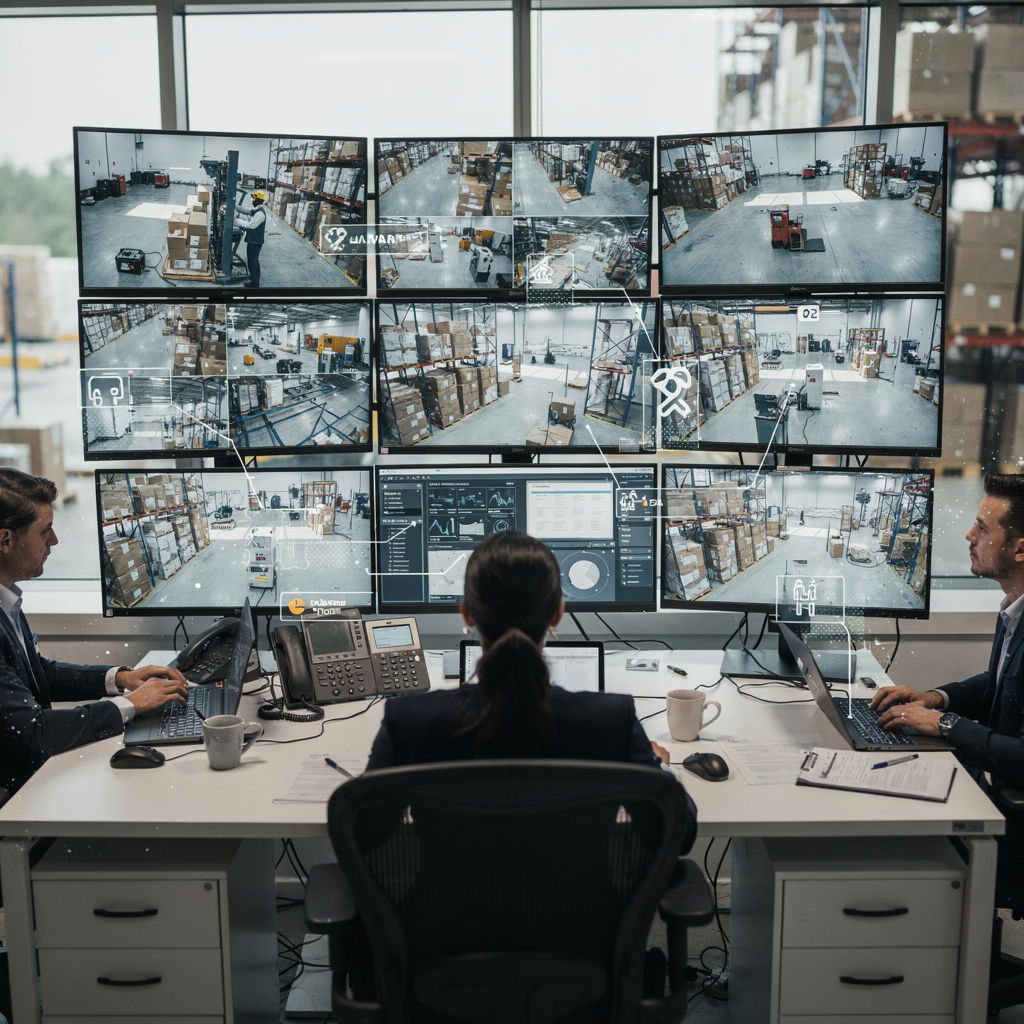
Centralised dashboards streamline decision-making. They present unified timelines, alerts, and confirmations. Also, they can show related textual evidence. For example, an operator might see a camera clip, an access log line, and a parsed note from a communication channel all in one view. This capability helps to automate triage and to generate incident reports. It also provides an auditable trail for compliance and post-incident review. For organisations subject to the EU AI Act, keeping models and video within the perimeter is often necessary. visionplatform.ai’s on-prem approach allows that while still offering agent-based recommendations for actions.
Case studies show value. The use of AI to sift large video and textual datasets speeds investigations and reduces manual hours. For instance, AI-enabled Network Detection and Response and combined video-text solutions can cut breach response costs by up to 40% (AI in Cybersecurity: Latest Developments + How It’s Used in 2025). Also, integrating ANPR/LPR, person detection, and access control into one management system increases situational awareness and operational efficiency. For airport teams, features like weapon detection, loitering analysis, and forensic search make everyday monitoring work better; learn more about weapon detection in airports here and forensic search use cases here.
AI vision within minutes?
With our no-code platform you can just focus on your data, we’ll do the rest
ai-generated video, ai avatar and video creation for modern training
AI-generated video and ai avatar instructors change how organisations build security awareness and skills. AI can create realistic training scenarios from templates. Trainers can rapidly assemble bespoke modules that match site-specific risks. For example, a scenario might simulate an after-hours intrusion without using real incidents. Also, generated scenarios let teams exercise response playbooks in a safe, repeatable way. This approach helps to streamline training and to keep staff ready for complex events.
AI avatars deliver consistent instruction at scale. An ai avatar can present scenario steps, ask questions, and adapt pacing. Using natural voices and simple visual cues, these avatars can keep learners engaged. Also, ai voices are now good enough for professional narration in training videos. The combination of avatars and scenario clips means organisations can generate training videos rapidly. Many platforms let you create a video or generate a video from text prompts, which speeds content production.
Video creation platforms now support text to video and text-to-video workflows. Trainers can turn text scripts into completed modules with visuals and voiceovers. Also, they can insert interactive checkpoints that evaluate decision-making. For security awareness training, this means staff learn by doing. Research shows scenario-based learning improves retention compared with lectures. For organisations that need to scale training, AI reduces time for video production and helps to maintain consistent messaging across sites.
Operational teams gain measurable benefits. They can reuse modules for onboarding, refreshers, and incident simulation. Also, they can track outcomes and tailor follow-up exercises. visionplatform.ai supports these needs by converting video events into searchable descriptions, which trainers can repurpose for realistic scenarios. In addition, an ai video platform that ties training content to actual site detections closes the loop between training and daily operations. For a quick example of a tailored detection, see intrusion detection in airports here.
training modules, training materials and get your video via email
Structured training modules boost comprehension and compliance. Begin with short lessons. Then add scenario walkthroughs and quizzes. Also, include interactive checkpoints that test decision-making. Each module should map to specific roles and critical areas. Trainers should include downloadable checklists, incident reports, and guided response steps. These training materials help staff act correctly under pressure.

Delivery matters. You’ll get your video via secure email or internal portals depending on policy. Also, many teams prefer a notification approach. For example, the system can send a link and an attached brief when a new training video is released. This ensures staff see important updates. In fact, using ‘get your video via email’ with a secure link helps distribution while preserving access control. Also, automated reminders and progress dashboards keep completion rates high.
Design modules to be short and practical. Use clear objectives. Then add a realistic scenario clip and an AI avatar that guides the learner. Also, include an audit trail to prove completion. An audit entry helps for compliance checks. Include automated report generation so managers can see who finished a module and who needs a refresher. Also, connect module results with operational metrics to optimize operations and to measure training efficacy.
Finally, integrate training into daily workflows. For example, if a control room sees repeated false alarms, trigger a refresher module for operators. Also, tie training completion to role-based access and to system permissions. This approach closes the loop between learning and performance. If you want to explore training modules that reflect real control room events, our VP Agent Search can convert recorded incidents into learning material quickly.
AI vision within minutes?
With our no-code platform you can just focus on your data, we’ll do the rest
use cases of ai-enabled video via surveillance and text analysis
AI-enabled video and text analysis support many practical use cases. First, perimeter surveillance benefits from multi-angle feeds and sensors. AI detects crowd anomalies, perimeter breaches, and suspicious vehicle behaviour. Also, systems can read a license plate while tracking a person for context. This capability improves early warning and forensic review. For airports, perimeter and crowd monitoring tie directly to passenger flows and service continuity. See examples of crowd detection and density in airports here.
Second, cyber-physical threat response relies on combining logs with video events. When IT detects unusual network activity, video can show physical access or tailgating. Conversely, a suspicious video event can prompt a log review. This integrated view helps to spot coordinated attacks and insider threats. The NCSC projects that AI will change threat dynamics through 2027, and the security community must adapt to an evolving landscape (Impact of AI on cyber threat from now to 2027). Also, text AI can scan communications for early indicators of coordination.
Third, operational ROI is measurable. AI-enabled Network Detection and Response and combined systems lower breach response costs and improve throughput. For example, some solutions reduce breach response costs by up to 40% through faster verification and automated workflows (AI in Cybersecurity: Latest Developments + How It’s Used in 2025). Also, AI can automate routine tasks, freeing analysts for higher-value work. Use cases extend to ANPR/LPR for vehicle access, PPE monitoring, and object-left-behind detection for safety and security.
Finally, text scanning uncovers insider risk. AI that turns unstructured text into signals can notify teams about policy violations or unusual coordination. Also, correlating a flagged message with a camera clip increases confidence before escalating an alert. Systems that provide an explained incident reduce operator fatigue and improve response times. For more on specific airport capabilities, review people detection and license plate analytics such as ANPR/LPR in airports here.
future of video: ai and ai-generated module development
The future of video blends computer vision, NLP, and predictive analytics to deliver proactive protection. AI will move from reactive alarms to predictive recommendations. Also, systems will adapt based on user performance and shifting threat profiles. For example, modules will change when new attack patterns emerge. AI’s role will be to identify weak spots, propose mitigations, and help automate routine workflows. visionplatform.ai envisions cameras as sensors that feed a reasoning layer for decision support.
Next-generation systems will generate training from real incidents. AI-generated modules will adapt content based on operator responses. Also, input prompts will let trainers create new scenarios quickly. Text-to-video and text to video capabilities will let teams turn written procedures into immersive clips. At the same time, AI video generator tools will support rapid video generation and video production for role-specific drills. This will streamline content pipelines and reduce costs.
Ethical and privacy safeguards must keep pace. Researchers demand standardised datasets and strong protections for civil liberties (AI-Based Weapon Detection for Security Surveillance). Also, compliance with GDPR and SOC 2 matters to customers. Systems should enable an audit trail and provide clear control over data and models. An audit capability helps to prove who accessed what and why.
Roadmaps point toward hybrid deployments. On-prem, edge, and cloud nodes will cooperate. Also, systems will provide configurable autonomy for routine events while retaining human oversight for high-risk scenarios. The result will be improved situational awareness, faster response times, and measurable operational efficiency. Finally, organizations that adopt data-driven, AI-enabled pipelines will be better positioned to optimise operations and to stay ahead of evolving threats.
FAQ
What is AI video analytics and how does it improve security?
AI video analytics combines computer vision and machine learning to analyse camera feeds and flag relevant events. It improves security by reducing false alarms, prioritising incidents, and providing contextual information that speeds up human decision-making.
How do video and text analysis work together?
Video analysis finds visual events, while text analysis scans messages, logs, and reports. Together they correlate signals to confirm incidents, reduce false positives, and provide richer situational awareness for responders.
Can organisations keep data on-premise for compliance?
Yes. Many vendors, including visionplatform.ai, offer on-prem processing that keeps video, models, and reasoning inside the environment. This helps meet GDPR and SOC 2 requirements and reduces cloud dependency.
How does AI help with training and simulation?
AI can generate training videos and create ai avatar instructors for consistent delivery. It also turns real incidents into scenario-based modules, which improves retention and ensures training matches actual risks.
What are common use cases for AI-enabled video in airports?
Use cases include people detection, ANPR/LPR, intrusion detection, weapon detection, and forensic search. These functions support passenger safety and operational continuity at scale.
Is it possible to automate incident response workflows?
Yes. Systems can automate routine tasks and pre-fill reports, while human oversight remains for high-risk scenarios. Automation shortens response times and improves operational efficiency.
How do organisations ensure ethical use of AI surveillance?
They adopt standardised datasets, clear consent frameworks, auditable logs, and governance processes. Regular audits and compliance checks help ensure responsible use and accountability.
What benefits come from correlating video and log data?
Correlation provides higher confidence before escalation, uncovers coordinated cyber-physical attacks, and improves forensic resolution. It reduces wasted effort on false alerts and focuses teams on validated threats.
How quickly can an organisation deploy AI-based modules?
Deployment time depends on integration complexity and data readiness. With templates and ai video platforms, teams can create initial modules quickly and iterate using input prompts to refine scenarios.
Where can I learn more about specific detection features for airports?
visionplatform.ai offers pages on people detection, weapon detection, and forensic search tailored for airports. These resources explain how detections map to operational flows and compliance needs.