Control room Foundations in Modern Utility Networks
The control room has evolved from a bank of dials and paper logs into a high‑speed, digital nerve centre for power, water and gas. Today a modernized control space must ingest SCADA feeds, smart meters and dense IoT telemetry to preserve supply and safety. For utilities, this evolution spans decades, and it reflects a shift from manual checks to model‑driven, data‑centric workflows. The term control room of the future captures that shift and points to a larger transformation that combines human oversight with automated support.
Key data sources now include SCADA streams, AMI smart meters and edge sensors that measure pressure, flow and voltage. These feeds provide continuous situational awareness and allow teams to monitor distributed assets. Utilities routinely process terabytes of telemetry per day to maintain service levels; this scale requires new integration patterns and scalable storage strategies. As a result, operators need concise, contextual insight rather than raw event lists.
At the same time, the power system now includes more distributed renewable plants and storage, and this adds variability to load and generation. To adapt, teams blend traditional distribution models with real‑time analytics and short‑term forecasts. For example, solar ramps and demand peaks require fast coordination between control room teams and field crews. visionplatform.ai integrates live video analytics with VMS data to turn cameras into sensors that explain what is happening on site, and this brings valuable context to alarm handling and incident review.
To support this evolution, design changes focus on human factors and clear dashboards. Operators must be able to search past events, verify alarms quickly and collaborate across disciplines. Features such as natural‑language forensic search reduce the time to find relevant footage, and they reduce fatigue for control room operators. In short, the modern control room combines data integration, human-centred design and strategic tooling to improve reliability, safety and efficiency.
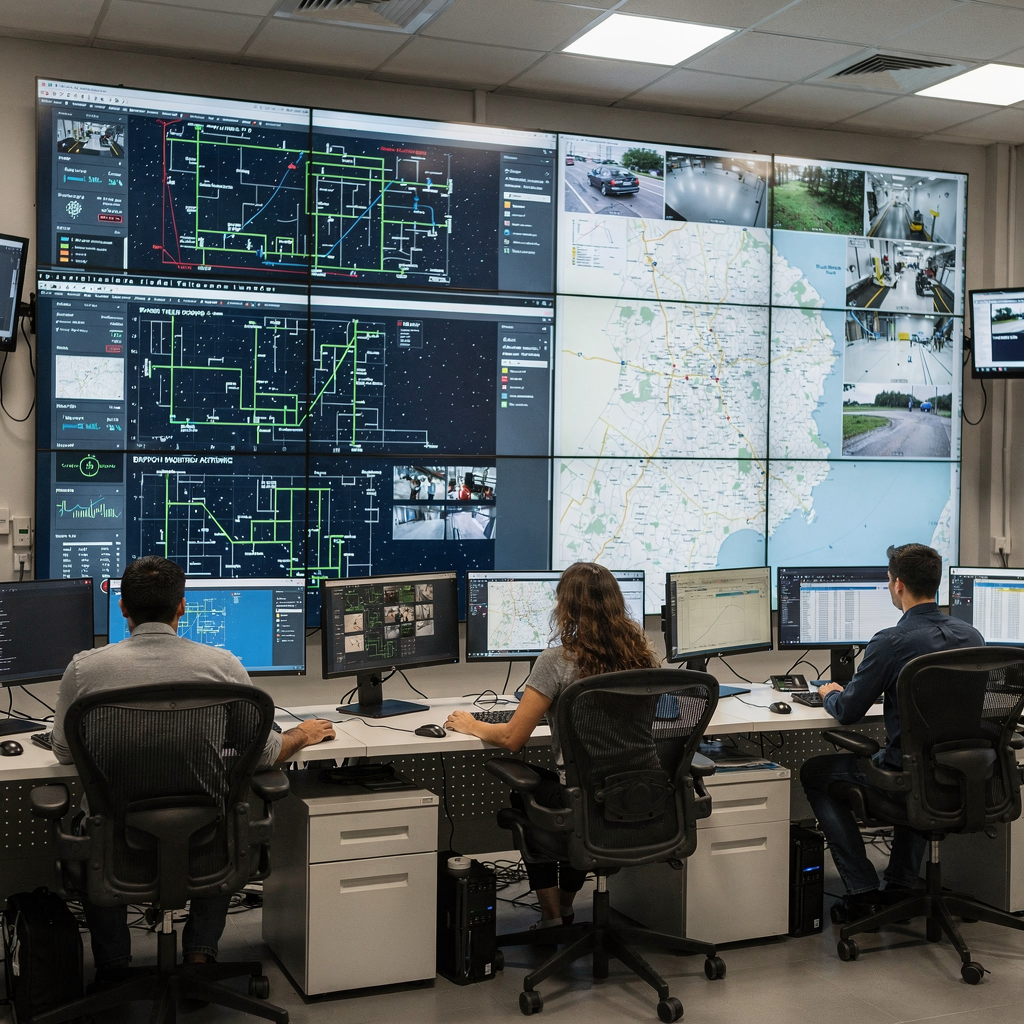
Real-time Data Strategies to integrate and enhance Operational Visibility
Real-time integration is central to strong situational awareness. To create a unified operational view, teams ingest IoT feeds, weather forecasts and consumption metrics into a single pane. Data pipelines normalize sensor formats, and they enrich events with context such as asset name, location and historical behaviour. When this occurs, dashboards show coherent trends, and teams can spot anomalies faster.
Cloud platforms and edge processing both play roles. Cloud systems scale storage and analytics, and edge nodes reduce latency for urgent control loops. A hybrid approach lets organizations keep sensitive video and metadata on-prem, while running non-sensitive analytics in elastic environments. This balance supports compliance and lowers data egress costs. In practice, real-time dashboards update every few seconds and present prioritized alerts, so teams respond with clarity.
A UK grid operator reported a 30% reduction in response time after streaming live telemetry and camera feeds into its control room. That operator combined feeder‑level current data, weather models and video verification to focus crews where a fault was likely to escalate. The project also shortened dispatch cycles and improved crew safety by verifying conditions before arrival.
Tools that integrate video as an operational datasource add another layer of insight. For example, visionplatform.ai converts camera detections into descriptive text and links those descriptions to alarms and procedures. This approach lets teams search footage with natural language and confirm incidents without switching systems. As a result, situational awareness improves, and teams gain actionable insights faster, which helps them optimize field responses and reduce mean time to repair.
AI vision within minutes?
With our no-code platform you can just focus on your data, we’ll do the rest
Leveraging predictive Analytics to optimize Grid Performance
Predictive analytics transforms maintenance and load planning. AI‑driven models learn normal behaviour from sensor streams, and they flag deviations that suggest imminent failures. Using these models, utilities can predict asset issues and schedule repairs before outages occur. The result is fewer emergency interventions and lower lifecycle costs for equipment.
Demand forecasting models combine historical consumption, weather and calendar effects to forecast short‑term load. These forecasts feed control strategies that shift flexible demand or dispatch storage. Predictive maintenance models can reach high accuracy in identifying faulty components; some studies show machine learning models achieving up to 85% accuracy in predicting asset failures. When predictive insights are trusted, operations shift from reactive to proactive.
One example of optimization is predictive load balancing that reduced overload incidents by 25%. That project used feeder analytics to reroute power preemptively during forecasted peaks, and it automated alerts for manual confirmation. In addition, AI agents can propose demand response actions such as short‑term curtailment or storage dispatch to stabilize the grid. This autonomous layer works best when human teams retain oversight and rules define safe automation boundaries.
The use of artificial intelligence in these contexts must be transparent. Operators expect explainable outputs and verifiable recommendations. To that end, visionplatform.ai exposes video reasoning alongside telemetry so teams can see why an alert was raised and what the agent used as evidence. This approach improves trust, enables faster decision‑making and helps utilities optimize asset health and overall network performance.
Expanding system capability in the control room of the future
Advanced human–machine interfaces will extend operator reach. Augmented reality overlays, interactive panels and voice‑driven search let teams consume dense information without losing focus. For instance, AR can highlight a feeder on a substation map while showing live video of a switch cabinet, and this visual fusion shortens verification steps. These interfaces make it easier to escalate incidents and to coordinate multi‑site responses.
Collaboration tools are equally important. Cross‑discipline chat, threaded incident notes and remote expert links allow specialists to join an incident instantly. Remote visual verification reduces travel and speeds field triage. Teams also benefit from AI agents that suggest recommended actions, pre‑fill incident reports and trigger workflows under controlled permissions. These agents act as persistent aides that reason across video, telemetry and procedures.
The expansion of capability depends on a single enterprise platform that federates inputs. That platform must support VMS integrations and structured event streams, and it should keep sensitive video on-prem when regulations require it. visionplatform.ai provides an on‑prem Vision Language Model and AI agents that convert detections into searchable descriptions. This capability helps control room operators find relevant footage, verify alarms and follow evidence‑based procedures without wasting time.
Benefits are clear: faster decision loops, clearer insights and higher operator confidence. As systems advance, operator training evolves too. Teams learn to trust recommendations while retaining final authority for complex incidents. The result is a more capable, flexible environment that scales with the grid and with evolving energy sources like solar and battery storage.
AI vision within minutes?
With our no-code platform you can just focus on your data, we’ll do the rest
Managing complexity in rooms of the future
Complexity increases as multi‑vendor systems join a shared control plane. To manage that complexity, teams adopt open standards, APIs and modular integration patterns. Data interoperability ensures that meters, relays, cameras and SCADA nodes speak a common schema, and that makes cross‑system correlation feasible. Integration reduces friction, and it shortens the time needed to assemble context for a decision.
Cybersecurity and threat hardening remain top priorities. Defense in depth, network segmentation and strict access controls protect sensitive video and control channels. Regular red teaming and compliance reviews help teams meet regulatory standards and reduce exposure to attacks. In parallel, secure on‑prem processing reduces the need to move large video archives offsite, and this supports privacy and governance goals.
Upskilling the workforce is part of effective adaptation. Training focuses on reading model outputs, validating AI recommendations and managing edge systems. Simulation drills combine simulated faults and realistic video to prepare staff for high‑stress incidents. These programs increase operator effectiveness and reduce cognitive load during real events.
To illustrate, visionplatform.ai addresses common pain points by turning camera detections into explanations and by exposing VMS data to AI agents. This reduces alarm noise and helps operators verify incidents quickly. The approach supports integration with other tools such as process anomaly detection systems and intrusion detection, enabling a richer operational picture without adding screens or manual steps. Ultimately, a clear framework for vendor integration and continuous training helps teams tame complexity and keep the infrastructure resilient.
AI-driven Tactics to Reduce outage and Strengthen Resilience
AI enables automated fault detection and self‑healing protocols that stop small issues from growing. Machine learning can flag abnormal patterns in feeder currents, and it can trigger rapid isolation routines that contain faults. These automated tactics reduce the service impact of failures and they help field crews focus on confirmed incidents rather than chasing false positives.
Rapid isolation techniques can reconfigure distribution topology to route around trouble spots. When combined with fast verification from camera analytics, teams can confirm hazardous conditions remotely and avoid sending crews into unsafe situations. This mix of automation and human oversight increases reliability and resilience for the network.
Quantitatively, projects that use automated detection, verified by video context and predictive scheduling, report significant gains. For example, average outage duration has fallen in pilot programmes by about 40%, and overall network reliability improved as predictive maintenance and faster isolation reduced repeat faults. These gains translate into fewer customer interruptions, lower restoration costs and less wear on equipment.
To get there, utilities adopt a clear integration framework and define the level of autonomy for each workflow. For low‑risk, repeatable events, agents can automate actions; for complex incidents, the system recommends steps and documents the rationale for human review. visionplatform.ai’s VP Agent Actions and VP Agent Reasoning exemplify this approach by offering guided workflows and explainable verifications that allow partial automation while preserving audit trails and operator control.
Ultimately, combining predictive analytics, explainable video reasoning and secure on‑prem AI helps utilities automate routine responses, improve foresight and deliver actionable insights. This makes the control room more robust, efficient and better prepared for future challenges across evolving energy sources and distributed assets.
FAQ
What is a control room of the future?
A control room of the future is a data‑centric operations centre that combines AI, real‑time feeds and human‑centred interfaces to improve decision‑making and reliability. It emphasizes explainable automation, integrated video context and tools that help teams verify and act faster.
How does real‑time monitoring improve grid operations?
Real‑time monitoring delivers current telemetry and video context so teams can detect anomalies quickly and prioritize responses. This reduces dispatch time and supports more accurate load management during peaks.
Can AI predict equipment failures accurately?
Yes. Machine learning models trained on historical sensor data and contextual inputs can reach high accuracy for specific failure modes, with some studies reporting up to 85% prediction rates. Proper validation and explainability are essential for operational trust.
How do video analytics fit into control room workflows?
Video analytics turn cameras into operational sensors that verify alarms, document incidents and provide searchable context. Solutions like visionplatform.ai convert detections into human‑readable descriptions and tie them to incident procedures and VMS records.
What cybersecurity measures protect modern control rooms?
Best practices include network segmentation, strict access controls, encryption and regular vulnerability testing. On‑prem processing of sensitive video reduces exposure and helps meet regulatory requirements.
How can operators trust AI recommendations?
Trust comes from transparent models, explainable outputs and human‑in‑the‑loop controls. Systems must show the evidence behind a recommendation and provide audit trails so operators can validate and learn from AI behaviour.
What training is required for control room operators?
Training covers interpreting model outputs, using search and verification tools, and following automated workflows. Simulation drills that pair telemetry with video scenarios help operators build confidence and reduce cognitive load.
How do predictive and preventive tactics reduce outages?
Predictive analytics identify weak points before failure, while automated isolation and verified actions contain faults quickly. Together these tactics lower outage duration and improve service reliability.
Are on‑prem AI solutions necessary for compliance?
On‑prem AI helps organisations retain control over video and sensitive data, which simplifies compliance with privacy and AI regulations. It also reduces cloud egress costs and supports secure integrations with existing VMS systems.
Where can I learn more about integrating video into operations?
Explore practical examples of forensic search, intrusion detection and process anomaly detection to see how video becomes operationally useful. For further reading, visit resources on forensic search in airports, intrusion detection in airports and process anomaly detection in airports to see applied cases and integration patterns.