ai
AI now drives better uptime and smarter operations in meat processing. In slaughter contexts, AI combines machine learning, IoT sensors, and data analytics to turn cameras and sensors into actionable tools. The core goal is clear: detect idle machinery and bottlenecks in real time, then respond so flow keeps moving. AI models watch cycles, count items, and predict stoppages so teams can act fast. Using artificial intelligence improves visibility, and it supports traceability and compliance with food safety rules.
AI uses structured data from sensors and unstructured data from video. It fuses vibration, temperature, and imaging feeds so a model knows when a conveyor slows. Edge AI can flag an unexpected pause in seconds. Then operations staff get an alert that links to the camera clip. This fast loop reduces mean time to repair, and it helps maintain product quality.
Predictive analytics play a vital role. Predictive models learn patterns of normal flow. They spot drift or slowdowns before a line stops. A study in a related poultry context showed very high real-time accuracy: a model achieved a 94% mAP at 39 fps (Development and Implementation of an IoT-Enabled Smart Poultry Processing System). That shows the potential for AI to detect states that precede idle equipment.
AI also supports decision-making beyond alerts. It ranks faults by likely impact. It suggests which machine to adjust first. It helps teams prioritize. In practice, AI reduces downtime and increases throughput. For example, industrial AI has been shown to cut idle time by 20–30% in similar production settings (Artificial Intelligence Technology in the Agricultural Sector). These savings translate to faster lines and lower operating cost.
Finally, practical deployments require careful integration. Edge compute, secure VMS links, and APIs let AI feed plant dashboards. Visionplatform.ai turns existing CCTV into operational sensors. That approach lets processors keep data on-premise, meet GDPR and EU AI Act concerns, and stream events into operations systems for real-time KPIs.
inspection
Traditional inspection relies heavily on human oversight and manual checks. Operators watch the line, sample pieces, and listen for abnormal sounds. They also inspect equipment for jams and misfeeds. Human teams supply situational awareness that sensors sometimes miss. However, manual inspection methods have limits. People tire, reaction times vary, and subjective judgements introduce inconsistency. That variability can allow small slowdowns to grow into long stoppages.
Inspection practices must meet strict food safety standards. Rules require traceability and documented corrective actions. An AI-enabled monitoring system can support those obligations. For example, linking a camera event to an audit trail maintains clear records. Such records speed regulatory reviews and support quality assurance.
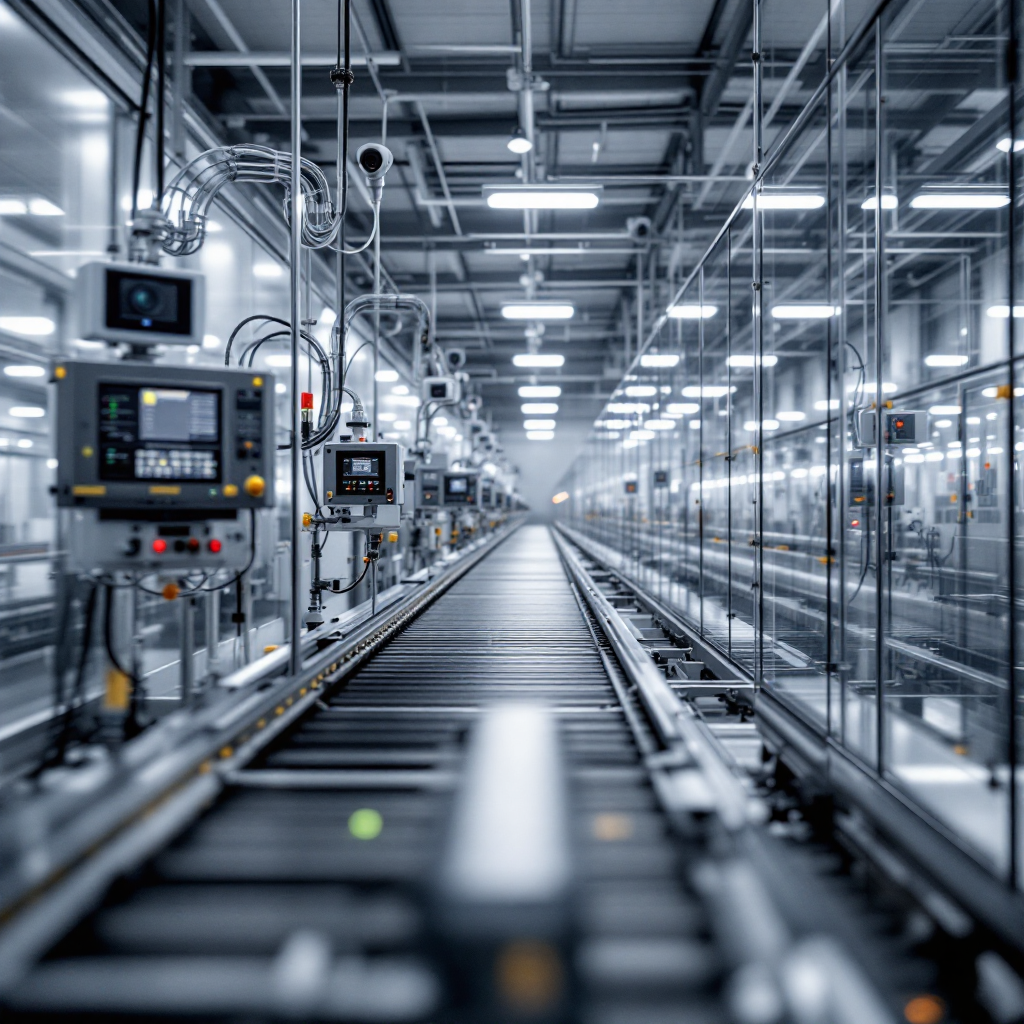
Inspection also needs speed. A monitoring system that processes imagery at tens of frames per second reduces the delay between a stoppage and a fix. In poultry operations, real-time imaging helped teams reduce manual checks while increasing detection rates (smart poultry processing study). This example proves that combine video and sensor data can accelerate corrective work without compromising food safety.
Yet, integration challenges remain. Sites often run heterogeneous equipment. Adding new sensors to old machines can be costly. Data quality varies across devices. To manage this, many plants start by instrumenting critical choke points. They then expand coverage iteratively. This staged approach yields immediate wins and reduces the risk of failed rollouts. It also lets teams refine alarm thresholds so they avoid false positives that erode trust in automated inspection.
AI vision within minutes?
With our no-code platform you can just focus on your data, we’ll do the rest
precision
Precision matters when measuring AI performance. Key metrics include mean average precision (mAP), frames per second (fps), and the percent reduction in downtime. High mAP shows that a model correctly identifies states. High fps ensures the system watches motion without skipping events. Together, these metrics shape how useful a system becomes on a noisy floor.
Reported benefits are strong in related fields. One study recorded a 94% mAP at 39 fps, demonstrating reliable, near-real-time detection for poultry stunning and handling (IoT-enabled smart poultry study). Industrial reports indicate AI can lower idle time by 20–30% and lift efficiency by 15–40% in comparable operations (systematic review) and (FTSG 2025 tech trends). Those ranges depend on baseline performance and the depth of integration.
Precision also depends on data quality. Noisy sensors degrade model accuracy. Inconsistent frame rates or poor lighting produce false alarms. Therefore, plants must invest in robust lighting, stable mounting for cameras, and consistent sampling from IoT sensors. This investment reduces false positives and ensures that alerts reflect real issues.
Integration across equipment types is critical. When AI receives synchronized signals from PLCs, cameras, and vibration monitors, models gain more context. That context leads to fewer missed events and better root-cause analysis. Companies that adopt a disciplined data quality program see much faster model convergence. They also enjoy better OEE dashboards and clearer ROI.
production line
A typical poultry production line follows several stages: stunning, scalding, evisceration, chilling, and packaging. Each stage has unique timing and mechanical behavior. Stalls often happen at transfer points, where flow must shift between machines. Other common bottleneck causes include misalignment, motor faults, and manual rework.
Idle equipment at one stage causes cascading delays downstream. If stunning slows, subsequent scalding and evisceration slow too. That domino effect reduces throughput and increases labor costs. It also raises the risk of quality compromise if products linger at intermediate temperatures. Maintaining a continuous flow protects product quality and food safety.
AI helps by monitoring both product and equipment movement along the production line. Computer vision counts items moving between stages. It measures gaps and identifies slowdowns in seconds. When a bottleneck appears, the system can flag the exact location and likely cause. In some deployments, AI detects foreign material and sizing anomalies that require human intervention. That capability supports quality control and quality assurance goals across the line.
Smart lines also use prognostics and system health management to reduce unplanned downtime. Predictive models assess component wear and predict when a motor may fail. That allows maintenance teams to plan interventions during scheduled windows. As a result, managers avoid disruptive surprises.
For teams new to AI, start small. Monitor a single conveyor or transfer point first. Then scale. Use evidence from a pilot to adjust alarms and integrate with operations tools. To learn more about anomaly detection patterns, see related resources on process anomaly detection in operations process anomaly detection. That article explains how event streams can feed dashboards and alerts across systems.
AI vision within minutes?
With our no-code platform you can just focus on your data, we’ll do the rest
vision system
A reliable vision system combines hardware and software choices. Key hardware includes industrial cameras, depth sensors, and consistent lighting. Choose cameras with appropriate frame rates and global shutters when motion blur is a concern. Depth sensors add 3D context and help when overlapping objects confuse a 2D view.
Lighting matters a great deal. Stable, diffused illumination reduces specular highlights. That stability helps models maintain consistent detections. In many plants, teams add enclosures or shields to control reflections. They also standardize camera mounts so scenes do not drift over time.
Computer vision techniques used on slaughter and poultry lines include object detection, flow analysis, and anomaly detection. Object detection locates machinery states, moving parts, and product packs. Flow analysis measures throughput. Anomaly detection flags unusual patterns such as prolonged queueing at a station. Combining these techniques yields robust situational awareness.
Deployments may target sub-second latency for critical stops. Edge inference running on a Jetson or GPU server minimizes round-trip time. Cloud processing suits historical analytics and heavy model training. Often, a hybrid model works best: infer at the edge and aggregate metadata to central systems for analytics. Visionplatform.ai follows this pattern. The platform uses existing CCTV to stream events to operations stacks while keeping data on-premise where required. This approach supports GDPR and EU AI Act readiness and preserves control.
For additional context on crowd and density analytics that translate to flow metrics, explore people-counting and crowd tools. These tools share principles with conveyor flow monitoring people counting. They show how camera-derived counts become reliable KPIs when integrated with operations dashboards.
ai vision system
Integration architecture determines latency, privacy, and scale. Edge AI brings inference close to the camera for low latency. Cloud systems simplify model updates and centralized training. A balanced design uses edge inference for real-time alarms and cloud or on-prem servers for model training and batch analytics. This design reduces data movement while keeping flexibility.
Training and adaptation are continuous tasks. Models must learn with on-site footage so they match specific lighting and equipment. Visionplatform.ai supports flexible model strategies: pick a model from a library, improve it on your data, or build a new model. All three paths keep training data local. That lets teams automate retraining while retaining control.
Continuous learning on the line solves drift. When line speed changes or a new fixture is installed, the model must adapt. A human-in-the-loop workflow helps. Operators label edge clips, and the system ingests those labels for scheduled retraining. This loop keeps detection accuracy high and false alerts low.
Several challenges persist. Data quality and synchronization across sensors require careful planning. Scalability can stress networks and storage. Models must resist environmental changes and handle occlusions. Research points to promising directions, including cognitive assistants that help operators interpret AI hints and make better decisions (factory operators’ perspectives on cognitive assistants).
Practically, many sites succeed by coupling AI vision inspection technologies with existing VMS and MQTT streams. That pattern lets cameras act as sensors. It also makes events usable in SCADA and BI systems. To explore event-based integrations, see how event streams can be used to power operations and dashboards on Visionplatform.ai process anomaly detection and to bridge security and operations via structured events forensic search.
Finally, the industry is moving toward smarter, humane slaughtering and intelligent management of poultry flows. When systems work well, they both enhance efficiency in meat processing and support quality assurance and food safety across the farm to slaughter lifecycle (FTSG trends report).
FAQ
What is AI detection of idle equipment?
AI detection of idle equipment uses models and sensors to spot machines that stop or slow down. It pairs video, vibration, and temperature data to create alerts and reduce downtime.
How does AI improve inspection compared to manual inspection?
AI runs continuously and does not tire, so it can spot transient events that humans might miss. It also records evidence for traceability, improving both speed and consistency.
Can AI help with food safety compliance?
Yes. AI creates audit trails and timestamps which support traceability and quality assurance. It also monitors process conditions that affect food safety.
What performance metrics should I track for a vision system?
Key metrics include mean average precision (mAP), frames per second (fps), false positive rate, and percent reduction in downtime. These numbers show both detection quality and operational impact.
How does edge versus cloud processing affect latency?
Edge processing gives low-latency alarms and keeps sensitive video local. Cloud processing helps with heavy training and centralized analytics. Many sites use a hybrid approach.
How much can AI reduce downtime in slaughter lines?
Studies in related domains report downtime reductions around 20–30% and efficiency gains of 15–40% after AI adoption (systematic review). Results vary by site and implementation depth.
What sensors complement cameras for better detection?
Vibration sensors, temperature probes, and PLC signals give context that video alone cannot. Depth sensors and consistent lighting also improve robustness in busy production lines.
How do operators keep AI models accurate over time?
They set up human-in-the-loop feedback and scheduled retraining using on-site footage. This process handles drift from new equipment or changed line speeds.
Is it possible to use existing CCTV for AI detection?
Yes. Platforms like Visionplatform.ai convert CCTV into a sensor network, enabling real-time detections while keeping data on-premise. That approach helps reuse cameras and accelerates deployment.
Where can I learn more about integrating event streams into operations?
Explore resources on event-driven integrations and process anomaly detection to see how camera events can power dashboards and SCADA systems process anomaly detection. For camera-based counts and flow metrics, see people counting concepts that translate well to conveyor monitoring people counting. For audit and search capabilities, review forensic search approaches forensic search.