AI Systems and Artificial Intelligence drive innovation in poultry processing
AI Systems and Artificial Intelligence bring new capabilities to poultry processing plants. First, they turn camera streams into actionable events. Then, they flag missing PPE and unsafe behaviours at pace. In this context, computer vision performs object detection and tracks people on the production line. For example, the yolo-v4 model for poultry slaughtering has been used to recognise worker actions and to support humane handling [development and implementation].
AI differs from legacy monitoring because it can process continuous video and learn from site-specific footage. Traditional audits rely on spot checks. By contrast, automated vision logs every event and lets supervisors study trends. This reduces human error, increases repeatability, and helps management act earlier. Visionplatform.ai turns existing CCTV into an operational sensor network that detects people, PPE and custom objects in real time, so teams can integrate detections with VMS and business systems.
Learning models such as deep learning models and neural network approaches power modern detection. They map pixels to classes like glove, mask, and apron. A model trained on site footage adapts to lighting, worker uniforms, and camera angles. Also, training with a representative dataset improves detection accuracy and lowers false positives. The system for red-feathered taiwan chickens and similar projects show how a tailored model for poultry slaughtering recognition in transient scenes can perform on real lines [yolo-v4 model and image].
Compared with manual inspection, AI operates continuously. In tests, AI-assisted detection raised compliance by about 25% versus manual inspection alone [AI compliance monitoring for animal stunning/bleeding zones]. That 25% jump matters. It reduces workplace injuries and supports animal welfare and food safety during slaughter steps. Practical AI deployments tend to use edge processing to keep data private and enable low-latency alerts.
AI-driven automation ensures compliance and monitoring in slaughterhouses
AI-driven automation workflows start with cameras and end with alerts. First, cameras capture video. Next, on-edge inference classifies PPE and worker posture. Then, the system publishes detections to a dashboard and to operations teams. Visionplatform.ai streams events via mqtt so alarms become operational metrics rather than isolated security alerts. Also, this approach helps teams automate corrective actions and reduce repeat violations [AI-assisted detection improves compliance rates].
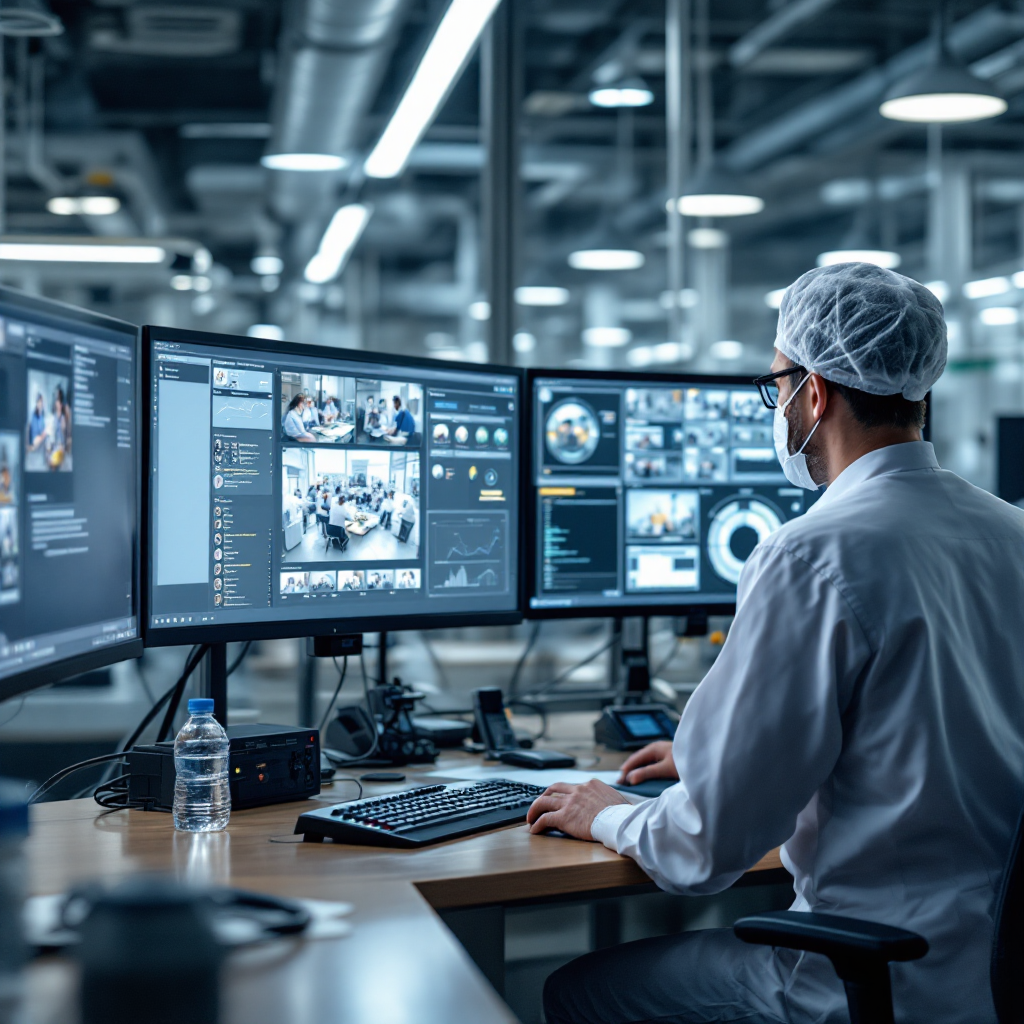
Workflows can integrate with access control and training systems. For instance, when a worker is logged without gloves, a supervisor receives a live alert and a time-stamped video clip. Then, operators can pause the line or coach the worker. The system tracks compliance over time and produces reports that show trends, root causes, and corrective training needs. Consequently, leaders measure compliance, correlate incidents to shifts, and allocate resources more effectively.
To capture compliance metrics, teams define rules and thresholds. The platform logs each event to an auditable store. That creates a reliable record for audits and regulatory checks. Also, the dashboard displays KPIs like percentage of tasks performed with correct PPE and average time to intervene. This single view of quality and safety helps inspectors spot recurring issues and track improvements. For data privacy and governance, on-prem edge processing keeps video in the plant and supports GDPR and the EU AI Act guidelines [gdpr and eu ai act].
AI vision within minutes?
With our no-code platform you can just focus on your data, we’ll do the rest
Real-time classification improves PPE detection and carcass inspection
Real-time classification distinguishes gloves, masks and protective clothing with high speed. Classification models assign labels to detected regions and then check placement and integrity. For small object detection such as glove fingertips or thin straps, tuned models and higher-resolution cameras help. The vision system uses both bounding boxes and mask segmentation to confirm coverage of critical zones.
Carcass inspection also benefits from AI. Systems inspect each carcass for defects, contamination, or foreign objects. They compare live images with a clean reference and flag abnormal patterns. This reduces missed defects and speeds downstream sorting. Combining video and sensor data increases confidence, because sensors can verify temperature, weight, and flow rate while cameras show visual defects. In trials, YOLO-based pipelines achieved strong detection accuracy on transient scenes, including distinguishing stunned and unstunned chickens using the yolo-v4 approach [unstunned chickens using the yolo-v4].
Precision and recall matter. Teams measure detection accuracy and tune thresholds to balance false positives and false negatives. For example, raising sensitivity reduces missed hazards but can increase alerts. Therefore, implementers run A/B tests and use feedback loops to refine the model. Also, a human-in-the-loop step helps during deployment so that operators can confirm or dismiss edge detections and improve the dataset. That iterative approach reduces unnecessary stoppages while maintaining food safety and throughput.
Furthermore, combining classification with a simple rule engine lets systems check compliance per slaughtering steps. For instance, if a processor enters a restricted zone without required PPE, the system logs the event, alerts supervisors, and timestamps the video clip for training. This integration of real-time classification with operational response shortens reaction times and improves traceability across the production line.
Integrating AI enhances food safety and supply chain traceability
AI helps detect hazards that threaten food safety. For instance, visual detection can spot visible contamination and foreign objects on meat products. Combined with laboratory data, these detections create a risk profile for batches. Also, AI-driven alerts trigger targeted sampling, which lowers overall testing costs while raising detection rates. The system supports traceability by tagging events to batch IDs and timestamps, which strengthens the slaughterhouses supply chain record.
IoT and sensor networks extend visibility beyond cameras. Temperature probes, weight scales and RFID readers link to video via common timestamps. This link lets teams reconstruct events end-to-end and trace a carcass from evisceration to packing. The integration with sensor networks into closed-loop controls can pause a conveyor when a hazard is detected, protecting consumers and workers alike. In one example, iot-monitored smart agriculture systems and smart agriculture systems for real-time alerts feed quality dashboards that operations use to adjust processing rates.
To secure data and maintain privacy, many sites use edge processing and keep datasets local. That approach aligns with GDPR and emerging EU AI Act requirements. Also, platforms that let teams own models and data simplify audits. Visionplatform.ai emphasises on-prem control so customers retain their footage and training sets. In addition, visionplatform.ai streams events via mqtt to enterprise stacks, enabling structured downstream analytics and operational KPIs [visionplatform.ai streams events via mqtt].
Finally, traceability boosts recall efficiency. When a contamination incident occurs, a searchable archive and linked sensor logs allow rapid isolation of affected batches. Thus, the supply chain recovers faster and regulators receive clear records. This end-to-end visibility helps food companies meet standards and protect consumers.
AI vision within minutes?
With our no-code platform you can just focus on your data, we’ll do the rest
Implementing AI in poultry slaughterhouse advances slaughter operations
Implementing AI on a busy floor poses challenges. First, lighting changes and wet floors create reflections that confuse models. Second, anonymous workers and moving machinery complicate tracking. Third, integration with legacy VMS and PLCs can take time. Nevertheless, careful site surveys, edge processing and staged rollouts reduce disruption.
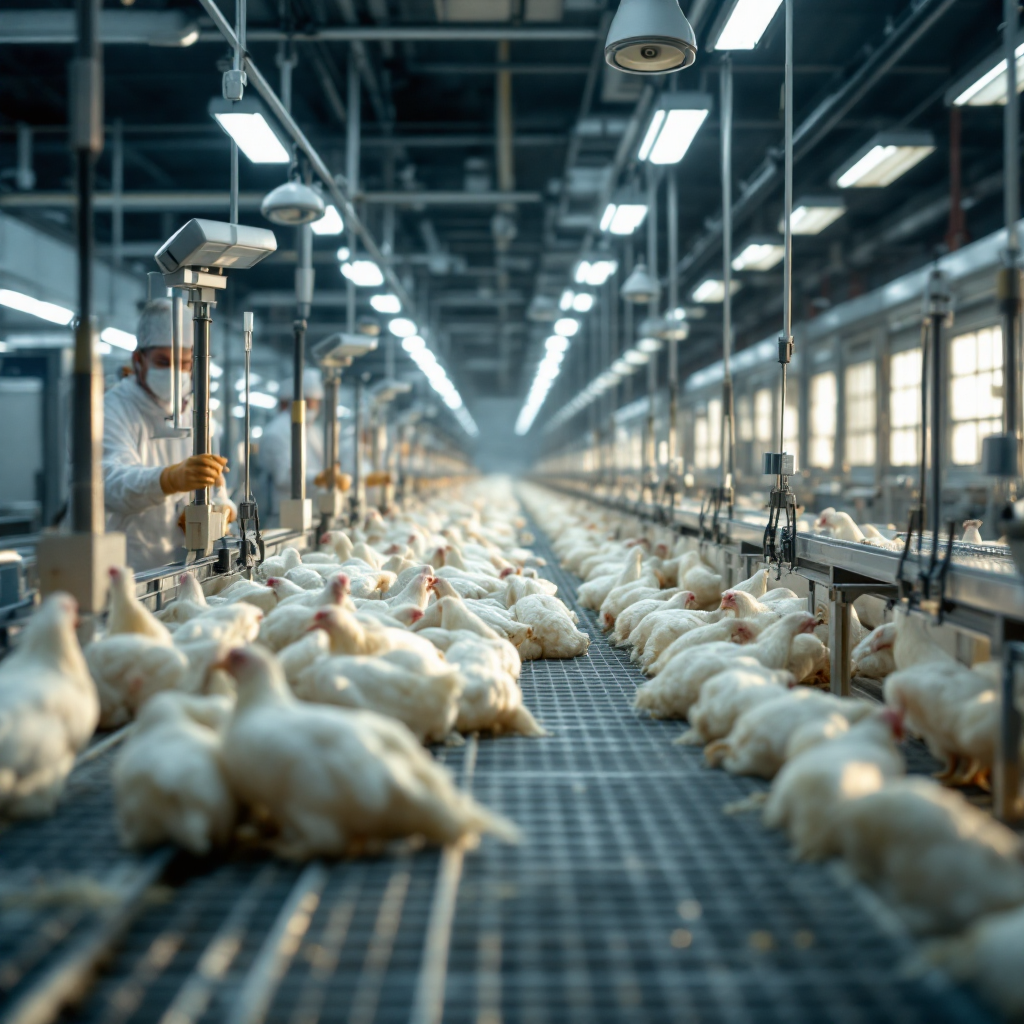
Use cases include poultry handling audits, automated evisceration monitoring, and welfare checks. An ai-driven humane poultry slaughtering system can track indicators such as motion patterns and vocal distress proxies, and help identify welfare issues early. Also, automated evisceration monitoring improves yield by detecting missed steps or equipment jams. For red-feathered operations, a system for red-feathered taiwan chickens was developed to monitor specific slaughtering steps and environment conditions.
Operational impacts are measurable. Implementations often report improved throughput and fewer stoppages after tuning models and rules. For example, reducing human error in PPE checks frees safety officers to focus on training. Also, realtime monitoring and smart management of alerts reduce downtime because the team receives only validated, high-confidence events. Edge devices and GPU servers run ai models with low latency, which keeps the production line moving.
Workers and management benefit. Safety improves because violations get noticed and corrected quickly. Production improves because quality checks happen continuously rather than intermittently. In the longer term, ai adoption can reduce insurance costs and raise regulatory confidence. To succeed, companies should plan for change management, staff training, and continuous model improvement via labelled feedback from operators.
Future directions for AI Systems in poultry processing and safety management
Research continues into small object detection and 3D object detection to enhance carcass and PPE recognition. New work pairs point-level fusion of lidar and camera feeds to create robust models in difficult lighting. Also, more projects focus on enabling accurate distinction between stunned and unstunned birds, which supports both animal welfare and food safety [Hyperspectral and detection research].
Regulatory trends matter. The EU AI Act and GDPR influence how processors deploy models and store footage. Organisations must prepare for audits and document model performance, data lineage and human oversight. For compliance, make model governance a core activity. Also, align with existing food safety standards and show evidence of detection accuracy and intervention workflows.
For scaling, follow these steps: start with a pilot on a single production line, then expand to other lines once the model performance stabilises. Train staff to label edge cases, and schedule periodic retraining to keep a model current with new uniforms, lighting or slaughtering methods. Use a modular platform that can integrate with your VMS and publish events to dashboards and enterprise systems. Visionplatform.ai supports flexible model strategies so teams can pick, retrain or build models locally while keeping data on-premise.
Emerging capabilities include edge federated learning, which improves models across sites without moving raw video, and smarter closed-loop controls that pause conveyors on high-confidence detections. Such advances will raise detection accuracy and operational resilience. As practical AI matures, processors will see measurable gains in worker safety, animal welfare and food safety.
FAQ
What is AI PPE detection and how does it work?
AI PPE detection uses computer vision and learning models to find protective equipment on workers in camera feeds. It labels items like gloves and masks, then sends alerts when something is missing or worn incorrectly.
How much can AI improve PPE compliance?
Studies show AI-assisted detection can improve compliance by around 25% compared to manual inspection alone [AI compliance monitoring]. That increase helps reduce injuries and supports regulatory reporting.
Can AI help with carcass inspection?
Yes. AI inspects visual defects and flags potential contamination on carcass surfaces, which speeds sorting and reduces recall risks. It also combines with sensors for better confidence in decisions.
How does integration with existing systems work?
Platforms typically connect to VMS and publish structured events to dashboards and enterprise stacks via MQTT or webhooks. Visionplatform.ai, for instance, integrates with leading VMS and streams events for operational use.
Is data privacy a concern with video analytics?
Privacy matters, and on-prem edge processing minimizes data transfer and supports GDPR and the EU AI Act requirements. Keeping datasets local also simplifies audits and governance.
What are common implementation challenges?
Challenges include harsh lighting, reflections, and integration with legacy equipment. Pilots, careful camera placement, and continuous retraining help overcome these issues.
Do these systems reduce human error?
Yes. Automated monitoring reduces reliance on intermittent manual checks, which lowers human error and improves consistency across shifts.
Can AI detect contamination?
AI can detect visible contamination and anomalies on meat products, but it complements rather than replaces lab testing. Together, visual alerts guide targeted sampling and faster responses.
How do we measure model performance?
Measure precision, recall and overall detection accuracy, and monitor false positive and false negative rates. Use human-in-the-loop feedback during deployment to refine thresholds and improve results.
Where can I learn more about PPE detection and related solutions?
Start with case studies and integration guides from solution providers. You can also review academic research on YOLO-based systems and industry reports on AI compliance monitoring [YOLO study].