Transform Perimeter Security with AI-Powered Surveillance for Zone Access Control
Clean zones are tightly controlled spaces used in pharmaceuticals, semiconductor fabs, and specialized healthcare areas where contamination and unauthorized presence create high risk. First, strict perimeter control is vital to protect processes, products, and people. Second, physical security and controlled access reduce the chance that a single mistake causes product loss or safety violations. For example, a single lapse in gowning or an unauthorized entry into a restricted zone can halt production and trigger costly remediation. Therefore, modern operations now explore how AI is transforming perimeter protection and operational safety.
AI-powered surveillance cameras now continuously monitor boundaries and doorways. They provide real-time alerts when someone crosses an access zone without credentials. In addition, AI systems can correlate badge events with video to detect unauthorized entry or when badges are shared. This reduces dependence on manual reviews and streamlines incident response. A study found that AI systems can cut breach incidents by up to 60% compared with manual methods (source). As a result, security teams see fewer false leads and faster, more focused responses.
Integration matters. AI video analytics now link with badge readers, biometric scanners, and access control system logs so that one event shows the whole story. For example, when a badge failure coincides with an uncredentialed person detected by surveillance, an automated alert routes to the right responder. Visionplatform.ai turns existing CCTV into an operational sensor network and can publish events to business systems for broader operational use. Indeed, this helps convert camera feeds into structured analytics and operational workflows, beyond simple alarms.
Also, edge deploy options preserve privacy and help with compliance demands, because processing can happen on-prem rather than in a distant cloud. In short, AI-powered surveillance paired with existing access control hardware reduces risk, improves situational awareness, and helps organizations meet higher standards for restricted zone management.
Artificial Intelligence in AI Security Systems: Enhancing Zone Access Detection
Computer vision models are the mainstay of modern AI security. For instance, YOLOv8 and similar architectures perform fast object and person detection with strong performance on specific tasks. In related work, YOLO variants achieved a Mean Average Precision (mAP50) of roughly 49.5% for cellphone detection tasks, a useful benchmark when adapting models to detect prohibited items in sensitive areas (source). Thus, these models provide a technical base to detect people, PPE, tools, and other objects that signal unauthorized presence or safety lapses.
Machine learning classifiers go further by analyzing patterns. They classify behavior, sequence frames, and flag anomalous dwell times or movement into access zones. Consequently, the system that detects unauthorized actions can trigger an immediate alert and record an evidence clip. AI-driven behavioral analysis helps detect unauthorized actions before an incident becomes a full breach. Additionally, continuous training pipelines let models adapt to site-specific conditions. For example, retraining on your own footage reduces false positives and tailors alerts to what matters on your site.
Response metrics improve measurably. Organizations report average reaction times improve by about 35% after adding AI analytics, because automated detections surface incidents earlier (source). Also, AI can operate in real-time and at the edge, so detection and local escalation occur with very little delay. Finally, combining object detection with access logs and environmental sensors increases detection confidence, which reduces false alarms and speeds valid responses.
To support regulated sites, artificial intelligence solutions must be auditable and explainable. Therefore, model choice, retraining cadence, and governance are key. A balanced deployment uses both on-device inference and ai analytics in secure environments to ensure models improve without exposing sensitive data.

AI vision within minutes?
With our no-code platform you can just focus on your data, we’ll do the rest
AI System and Security Technology Integration for Clean Zone Access Control
An effective AI system for clean zones blends cameras, sensors, edge processors, and cloud analytics into a layered security architecture. Cameras capture visual data. Sensor arrays capture door state, airlock pressure and HVAC status. Edge AI devices run inference close to the source. Cloud analytics aggregate long-term trends and provide centralized dashboards. This composition supports both local automated actions and enterprise-level oversight.
Hardware and software layers must work together. Hardware includes camera systems, access control panels, and edge ai appliances. Software includes model runtimes, event routers, and integration adapters for VMS and SCADA. Network architecture secures event streams and prioritizes low-latency channels so that critical events move without delay. For example, Visionplatform.ai integrates with leading VMS solutions and streams events via MQTT so operations and OT systems can use camera data beyond alarms.
Data flow is straightforward and interoperable. Video and sensor inputs feed an edge processor where AI detects a person or an object. The edge then forwards structured events to a central VMS and to SCADA or BMS for operational correlation. As a result, incident context appears in both security consoles and operational dashboards. This reduces duplicate work and helps security teams and operators act together when an incident occurs.
Redundancy and fail-safe mechanisms are essential. Systems should include hot failover for edge processors, mirrored storage for video, and secondary communication paths for alerts. Also, audit logs must persist to satisfy compliance requirements. With these layers in place, the solution remains available even under stress and supports rapid recovery after a hardware failure.
AI Security: Compliance and Alert Management in Sensitive Environments
Clean zones are subject to strict regulatory control. For example, ISO 14644 guides cleanroom classification. Similarly, electronic records and signatures follow principles like those in FDA’s CFR 21 Part 11 in relevant facilities. Therefore, AI deployments must produce tamper-evident logs and auditable model changes. Automated compliance reporting helps streamline audits, because AI systems can generate event timelines and evidence clips on demand.
Alert logic and escalation paths must be clear. When an unauthorized person enters a controlled access area, the alert should include video, timestamp, door state, and badge history. Role-based notifications route the alert to the right responder. In addition, automated workflows can notify quality control and process engineers when contamination risk is suspected. Consequently, incident response becomes cross-functional and faster.
Governance is crucial. Recent analyses emphasize that organizational decisions and reporting gaps often contribute to failings in AI adoption (source). Therefore, implement oversight policies that define model ownership, retraining triggers, and incident reviews. Policies should specify how and when to automate actions versus when to require human confirmation. This minimizes human error while ensuring accountability.
Privacy and data protection also matter. Studies on AI privacy risks show potential data exposure when multilingual models or cloud-only architectures are used (source). To address this, keep processing on-prem or on edge ai devices when possible. Also, use anonymisation and encryption to protect identities and maintain auditability. These practices support compliance and reduce legal risk.
AI vision within minutes?
With our no-code platform you can just focus on your data, we’ll do the rest
Use Cases of AI-Powered Security Systems for Unauthorized Access Detection
Use cases show real impacts. In pharmaceutical cleanrooms, AI can verify gowning, enforce PPE, and block unauthorized entry into aseptic zones. For example, PPE detection paired with badge verification prevents contaminated personnel from entering a sterile production line. Visionplatform.ai supports PPE detection while keeping models and data on-prem, which helps manufacturers protect product integrity and comply with industry rules. For more related features, see PPE detection examples in airport settings here.
Semiconductor fabs also benefit. These facilities protect wafer lines from contamination and require strict access protocols. AI detects unverified entry and potential safety violations near tool rooms. As a result, fabs experience fewer production interruptions and lower scrap rates. In practice, deployments in similar high-stakes environments have shown significant breach reduction and measurable cost savings. Indeed, an integrated approach that includes perimeter sensors and ai analytics reduces risk and improves uptime. For more on perimeter detections, visit this resource perimeter breach detection.
Across sectors, documented outcomes include reduced security breaches, faster incident response, and lower operational cost. One source documented up to a 60% reduction in breach incidents when AI replaced manual surveillance for specific tasks (source). Also, organizations report the advantage of AI in improving situational awareness and enabling proactive measures before a full incident occurs. For forensic review and post-incident analysis, structured video search and event tagging are invaluable. To explore related search capabilities, see forensic search examples here.
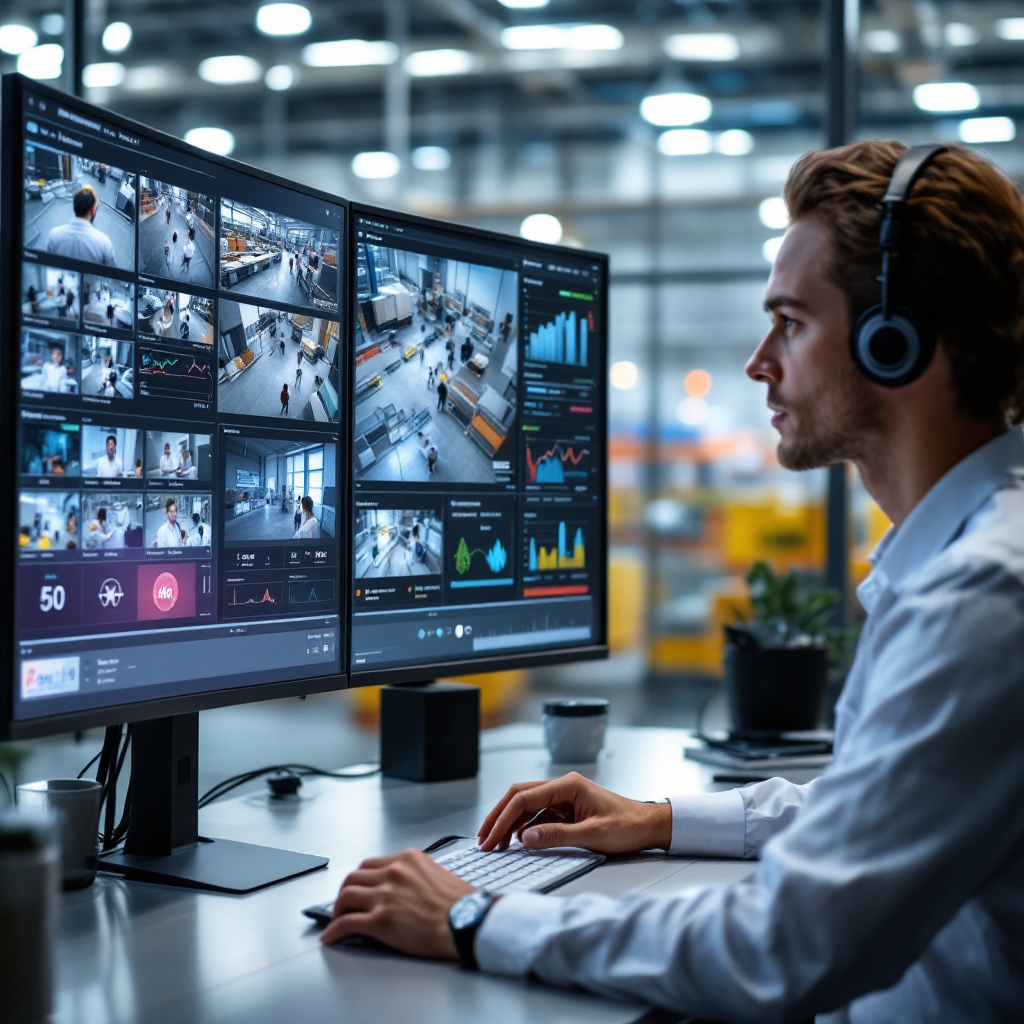
Surveillance and Using AI for Proactive Alert and Threat Detection in Clean Zones
Behavioral analysis and anomaly detection are at the heart of proactive security. AI models track movement patterns and compare them to baseline behavior. When someone lingers near a restricted equipment bay or approaches a door after hours, the system raises an alert. Then, automated logic evaluates multiple signals to reduce false alarms. For example, combining motion detection with badge logs and sensor readings lowers nuisance alerts and boosts confidence that an event is real.
Alert thresholds and tuning are practical topics. Start with conservative thresholds and then adjust based on operational feedback. Metrics like false-positive rate and time-to-action guide tuning. Also, keep a human-in-the-loop for early stages so security teams can validate detections and refine rules. In many deployments, iterative tuning cuts false alarms while keeping sensitivity high.
Privacy safeguards include encryption, data minimisation, and anonymisation. Edge ai deployments limit raw video transmission, while event logs provide structured, actionable details only when needed. This approach maintains privacy and supports compliance. A parallel consideration is the need for oversight: policies should document who can view footage and how long it is retained. These measures improve trust and lower legal exposure.
Looking forward, integrating AI with IoT sensors and operational systems will make systems even smarter. IoT data such as environmental readings can enrich AI analytics so that the system identifies not just an intruder but a contamination risk. As a result, security becomes more than loss prevention; it supports safety and efficiency across the facility. Finally, organizations that adopt these layered defenses are better positioned to prevent potential threats and maintain continuous operations.
FAQ
What is an AI-powered Unauthorized Access Detection system?
An AI-powered Unauthorized Access Detection system uses computer vision and machine learning to spot people, objects, or behaviors that violate access protocols. It combines video, sensors, and event logic to trigger alerts and support rapid response.
How does AI improve perimeter security in clean zones?
AI improves perimeter security by continuously monitoring boundaries with surveillance cameras and sensors, correlating events with badge and biometric logs, and automating alerts. This reduces manual monitoring and helps detect unauthorized entry faster.
Can AI systems help meet compliance requirements?
Yes. AI systems can generate audit trails, store tamper-evident logs, and produce compliance reports aligned with standards like ISO 14644 and regulatory expectations similar to CFR 21 Part 11. Proper configuration supports inspection readiness.
Are privacy risks a concern with AI surveillance?
Privacy risks exist, especially with cloud-only processing and wide dataset sharing. To reduce exposure, organisations should keep processing on edge devices, encrypt data, and use anonymisation where possible.
What accuracy can I expect from computer vision models like YOLOv8?
Model accuracy varies by task and dataset. Benchmarks show strong detection performance for many classes; as an example, related work reported mAP50 values around 49.5% for a specific object detection task, and site-specific retraining typically improves those numbers for operational needs (source).
How do AI alerts integrate with existing security systems?
AI alerts can integrate with VMS, access control systems, and SCADA/BMS via APIs, webhooks, or MQTT streams. This allows security teams and operations to receive actionable events and correlate them with other data sources.
What is the role of edge AI in clean zone monitoring?
Edge AI processes video on local devices, reducing latency and protecting sensitive footage from leaving the site. This supports real-time monitoring and helps with GDPR and EU AI Act readiness.
How do organisations reduce false alarms from AI?
They reduce false alarms by retraining models on site-specific footage, combining multiple sensor signals, and tuning alert thresholds iteratively with security experts. Human validation during initial deployment is also helpful.
Can AI systems detect both people and objects in clean zones?
Yes. Modern AI video analytics can detect people, vehicles, PPE, tools, and other objects, and can correlate these detections to identify safety violations or potential contamination events.
Where can I learn about operational deployments and related features?
For practical examples and related capabilities such as perimeter breach detection, PPE detection, and forensic search, explore resources that describe implementation in high-security environments, for example perimeter breach detection here and PPE detection here, or forensic search here.