AI video analytics and video management system: CVEDIA vs Visionplatform.ai overview
First, let us define a video management system and the role of AI video analytics in modern surveillance. A video management system is software that captures, stores, and presents video footage. It also coordinates alerts, metadata, and operator workflows. AI video analytics adds detection, classification, and contextual insight to those streams. Also, additionally, furthermore, next, then, therefore, thus, meanwhile, however, consequently, hence, likewise, similarly, finally, first, second, third, besides, subsequently.
CVEDIA focuses on synthetic data generation to train robust computer vision models. Their core strength is producing diverse, edge-case-rich datasets that reduce real data needs. According to industry reporting, synthetic data can reduce the need for real-world data collection by up to 90% while often improving model accuracy by 15–30% in complex scenes (65 Best Image Recognition Software for 2026). This statistic highlights why CVEDIA is often selected for autonomous inspection, robotics, and systems that face rare, dangerous, or hard-to-capture scenarios.
Conversely, Visionplatform.ai turns existing cameras and VMS systems into AI-assisted operational systems. The platform emphasizes real-world annotation workflows, model lifecycle management, and on-prem deployment. Visionplatform.ai claims to reduce annotation time by 50% through AI-assisted labeling and to improve deployment speed by 40% with streamlined workflows (8000+ Remote Companies by ContentCrew). As a result, teams working in retail analytics, healthcare imaging, and manufacturing quality control benefit from faster iteration and production-ready models.
Use cases include autonomous inspection for CVEDIA and retail or manufacturing analytics for Visionplatform.ai. Also, people counting in airports and people detection in airports are examples where Visionplatform.ai’s tools integrate with access control and Milestone XProtect. For practical links, see our pages on people counting in airports and perimeter breach detection in airports. First, choose the data approach that matches your risk profile and compliance needs. Next, factor in whether you need on-prem processing, GPU or CPU support, and how many IP camera streams you will process. Finally, consider how each vendor helps you reduce false and the operational burden on the operator.
real-time detection, alert and intelligent video analytics plugin: features compared
In real deployments, real-time detection matters. CVEDIA’s synthetic-data-trained models excel at detecting rare objects and edge scenarios. Meanwhile, Visionplatform.ai focuses on field-validated models and efficient alert verification so operators see fewer raw alarms and more explained situations. Also, additionally, furthermore, next, then, therefore, thus, meanwhile, however, consequently, hence, likewise, similarly, finally, first, second, third, besides, subsequently.
Detection accuracy in complex scenes often improves by 15–30% when models are trained on synthetic datasets that include occlusions, weather, and edge cases (65 Best Image Recognition Software for 2026). CVEDIA leverages that advantage to harden models for autonomous inspection and robotics. Visionplatform.ai prioritizes sub-second alert delivery and streamlined operator verification. The platform’s event handling reduces time per alert by combining detection with context, which the company quantifies as faster deployment and less time wasted on false alarms (ContentCrew listing).
Alert mechanisms differ. CVEDIA outputs high-confidence detections and class labels optimized for downstream systems. Visionplatform.ai sends event-driven notifications, webhooks, MQTT streams, and structured events that the control room can use directly. The latter supports custom thresholds and dynamic rules to reduce false positives and to manage false alarms while preserving sensitivity for true events.
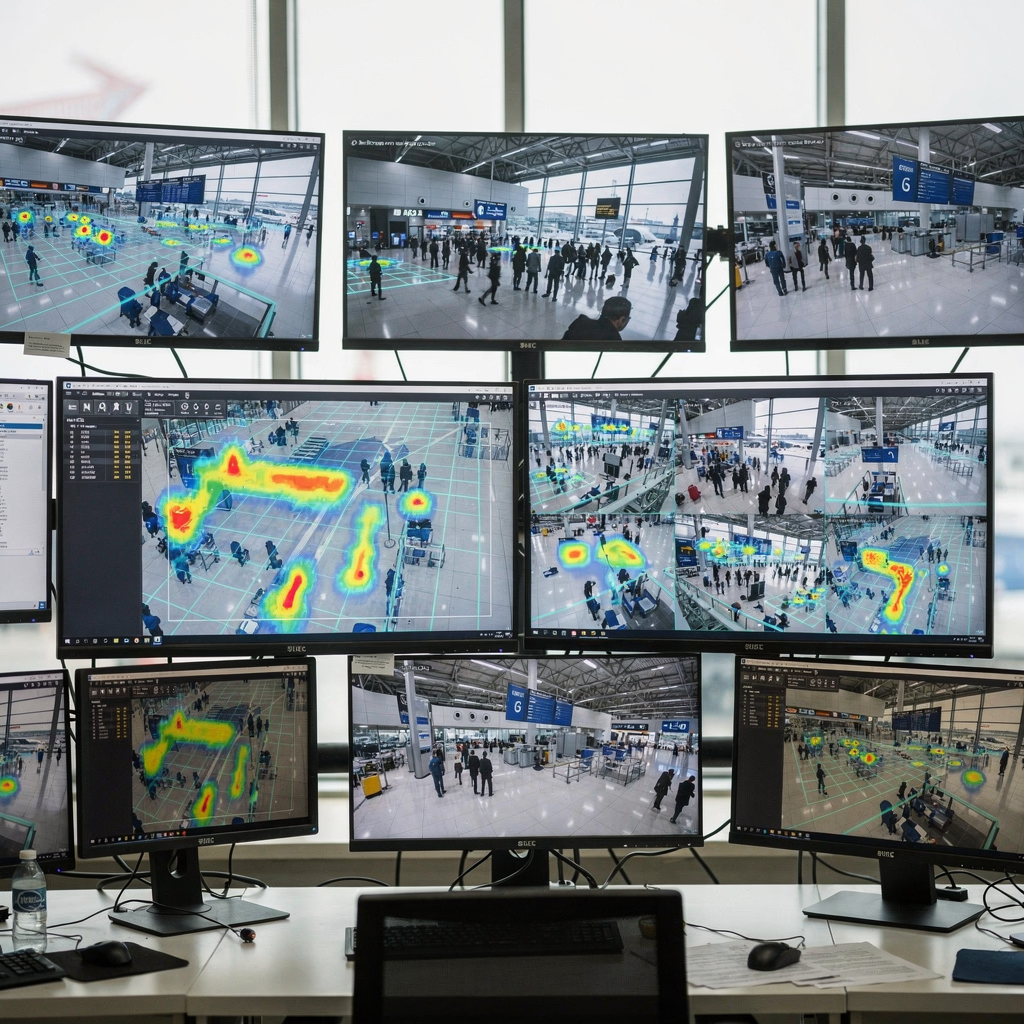
Intelligent video analytics plugin capabilities include rule-based triggers, heat-maps, object-counting, and forensic search. For example, one operator may use a heatmap to spot congestion. Another may use object-counting to track throughput. Visionplatform.ai provides an analytics plugin with APIs and SDKs so teams can integrate detectors into dashboards and BI. CVEDIA models often integrate via REST endpoints or SDKs on-prem.
Performance figures to note: CVEDIA reports a 15–30% accuracy gain in complex scenes, while Visionplatform.ai advertises sub-second alert delivery and significant annotation-time savings (synthetic data statistic, annotation claim). In practice, you should test detection and alert paths end-to-end to measure how analytics reduce operator load and overall incident-handling time.
AI vision within minutes?
With our no-code platform you can just focus on your data, we’ll do the rest
visionplatform.ai ai analytics plugin integration and analytics platform
This chapter describes Visionplatform.ai AI analytics plugin architecture and contrasts it with CVEDIA integration options. Also, additionally, furthermore, next, then, therefore, thus, meanwhile, however, consequently, hence, likewise, similarly, finally, first, second, third, besides, subsequently.
Visionplatform.ai exposes its visionplatform.ai ai analytics model and tooling through APIs, SDKs, and containerised deployment patterns. The platform runs on-prem and supports GPU servers and edge devices such as NVIDIA Jetson. It also exposes streaming structured events, making it straightforward to integrate with dashboards, BI, and OT systems. The architecture supports an on-prem Vision Language Model that turns raw video into searchable text, which enables VP Agent Search for forensic queries and natural-language investigations.
CVEDIA offers on-prem SDKs, cloud REST endpoints, and hybrid deployment options for model serving. Their synthetic-data-first workflow often includes tools to export models into standard runtimes, which helps teams integrate into existing VMS ecosystems. If you need to integrate custom detectors into an existing VMS, both vendors provide documented connectors. Visionplatform.ai goes further by exposing events as MQTT and webhooks and by offering a tight Milestone integration for richer operator actions.
Analytics platform features to compare include the user interface, collaboration tools, model version control, and the ability to process video and metadata for automated reasoning. Visionplatform.ai’s VP Agent Suite emphasizes operator workflows, reasoning, and actions that reduce cognitive load. It also keeps video and models on-prem for GDPR and eu ai act readiness and compliance, which addresses concerns about cloud video and data export. You can read about GDPR and EU AI Act guidance on our site and consider the implications when you plan deployment.
Compatibility with third-party VMS varies. Visionplatform.ai integrates with leading video management software and offers an ai analytics plugin for NX and Milestone connectors. CVEDIA models can often be wrapped and integrated, but may require additional engineering to deliver structured events in the expected format. Plan a test deployment to validate event throughput, bandwidth and CPU or GPU needs, and how the analytics platform supports collaboration between data scientists and operators. For a practical example of a detection workflow in an airport environment, see our page on loitering detection in airports.
intelligent video analytics, video analytics in xprotect vms and stream: Milestone XProtect VMS functionality of the XProtect
Milestone XProtect is a widely used video management system and Milestone XProtect VMS provides an open platform for third-party analytics. Also, additionally, furthermore, next, then, therefore, thus, meanwhile, however, consequently, hence, likewise, similarly, finally, first, second, third, besides, subsequently.
Both CVEDIA and Visionplatform.ai support plugin installation into Milestone. In practice, XProtect supports analytics by receiving structured events, metadata, and streams from analytics engines. When extended with AI, XProtect offers live analytics dashboards, event playlists, and rich forensic search. The functionality of the XProtect includes the ability to present analytics run results inside the XProtect Smart Client and to export video for incident review. Milestone XProtect is an open-platform, and xprotect integrates with access control to fuse alarms and video for richer operator context.
CVEDIA approaches stream-optimised inference by focusing on model robustness and edge-ready binaries. This reduces the number of frames needed to reach a confident detection and so can lower bandwidth. Visionplatform.ai optimises for operator workflows. The platform streams structured events and provides stream filters and dynamic thresholds to manage bandwidth and reduce false alarms. Visionplatform.ai also supports edge processing, which keeps raw video on-prem and uses GPU or CPU resources at the edge to run inference close to the camera.
Example workflows include perimeter breach detection with multi-camera verification, object tracking across entrances, and export of video clips for forensic review. For a perimeter use case, see our detailed guide to perimeter breach detection in airports. For people-counting and queue management, the platform supports people counting in airports and people detection in airports to build KPIs and operational dashboards. The operator receives a verified alert with contextual metadata and a suggested action, which helps to reduce false positives and speed response times. XProtect supports event playlists and forensic queries so operators can rapidly reconstruct incidents from structured events and raw video footage.
AI vision within minutes?
With our no-code platform you can just focus on your data, we’ll do the rest
configure advanced ai capabilities for video surveillance: AI-driven video analytics software
Next, we cover how to configure advanced AI capabilities for video surveillance on each platform. Also, additionally, furthermore, next, then, therefore, thus, meanwhile, however, consequently, hence, likewise, similarly, finally, first, second, third, besides, subsequently.
Start with clear objectives. Define what you want to detect and why. Then decide whether you will use synthetic-data scenario testing or human-in-the-loop labelling refinement. CVEDIA enables synthetic scenario testing that accelerates model creation for rare events, while Visionplatform.ai supports a human-in-the-loop cycle that improves field performance and reduces annotation time by around 50% (ContentCrew).
To configure detection rules, set thresholds for confidence and tailor alarm logic to reduce false positives. Visionplatform.ai offers tools to configure rule sets and to retrain models with site-specific data. CVEDIA offers scenario-driven re-training using synthetic variations. Both platforms support on-prem deployment to meet GDPR and EU AI Act constraints and to provide eu ai act readiness. You can deploy on GPU servers for throughput or on CPU for lower-cost edge nodes. The choice affects bandwidth and CPU utilization and determines whether you can run thousands of streams or a handful.
Advanced AI features differ by vendor. CVEDIA is strong at scenario-driven robustness and advanced ai model generation. Visionplatform.ai focuses on turning detection into decisions with on-prem Vision Language Models, operator reasoning, and VP Agent Actions. Typical surveillance use cases include loiter detection, intrusion and perimeter breach detection, PPE compliance, and queue management. See our resources on intrusion detection in airports and loitering detection in airports for practical examples.
Scale considerations: if you operate a high-density camera network, prefer edge processing and GPU servers to keep raw video on-prem and to reduce bandwidth. Visionplatform.ai supports such deployments and integrates with Milestone and other leading video management systems. CVEDIA models can be packaged for edge CPUs or GPUs depending on latency and throughput needs.
faq and free consultation: Choosing video management software with ai-driven video analytics
Finally, we cover common questions and next steps. Also, additionally, furthermore, next, then, therefore, thus, meanwhile, however, consequently, hence, likewise, similarly, finally, first, second, third, besides, subsequently.
Common questions include data privacy, licensing, hardware requirements, and support SLAs. Both platforms offer on-prem options to keep video and metadata inside your environment and to support gdpr and eu ai act compliance. Visionplatform.ai explicitly supports GDPR and EU AI Act alignment through on-prem models, audit logs, and transparent configurations, which aids eu ai act readiness.
Benefits of a free consultation include a tailored proof-of-concept, ROI estimation, and an integration plan. A pilot will show how analytics reduce operator load, how analytics reduce false alarms, and how detectors perform on your video footage. To add AI, you can add ai video analytics tools to Milestone or other VMS; if you want, we can outline an ai analytics plugin approach for your environment. Visionplatform.ai can integrate with access control and other systems so that the operator sees correlated evidence and suggested actions.
Next steps: set up a trial, define a pilot scope, and agree performance benchmarks such as detection accuracy, false positives rate, alert latency, and throughput per GPU. Visionplatform.ai offers VP Agent Search for forensic queries and VP Agent Reasoning to turn detections into verified situations. For longer projects, plan for model retraining cycles, and test how raw video footage and structured events flow through the analytics platform. If you want a consultation, request a free consultation to scope pilot timelines, hardware needs, and integration tasks. Also, for reference, you can review related solutions like our forensic search in airports.
FAQ
What is the difference between CVEDIA and Visionplatform.ai?
CVEDIA focuses on synthetic data to create robust detection models for rare and hazardous scenarios. Visionplatform.ai emphasizes end-to-end integration, operator reasoning, and on-prem AI that turns detections into decisions.
How does synthetic data reduce real-world data needs?
Synthetic data simulates edge cases and rare events so models learn from more scenarios without manual collection. Industry reporting notes synthetic data can reduce the need for real-world collection by up to 90% (source).
Can Visionplatform.ai integrate with Milestone XProtect?
Yes. Visionplatform.ai integrates with Milestone XProtect and can expose structured events to the XProtect Smart Client. XProtect supports event playlists and forensic search for incident reconstruction.
Do these platforms support on-prem deployment?
Both vendors support on-prem models and deployments. Visionplatform.ai highlights on-prem Vision Language Models and edge processing for GDPR and EU AI Act compliance.
How do I reduce false positives in my deployment?
Tune confidence thresholds, apply multi-camera verification, and add context from access control systems. Visionplatform.ai’s reasoning layer also helps to reduce false positives by correlating evidence before alerting the operator.
What hardware do I need for large-scale deployments?
Large-scale systems typically use GPU servers for inference and may use edge devices for pre-filtering. CPU-based nodes can serve lower-throughput sites. Balance bandwidth and GPU capacity to match your stream count and latency targets.
What use cases include airport operations?
Common airport use cases include people counting in airports, people detection in airports, perimeter breach detection, and forensic search. These help both security and operations to monitor flow and incidents.
Can I get a trial or pilot before committing?
Yes. Ask for a trial to evaluate detection accuracy, alert latency, and end-to-end integration. A free consultation can define a pilot scope and ROI estimate for your site.
How do these platforms handle video data and compliance?
Both platforms offer on-prem options to keep video data and metadata within your environment. Visionplatform.ai specifically supports GDPR and EU AI Act guidance through auditable logs and transparent configurations.
Where can I learn more about specific detector types?
Visit vendor pages for targeted detectors such as ANPR/LPR, PPE, and intrusion. For example, explore our pages on ANPR/LPR in airports and PPE detection in airports for technical detail and deployment examples.