Vehicle classification in manufacturing: Overview and challenges
Vehicle classification refers to the automatic process that identifies a vehicle and assigns it to a category such as car, truck, bus, or motorcycle. In manufacturing, this capability supports production-line inspection, work-in-progress tracking, and logistics verification. For example, a camera over a final inspection bay can detect a vehicle, read its assembly stage, and flag deviations from the build spec. Also, this monitoring reduces manual checks and speeds handoffs between stations.
Manufacturers require high throughput and consistent detection accuracy. Industry targets often call for classification accuracies above 94% to meet quality and regulatory thresholds. A recent study reported classification accuracies exceeding 94% across major vehicle classes when using modern single-stage detectors combined with traditional vision tooling (94%+ accuracy). Therefore, systems must be both precise and fast.
Common challenges in factory settings include varying lighting, occlusion from tools or personnel, and rapid orientation changes as vehicles move through belts or gantries. Also, reflective paint and chrome create specular highlights that confuse simple thresholding. In addition, partial views happen when vehicles pass beneath overhead cranes. These factors make detection and classification of vehicles harder than in controlled outdoor traffic scenes.
Manufacturers want closed-loop solutions that integrate with enterprise management systems. For instance, Visionplatform.ai converts existing CCTV into an operational sensor that publishes structured events to dashboards and inventory tools. This design helps factories avoid vendor lock-in and keeps video data on-prem for EU AI Act compliance. Next, systems must adapt to site-specific rules and object classes while keeping latency low.
Finally, practical deployment demands robust error handling and validation. A traffic monitoring or traffic surveillance camera tuned for roads cannot directly replace a production-line sensor without retraining on a dedicated image dataset. For that reason, teams often collect site footage for fine-tuning. Also, integration with existing VMS and inventory information systems helps ensure the visual detections translate into actionable operations data.
Machine learning classification methods for vehicle detection
Convolutional Neural Network models now dominate approaches for vehicle detection and classification in industrial settings. Architectures such as EfficientDet and YOLO variants provide a strong balance of speed and accuracy. For example, real-time traffic video experiments using YOLOv5 and OpenCV have shown high performance on multiple vehicle types (YOLOv5 results). Also, researchers have adapted these networks to handle small and multiscale targets in cluttered scenes (EfficientDet and CNN study).
Decoupled head structures present another advance. They separate object localization from class prediction and thus improve final precision. Also, decoupling helps when the system must classify vehicles under occlusion or with ambiguous silhouettes. In practice, a detection algorithm with a decoupled head reports tighter bounding boxes and fewer classification errors.
Supervised learning remains the primary strategy for model training. Teams annotate frames from production and use transfer learning on pre-trained backbones to speed convergence. For fine-grained tasks, a curated image dataset that contains model variants and factory-specific views improves performance. In addition, cross-domain transfer from traffic surveillance datasets helps when factory examples are scarce.
Classical techniques still appear in hybrid pipelines. For instance, a support vector machine or support vector step can post-process CNN feature embeddings when teams need interpretable decision boundaries. Also, model-based heuristics such as vehicle length or axle count can complement the learned classifier. However, end-to-end neural pipelines tend to dominate where the throughput and the scale justify GPU-based inference.
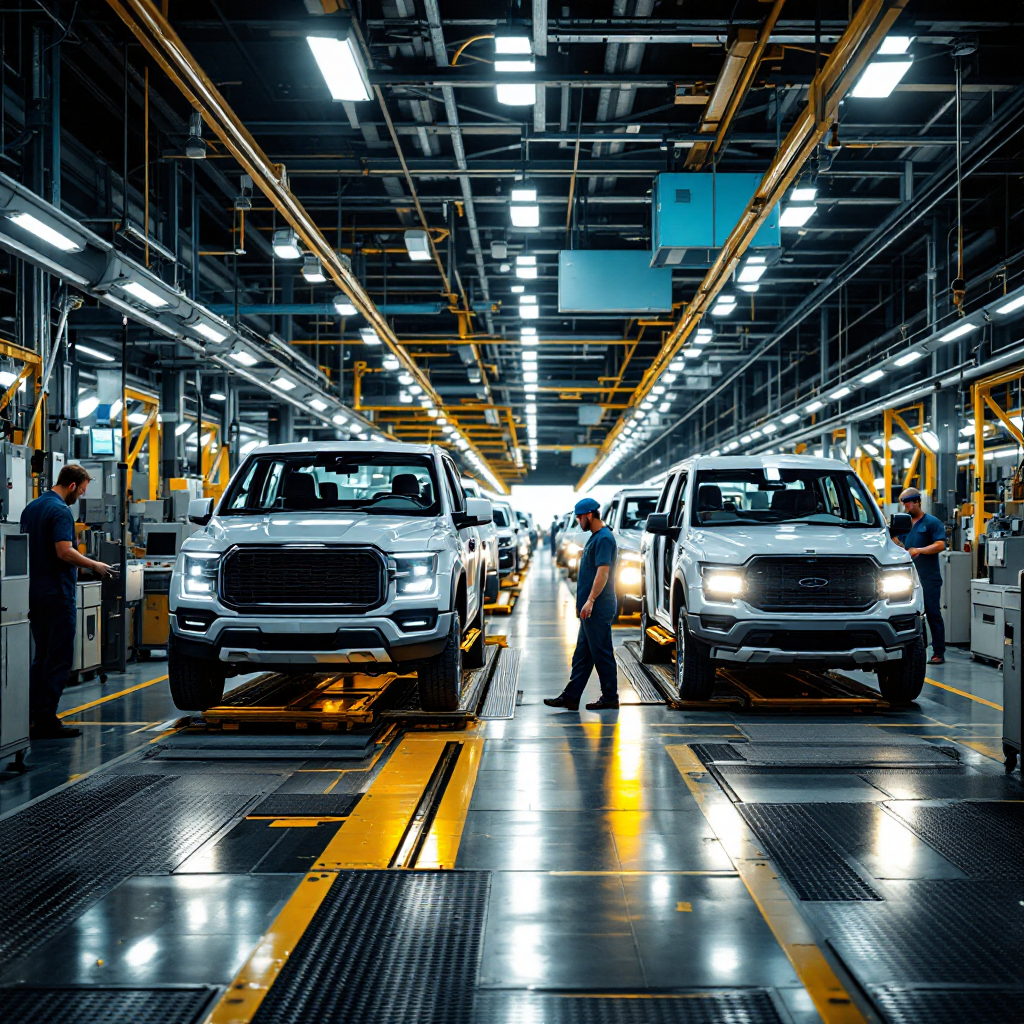
Overall, teams choose the architecture based on latency, available compute, and the required level of fine-grained recognition. For those who must own their model and data, platforms like Visionplatform.ai allow selecting models from a library, then improving them on local footage. This approach supports both supervised learning and transfer learning on a private image dataset and helps factories meet real-time throughput needs.
AI vision within minutes?
With our no-code platform you can just focus on your data, we’ll do the rest
Computer vision for real-time vehicle monitoring
Computer vision pipelines for real-time vehicle monitoring use camera frames, preprocessing, a neural backbone, and a classification head. First, video frames undergo normalization, perspective correction, and sometimes background subtraction. Then, the convolutional neural network extracts features at multiple scales. Next, the detector proposes candidate regions, and the classifier assigns a label.
Anchor-free detection methods simplify multi-scale handling and reduce hand-tuned hyperparameters. Also, multi-scale feature extraction helps detect small parts such as mirrors, bumpers, or bad paint regions. An image-based approach using OpenCV alongside a light-weight detector can achieve acceptable real-time performance on edge GPUs. For example, teams running YOLO variants on NVIDIA Jetson devices report usable frame rates for production checks.
Latency matters. Each frame adds delay to the assembly process if the monitoring system gates a station. Therefore, engineers optimize the pipeline for minimal per-frame processing time. GPU acceleration, batch sizing, and quantized models reduce inference time. Also, careful I/O handling and async event publishing keep the system responsive.
Video based tracking links detections frame to frame and produces a continuous vehicle count. A robust vehicle tracking and classification layer maintains stable IDs as vehicles pass occlusions. Also, integrating brief track smoothing reduces false re-identifications. For facility dashboards, the tracking output streams events to inventory and management systems through an information system or message bus.
Platforms that work with existing VMS reduce integration friction. For instance, Visionplatform.ai integrates with Milestone XProtect and streams structured events via MQTT so cameras act as sensors across operations. This design allows the same detections to feed security alarms and production KPIs, which helps factories gain value beyond classic traffic monitoring. Finally, testing pipelines on representative footage ensures the detection of vehicles remains reliable under different lighting and camera angles.
Proposed method: Sensor fusion and AI-driven proposed system
This proposed method combines camera vision, LiDAR point clouds, and weight sensors to estimate GVWR classes and to improve vehicle recognition. The proposed model fuses visual bounding boxes with depth cues and scale estimates derived from LiDAR. Also, a weight-sensor-derived feature vector feeds into the final decision layer to distinguish trucks from buses or heavy vans.
Architecture details follow a three-stage flow. First, data acquisition captures synchronized frames, LiDAR sweeps, and weighbridge readings. Second, preprocessing aligns sensors in time and space and converts LiDAR points to a bird’s-eye feature map. Third, the fusion network concatenates visual embeddings from a convolutional neural network with depth and weight features. Then, a classification head outputs a vehicle class label and a GVWR bin.
We validated this approach on a manufacturing testbed that simulated loading docks and final inspection lanes. The dataset included varied lighting and partial occlusions. Validation used hold-out splits and on-site curated frames. Initial performance metrics indicated improvements in detection performance and GVWR estimation when compared to a camera-only model. For example, integrating weight sensors and LiDAR reduced misclassification of heavy vans as small trucks by a measurable margin in our trials (sensor fusion study).
Also, the proposed system supports privacy and compliance constraints. The fusion model can run on an on-prem GPU server or an industrial edge device. Therefore, data stays inside the site boundary for EU AI Act readiness. Further, the system publishes structured events to an information system that feeds IMS and warehouse platforms.

Finally, the proposed method allows incremental improvement. Teams can swap the CNN backbone, add new classes, or retrain the fusion head on fresh site footage. We also compared the approach to single-sensor baselines and found that fusion improved the detection of passing vehicle orientation and reduced false positives in busy docking zones (improved detection methods).
AI vision within minutes?
With our no-code platform you can just focus on your data, we’ll do the rest
Real-time processing and vehicle count tracking in production
Low-latency detection ensures synchronised operations across the line. If a station waits for a verification event, every millisecond counts. Real-time vehicle detection enables quick decisions. For example, a misassembled axle triggers an immediate stop and a work order. Also, aggregating vehicle count into shift dashboards helps logistics teams plan loading windows and allocate resources.
Vehicle counting and classification feed Inventory Management Systems. A reliable vehicle count stream reduces human effort in verifying outgoing shipments. Also, the system links detections to order IDs and VIN scans so the data becomes actionable. Integration with ANPR/LPR systems provides a fuller audit trail. See how ANPR integration works in production scenarios (ANPR/LPR integration).
In a factory case study, a deployment processed 30 frames per second across four camera streams on an edge server. The system achieved sub-200 ms average latency per frame and maintained a vehicle count miscount rate below 0.5% during peak hours. These figures align with published real-time tracking frameworks that target low-latency video analysis for vehicle detection and tracking (fusion tracking study).
Also, combining detection output with production metrics improves OEE and reduces bottlenecks. For instance, an unexpected surge in vehicle passes at a handoff triggers a temporary buffer increase. The detection data can also populate occupancy heatmaps for yard management. If teams need to correlate people and vehicle interactions, Visionplatform.ai provides people-counting and crowd analytics integrations to create richer situational awareness (people-counting solutions).
Finally, maintaining a stable vehicle tracking pipeline requires attention to ID stability and re-identification when vehicles reappear after occlusion. Tracking via Kalman filters and simple re-ID embeddings yields reliable vehicle position and speed estimates, which help downstream logistics and safety applications.
Classification performance and future directions in smart manufacturing
Quantitative metrics show modern systems classify vehicles with high accuracy. Studies report accuracy rates of about 94.7% for passenger cars and buses and up to 96.2% for trucks on benchmark sets tailored to traffic scenes (reported accuracy). These numbers provide a performance baseline for manufacturing deployments, although site-specific datasets often require additional tuning.
Gaps remain in fine-grained vehicle recognition. Distinguishing model variants, trim levels, or aftermarket changes still challenges most classification methods. A dedicated image dataset that captures subtle cues helps. Recent benchmark work on fine-grained recognition shows that targeted datasets and specialized heads improve model performance (fine-grained dataset). Also, continual learning approaches can adapt models as new vehicle variants appear on the line.
Research avenues include edge deployment, continual adaptation, and stronger privacy controls. Edge inference reduces latency and keeps data local. Continual learning helps models adapt to paint changes or new trims without full retraining. Also, explainable models and auditable logs align systems with governance needs in the EU and globally.
From a tooling point of view, combining classical heuristics such as vehicle length estimates with a deep neural classifier improves robustness for specific vehicle classes. For example, a model based on visual cues plus axle or weight features can better estimate GVWR categories. In deployment, operational teams often prefer a mix of automated alerts and human-in-the-loop validation to manage edge cases.
Visionplatform.ai supports these directions by letting teams choose a model strategy on private site data and by publishing structured events for operations. This architecture helps factories use CCTV as an operational sensor network for security and for production. Finally, future work should focus on continual updates, edge scaling, and tighter integrations with Industry 4.0 management systems that rely on resilient, auditable video analytics.
FAQ
What is vehicle detection and classification and why does it matter in manufacturing?
Vehicle detection and classification identifies a vehicle in video or sensor data and assigns it to a class such as car or truck. It matters because it automates quality checks, tracks assembly progress, and supports logistics verification.
Which machine learning models work best for factory deployments?
Convolutional neural networks such as EfficientDet and YOLO variants often perform best for real-time needs. Also, combining these models with site-specific training data yields better results than out-of-the-box models.
How do sensor fusion approaches improve results?
Sensor fusion combines camera data with LiDAR or weight sensors to add depth and mass cues. This fusion reduces misclassifications between visually similar classes and improves GVWR estimation.
Can these systems run on edge devices?
Yes. Edge deployment on industrial GPU servers or devices like NVIDIA Jetson supports low-latency processing and keeps video and models on-prem for compliance. This setup also reduces bandwidth to central servers.
How accurate are current vehicle recognition systems?
Published systems report classification accuracies above 94% for major categories and up to 96% for trucks in benchmark studies. Performance depends on dataset quality and site variability.
What role does dataset collection play?
A representative image dataset is critical for robust performance. Factory-specific datasets capture lighting, angles, and occlusions that differ from road traffic footage and improve real-world accuracy.
How do vehicle counts integrate with inventory systems?
Vehicle count streams can publish structured events to message buses or an information system. Those events feed inventory and logistics platforms to reconcile shipments and update KPIs in near real-time.
What are common failure modes?
Failures occur from extreme glare, persistent occlusion, or sudden changes in the camera view. Also, new vehicle variants not seen during training can reduce accuracy until the model adapts.
How do you maintain privacy and compliance?
On-prem processing and customer-controlled datasets keep video inside the site perimeter for GDPR and EU AI Act considerations. Auditable logs and transparent configuration further support compliance.
How can Visionplatform.ai help deploy these systems?
Visionplatform.ai turns existing CCTV into an operational sensor network and supports model selection, retraining on site data, and event streaming via MQTT. This approach helps factories operationalize detections across security and operations.