search fundamentals for camera ai footage management
Search in video contexts means finding moments that matter quickly. For security teams, it means less time scrubbing and more time acting. The volume of footage now coming from every camera has exploded as CCTV and IoT devices spread. For example, the number of connected IoT devices rose to roughly 21.1 billion by late 2025, growing at about 14% annually this report shows. Also, sites with many cameras produce overlapping and redundant streams. Therefore, manual review no longer scales. As a result, AI is essential to index, tag, and retrieve relevant footage fast.
Data heterogeneity is a core obstacle. Different camera vendors provide varied resolutions, frame rates, and codecs. Some streams come from fixed cameras. Some streams come from PTZ gear that pans and zooms. Storage formats vary between on-prem NVRs and cloud or edge stores. In practice, inconsistent metadata and time-stamps make it hard to assemble a single timeline. Also, frame-rate drift and compression artifacts reduce the effectiveness of simple heuristics.
AI gives us structure. Deep learning models extract appearance, pose, and motion features from each frame. Then, indexing turns those features into searchable tokens. A modern system can return a relevant video clip or timeline entry in seconds. Forensic teams can then find specific critical moments and export clips for evidence. Also, AI supports object detection and object tracking so teams can detect a person or vehicle and then follow that asset across streams. The review of deep learning in intelligent surveillance stresses these roles for AI in object recognition, action recognition, and crowd analysis (PDF) Intelligent video surveillance: a review through deep learning ….
Search for security cameras is now an operational necessity. In practice, system designers must balance on-device processing and central indexing. Edge inference reduces bandwidth and keeps sensitive video local. Cloud services scale indexing and analytics. Both approaches require careful attention to privacy and compliance. visionplatform.ai builds on this idea by converting existing VMS streams into searchable knowledge, which helps control rooms save valuable time and reduce investigation time.
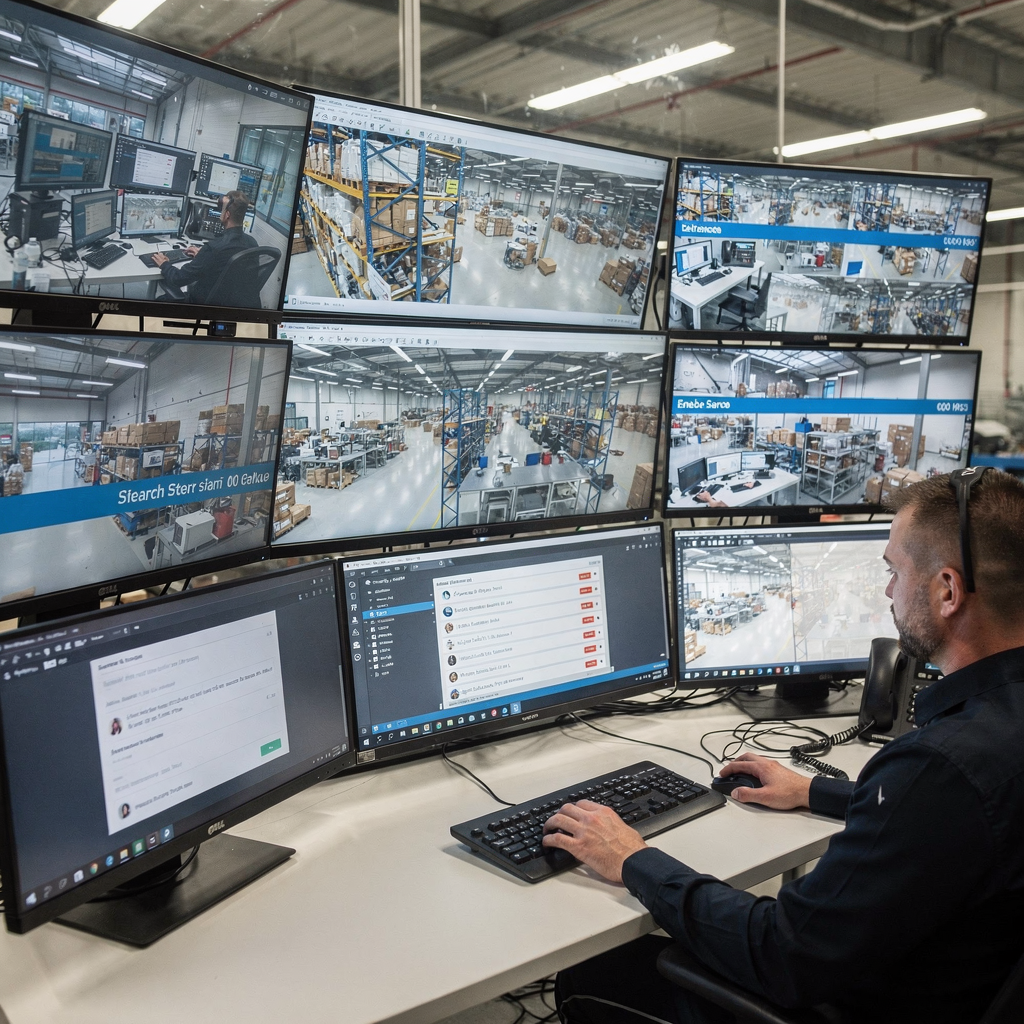
video search in multi-camera networks: track challenges
Large sites use many cameras to cover public areas, transit hubs, and perimeters. Airports, stadiums, and city centres deploy dense networks with overlapping views. In such environments, multiple camera streams must be correlated to follow people and vehicles across space. The goal is to maintain identity continuity when subjects move between fields of view. However, occlusions and perspective changes complicate this task.
Occlusions happen often. People pass behind pillars or between crowds. Also, lighting shifts dramatically from indoor concourses to outdoor ramps. Perspective changes mean the same object looks different when seen from another camera. These factors increase false positives and make re-identification harder. To address this, designers combine appearance features with motion cues. Also, temporal aggregation helps to smooth short occlusions and re-link tracks.
Metrics matter. Precision and recall are common. In multi-camera systems, additional metrics include ID switch rate and fragmentation. ID switch rate counts how often a tracked identity is incorrectly reassigned. Fragmentation measures how often continuous movement is split into multiple track fragments. High precision and low ID switches indicate robust multi-camera tracking. Operators also care about response time. Fast and accurate search results reduce the time to locate an incident.
When a team needs vehicles across multiple cameras, they want route reconstruction and license-plate re-identification. A reviewed surveillance overview highlights how PTZ and fixed cameras combine to improve continuous coverage and event reconstruction Surveillance Technology – an overview. Also, CCTV deployment studies show practical crime reductions in many monitored public spaces data on CCTV effectiveness. In real operations, solutions must be tuned to site specifics. visionplatform.ai supports this by integrating VMS context so trackers can adapt to real layouts.
AI vision within minutes?
With our no-code platform you can just focus on your data, we’ll do the rest
ai-powered smart video search: core technologies
AI-powered video search depends on several families of models. First, object recognition models detect a person, a bag, or a vehicle. Next, re-identification networks match appearance across views. Then, action recognition models label behaviors like loitering or falling. These models run at the edge and on servers. They generate structured events and textual descriptions for later retrieval. The review of intelligent video surveillance details these deep learning roles clearly (PDF) Intelligent video surveillance: a review through deep learning ….
Smart video search combines visual features with motion vectors and metadata. Metadata includes camera ID, time-stamp, and PTZ state. Motion vectors come from encoder outputs or optical flow. Appearance features come from AI embedding spaces. Fusion techniques merge these signals to improve robustness. For example, a multimodal index might weight time proximity and visual similarity to rank candidate matches.
In operations, systems deliver real-time alerts. An AI agent flags suspicious behavior and pushes a notification to the control room. Then, an operator can click to view the clip and get a short narrative explanation. This reduces cognitive load. visionplatform.ai adds an on-prem Vision Language Model that turns detections into human-readable descriptions. As a result, teams can conduct natural language forensic search that resembles the way you search the web. Also, cloud strategies matter. Some organisations require cloud-native options for scale, while others mandate that video never leaves the site.
Real deployments also use vendor integrations. For example, Edge AI servers stream events into VMS platforms. The Milestone integration from visionplatform.ai exposes XProtect data to AI agents, which then reason over events and trigger guided actions. This combination of detection, description, and decision support is what makes smart video search practical in busy control rooms.
multi-camera tracking to track vehicle and people
Multi-camera tracking pipelines start with detection. Each frame yields candidate bounding boxes. Detections are linked into short trajectories by object tracking algorithms. Then, re-identification joins trajectories across cameras to create continuous identities. Appearance embeddings, motion models, and camera topology maps are fused to improve matches. This pipeline supports both people and vehicle workflows.
Vehicle tracking use cases often require ANPR/LPR and route reconstruction. A system captures a licence plate at one camera, then matches that plate across other cameras to map a route. This supports investigations into theft, parking violations, or suspicious movements. visionplatform.ai supports ANPR and vehicle classification and provides tools to trace vehicles across multiple cameras and sites. For complex logistics, operators can reconstruct a path by combining timestamps and location metadata.
People tracking use cases include lost child searches, perimeter breach verification, and loitering detection. When the objective is to find specific individuals, re-identification is key. Re-identification works best when the system uses varied cues. Clothing color, gait, and carried items are examples. In crowded scenes, object tracking performance is measured by ID precision and fragmentation. For forensic tasks, short response times matter. Fast indexing and an intuitive interface can cut investigation time substantially.
Quantitative results vary by site, but studies show that integrated systems can lower false alarm rates and speed up evidence collection. For example, airports that use dedicated people detection, ANPR, and perimeter breach detection often see faster verification and fewer escalations. For more on airport use cases such as vehicle detection and classification, see this practical resource vehicle detection and classification in airports. Also, learn about forensic search features tailored for airports at the forensic search page forensic search in airports. These integrations reduce manual steps and let teams focus on critical moments.

AI vision within minutes?
With our no-code platform you can just focus on your data, we’ll do the rest
intuitive natural language query: using ai for video search
Natural language interfaces change how operators interact with archives. Instead of complex filters and camera lists, operators type phrases like “red vehicle at gate” or “person loitering near dock after hours.” The system then maps words to visual concepts and returns ranked segments. visionplatform.ai’s VP Agent Search demonstrates this by converting video into human-readable descriptions so teams can find incidents from any location via free-text forensic search in airports. This approach lowers training needs and speeds response.
Under the hood, natural language processing maps tokens to AI model outputs. A query parser translates dates, object types, and spatial cues into search constraints. For instance, a user can enter a date and time and ask to view a specific date, or they can ask to find specific behaviors. The query builder also supports operators who prefer structured inputs. They can filter by location, camera, or asset. This hybrid UI blends intuitive free text with precise controls.
Usability gains are measurable. Operators find incidents faster, and they need fewer steps to export a clip. Search performance improves because the VLM provides semantic indexing, which captures context such as “loitering” or “running.” The system also supports timeline scrubbing and thumbnails, so operators can quickly pinpoint critical moments. In many sites, this reduces investigation time and helps teams save valuable time on routine queries.
Finally, combining natural language with guided actions makes a difference. The AI agent can suggest next steps after verification. For example, it can pre-fill an incident report or notify a duty team. These workflows close the loop between detection and response, and they let teams act with confidence. For more on people detection in busy transit hubs, see our detailed page on people detection in airports people detection in airports.
search works: implementing ai video search across multi-camera footage
Implementations must balance edge and cloud. Edge inference reduces bandwidth and preserves privacy. Cloud indexing scales search capacity and long-term analytics. A typical architecture uses on-device detection and a central indexer for retrieval. Events stream to databases and are indexed for full-text and vector queries. The index supports fast queries across cameras, timelines, and metadata.
Time-stamp synchronisation is critical. Systems rely on NTP or PTP to align streams and build a coherent timeline. Accurate timestamps let operators jump to a moment across all cameras. In practice, the index stores both raw time and derived timeline segments so teams can combine searches by date and time with spatial filters. Also, metadata tagging is applied to every event so retrieval is precise. Tags include camera ID, object class, confidence, and human-readable descriptions.
Operational best practices help maintain performance. First, monitor model drift and retrain as the environment changes. Second, separate storage tiers so recent footage is hot and archived clips are cold. Third, instrument latency and query success rates. This provides the visibility needed to keep search fast and reliable. For enterprises that must keep video on site, on-prem solutions limit cloud exposure. visionplatform.ai supports on-prem models and integrates tightly with VMS platforms to keep data controlled and auditable. The VP Agent Suite exposes VMS data and supports actions that mirror how operators normally respond, which reduces manual steps and makes sure cameras become operational sensors rather than mere detectors.
Privacy and compliance also guide design. Follow local guidelines and log all access. In regulated regions, keep training data auditable. Finally, make the UI intuitive so operators can pick a location or camera by choosing from a map and then view a specific date and time. When those pieces fit together, search surveillance video stops being an investigation bottleneck and starts to deliver timely answers across multiple cameras and sites. The architecture also supports export and limited download for evidence handling and secure chain-of-custody.
FAQ
What is AI video search and how does it differ from basic playback?
AI video search uses machine learning to index visual content so users can find relevant segments by keywords or descriptions. Basic playback only allows manual scrubbing through recordings, while AI video search returns precise clips and metadata quickly.
How does multi-camera tracking improve investigations?
Multi-camera tracking links detections across several views to reconstruct movement paths or routes. This lets investigators follow a person or vehicle as they move through a facility, reducing time to locate critical moments.
Can natural language queries really replace complex filters?
Yes. Natural language interfaces let operators type human descriptions instead of building long rule chains. They simplify common tasks and lower training needs while preserving precise controls for power users.
How are timestamps synchronised across many cameras?
Systems use NTP or PTP protocols to align device clocks. Accurate synchronisation enables a unified timeline, which is crucial to reconstruct incidents across cameras and to pin down a specific date and time.
Is on-prem AI better for privacy than cloud processing?
On-prem AI keeps video and models inside the organisation, which reduces risk and supports compliance. Many sites choose on-prem to meet regulatory needs and to avoid sending sensitive footage off-site.
What is re-identification and why does it matter?
Re-identification matches the same person or vehicle across different camera views. It matters because it preserves continuity when subjects move out of one view and into another, which is essential for tracking and forensic work.
How does AI reduce false alarms in control rooms?
AI can verify detections by correlating events, VMS logs, and scene context before escalating. This contextual verification lowers false positives and helps operators focus on real incidents.
Can AI systems integrate with existing VMS platforms?
Yes. Modern solutions integrate with popular VMS products and expose events via APIs, webhooks, or MQTT. This lets teams use existing workflows while gaining AI-assisted capabilities.
What role do metadata and motion vectors play in search?
Metadata like camera ID and time-stamp narrows searches quickly, while motion vectors capture dynamic cues that help distinguish similar-looking objects. Together they improve precision in retrieval.
How can I get fast and accurate search results from any cloud-connected system?
Use a hybrid design: run detection at the edge and index descriptors centrally for rapid retrieval. Also, tune models to the site and monitor performance so results remain precise and timely.