Introduction to airport AI and vision-language model Technologies
Airports face three persistent challenges: security screening, complex logistics, and crowded passenger flow. Airlines and terminals must manage safety, schedules, and customer service at once. A modern international airport needs systems that scale. AI and artificial intelligence offer tools to meet those needs. Vision-language model is one such tool. It links images and natural language so systems can describe scenes, answer questions, and suggest actions. These capabilities help improve operational efficiency across the airport, and they enable new ai-driven workflows for staff and systems.
Industry forecasts show meaningful gains. For example, AI implementations are projected to improve operations by up to 30% by 2027 AI and Trusted Data: Building Resilient Airline Operations – OAG. That figure highlights the potential to reduce delays and to optimize staffing. It also illustrates why the aviation industry is investing in trusted data pipelines and integrations with language models and large language models. In practice, that means combining visual inputs with schedule data and maintenance logs to drive faster decisions. visionplatform.ai builds an ai platform that keeps video on-prem and that exposes video events as structured inputs for agents. This approach helps control rooms move from raw alarms to context, reasoning, and decision support, and it shows how an ai-powered control room can transform routine monitoring into proactive operations.
These systems do more than flag objects. They help security personnel and operations teams understand patterns. They enable ai systems to recommend responses and to automate repetitive steps. For example, a control room can trigger a checklist when luggage screening flags an anomaly, and then route suggested actions to the right security staff. The mix of ai technologies, language models, and real-time analytics creates a foundation for a smarter airport that balances safety, throughput, and passenger experience. As adoption grows, stakeholders must weigh benefits against governance. Still, the case for AI in airport operations is clear: better decisions, faster actions, and measurable gains in operational efficiency.
Data-driven computer vision for airport operations Efficiency
Applying computer vision systems across the terminal changes how teams monitor gates, taxiways, and public areas. A data-driven computer vision approach collects visual evidence from cameras, then extracts structured events for dashboards and alerts. These events support predictive analytics and help staff process vast amounts of visual data that once required constant human attention. Systems can identify and classify objects in real-time video and can spot patterns inside busy concourses. This reduces manual searching and improves response speed.
Frontier benchmarks show strong performance. Recent evaluations report zero-shot accuracy rates exceeding 85% on complex recognition tasks relevant to security and logistics NeurIPS 2025 Datasets & Benchmarks. These numbers matter because they signal that models trained on web-scale image-text pairs can generalize to new airport scenes. A well-designed computer vision solution can thus support threat detection, lost-item searches, and perimeter monitoring with minimal site-specific retraining. It can also feed analytics that reveal where resources should concentrate, which helps reduce bottlenecks during peak periods.
For airports, pattern recognition and digital images drive actionable insights. For example, when video feeds detect a stalled service vehicle on a taxiway, the system can alert ground operations and estimate clearance times. When crowd density rises near a gate, the same analytics platform can advise staff to open additional lanes. visionplatform.ai integrates with VMS and offers forensic search tools so teams can search video in natural language, which cuts investigation time. By turning raw pixel streams into searchable descriptions, airports gain visibility across the site and can allocate resources more effectively.
AI vision within minutes?
With our no-code platform you can just focus on your data, we’ll do the rest
Use case: real-time analysis of passenger Flows with visual AI
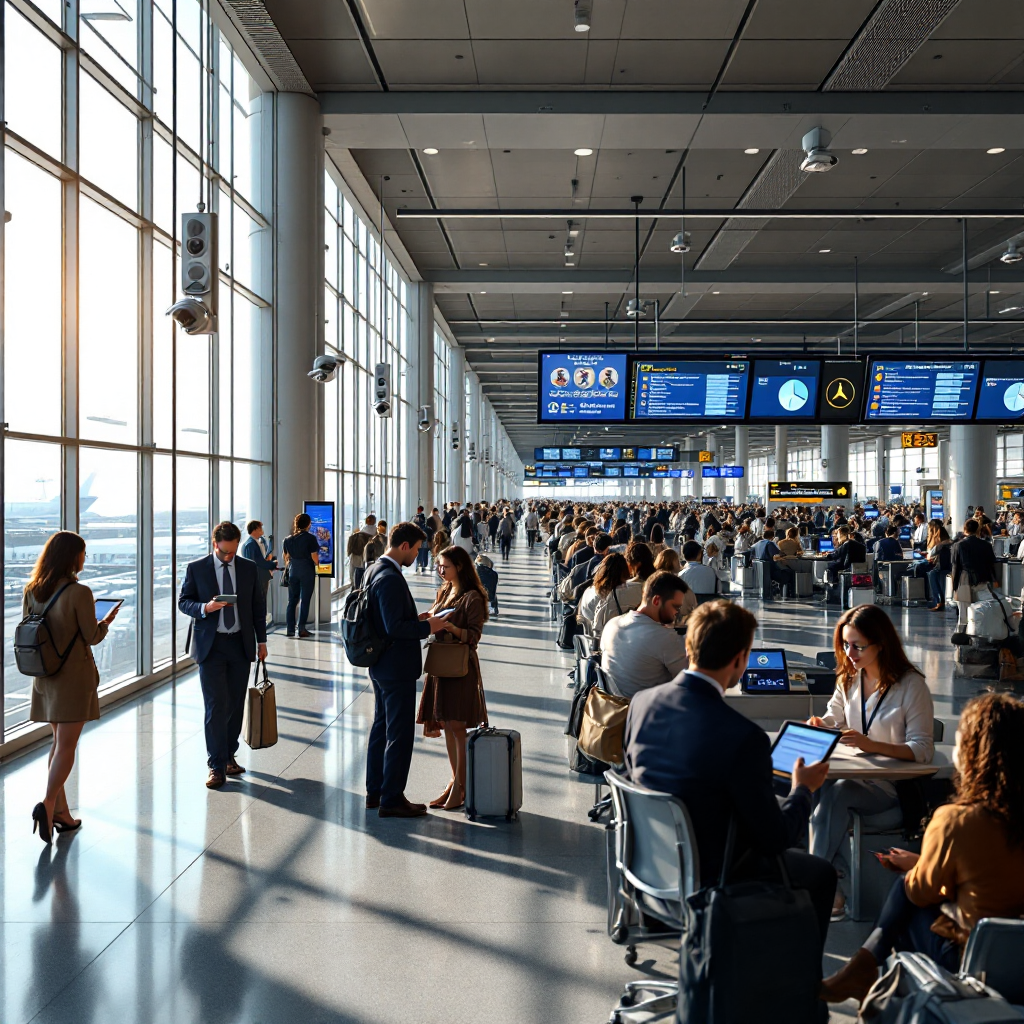
Real-time analysis of passenger flow drives measurable improvements. Visual AI can detect crowding, flag long queues, and suggest reroutes to reduce wait times. Sensors and cameras supply images and videos to models that run inference at the edge or on-prem. Then the system produces heatmaps and occupancy reports that staff use to reduce bottlenecks. In practice, this process lets security and gate teams react during peak periods and keep lines moving. Consequently, customer experience and throughput both improve.
One concrete benefit is lower passenger wait times at security and check-in. By combining occupancy analytics with schedule data, predictive analytics can forecast busy intervals and recommend staffing changes in advance. For example, an automated system might suggest opening an extra lane 10 minutes before a surge. Those time predictions reduce congestion. They also reduce stress on staff who otherwise react only after queues form. Many international airport terminals now test kiosks that display live guidance and that answer simple queries from travelers. These interactive solutions use visual question answering and simple natural language interfaces to help people find gates, restrooms, and services.
To illustrate, imagine a traveler asking a kiosk, “How long is the security line?” The kiosk uses real-time video to estimate queue length and returns a concise answer. Then it can display the fastest route to a short line or to a quiet waiting area. This question-answering capability helps people with reduced mobility find accessible paths and improves overall accessibility. visionplatform.ai complements these deployments by exposing events as structured inputs so AI agents can recommend staffing actions and automate notifications. The result is a more efficient airport and a smoother passenger flow that benefits both travelers and operations teams. For more on crowd metrics and density analytics, see the platform’s crowd detection and people counting resources crowd density analytics.
Integrating VLM and learning models for Baggage Handling
Baggage systems benefit from VLM-led automation. By correlating visual tags, barcode photos, and textual flight data, learning models can track a bag from check-in to aircraft. This lowers the number of mishandled items and speeds resolution when problems occur. Machine learning models trained on domain-specific training data learn to read tags, to match items to flights, and to route luggage through automated sorters. The outcome includes fewer missed connections and fewer claims for lost luggage.
A practical integration uses image OCR, object detection, and logical rules. The system first uses machine vision to read a tag. Then it uses a language matcher to pair the tag with flight manifests. If a mismatch appears, the system flags the item and notifies baggage handlers. This workflow supports automation while still permitting human confirmation for exceptions. It reduces manual scanning and gives handlers clear, concise alerts they can act on.
Hardware matters for these pipelines. Real-time inference benefits from efficient GPU servers and optimized frameworks like CUDA, and solutions can run on devices powered by NVIDIA AI accelerators. For sites constrained by compliance or by network policy, on-prem deployments keep video and metadata local. visionplatform.ai supports custom model workflows that let operators use a pre-trained model, improve it with site data, or build models from scratch. This flexibility ensures that a modern airport can scale baggage solutions without forcing cloud dependency. For baggage scenarios that involve left or unattended items, teams can consult object-left-behind detection for automated tagging and escalation object-left-behind detection.

AI vision within minutes?
With our no-code platform you can just focus on your data, we’ll do the rest
VQA and visual question answering for Passenger Assistance
Visual question answering, often shortened to VQA, combines visual inputs with language to answer traveler questions. VQA systems let passengers ask, “Where is my gate?” and receive responses that reference camera views and maps. These interfaces use natural language processing and language models to translate a spoken or typed query into a search over images and metadata. Then they produce an answer that cites camera observations and timetable data. The result is a faster and friendlier passenger experience.
VQA helps staff as well. Security staff and customer service agents can query a system in natural language to pull historical video for investigations, to confirm events, or to find a lost item. Question-answering over video cuts investigation time and reduces human error by returning focused clips and textual summaries. These capabilities support safety and efficiency in gates, retail areas, and transit zones. A VQA workflow can deliver timestamps, camera views, and suggested next steps so teams can respond to incidents more confidently.
Integration with on-prem systems matters for compliance. visionplatform.ai provides an on-prem Vision Language Model and agent tools that let operators search across cameras and timelines using natural language. That preserves data privacy and keeps sensitive video within controlled environments. Interactive kiosks and mobile assistants can also use VQA to improve wayfinding, to provide step-by-step directions for check-in procedures, and to support passengers with accessibility needs. As these systems evolve, they will tighten the link between images and language, and they will offer richer, context-aware assistance across the terminal. For airline-facing workflows that need people detection, the platform also links to detailed detection modules such as people counting and thermal detection people detection.
Future Directions: deep learning models, VLM and real-time Airport Solutions
Research continues to push deep learning models that handle vision-language tasks in more robust ways. Developers aim to make models resilient to changing lighting, weather, and camera angles so systems operate reliably across airport environments. Future work will combine multimodal ai techniques with domain-specific datasets and with convolutional neural backbones to improve pattern recognition on taxiways, in terminals, and at curbside. The goal is clear: build an efficient airport that maintains safety and throughput even under stress.
At the same time, governance and data privacy remain central concerns. Deployments must protect personal data and must meet regulatory standards for on-site processing. visionplatform.ai’s on-prem architecture demonstrates one path: keep video, models, and inference local to reduce risk. Collaboration between vendors, airports, and the broader data science community will also supply better training data and clearer standards for model evaluation. For instance, benchmark studies continue to refine how vlms perform on real-world tasks and how to measure robustness and explainability Building and better understanding vision-language models: insights and ….
Expect more automation around routine tasks, and expect more AI agents that assist control rooms. These agents will help staff in real time, and they will surface recommendations that reduce human workload and reduce response latency. They will also provide audit logs for compliance, which is crucial for the aviation industry. As generative AI and large language models mature, they will play a role in drafting incident reports, summarizing clips, and aiding decision-making. The future will therefore blend machine vision, predictive analytics, and agent-based automation to create a smarter, safer, and more responsive airport. For technical audiences interested in benchmarks and evaluations, recent surveys provide deeper context Vision-Language Models for Vision Tasks: A Survey and industry reports outline operational benefits AI and Trusted Data: Building Resilient Airline Operations – OAG. Overall, sustained collaboration will drive the next wave of ai applications in airport environments.
FAQ
What is a vision-language model and how does it work in an airport?
A vision-language model links visual inputs with textual understanding so systems can describe scenes and answer questions about them. In an airport it can read camera views, extract events, and provide natural language summaries that assist staff and travelers.
Can VLMs help reduce passenger wait times?
Yes. VLMs can power systems that estimate queue length and predict surges, which helps staff open lanes in advance. Those predictive actions help reduce passenger wait times and smooth peak periods.
Are these systems safe for passenger privacy?
Privacy depends on deployment choices. On-prem solutions keep video local and reduce cloud exposure, which aids compliance with regional rules and with data privacy requirements.
Do airports need special hardware to run VLMs?
Some pipelines use GPUs for efficient inference and training, and frameworks like CUDA accelerate processing on compatible hardware. However, optimized edge devices can also handle many real-time tasks without central servers.
How do VLMs improve baggage handling?
VLMs read visual tags and link them to flight manifests, which helps identify and route luggage accurately. This automation reduces mishandling and speeds resolution when exceptions occur.
What is visual question answering (VQA) and why is it useful?
VQA lets users ask questions about images or video and receive natural language answers. It streamlines passenger assistance and helps staff find relevant clips or data quickly during incidents.
Can small airports adopt these technologies?
Yes. Scalable solutions exist for smaller sites, and an ai platform can run on-prem or at the edge to match budget and compliance needs. Incremental deployment reduces risk and proves value.
How do these systems reduce human error?
They provide consistent, evidence-based recommendations and reduce manual searches, which lowers the chance of missed cues. Structured alerts and agent support help staff respond uniformly to incidents.
What role do benchmarks play in deployment?
Benchmarks verify model accuracy and generalization, which guides deployment choices and retraining needs. Public evaluations help teams select models that perform well on vision-language tasks relevant to airports.
Where can I learn more about integrating these tools with existing control rooms?
Start with vendor resources and case studies that describe on-prem deployments and VMS integrations. For practical examples of people and crowd solutions, see resources on crowd detection and people counting such as the platform’s crowd density analytics crowd density analytics and people counting pages people counting.