language model and vlms
A language model is a statistical or neural system that predicts text and supports natural language tasks. It reads an input and maps sequences to probabilities, and then it helps with text generation, classification, translation, and more. A well-tuned language model also provides contextual signals for downstream tasks, and it powers search, summarisation, and decision support. In modern applied AI, a language model often sits behind a user-facing interface, and it forms part of a pipeline that includes data ingestion, indexing, and inference.
Vision language models extend this paradigm by fusing visual inputs with text. VLMS pair image and text to produce aligned representations, and they let systems answer questions about images, produce a caption, or rank search results for a visual query. Where classic text models operate on tokens from words, vision language models consume visual tokens from a vision encoder and text tokens from a text encoder. The pair then interacts via attention or contrastive objectives to form joint embeddings that support both retrieval and generation. This shift is described in recent surveys and shows how instruction tuning improves multimodal results Generative AI for visualization.
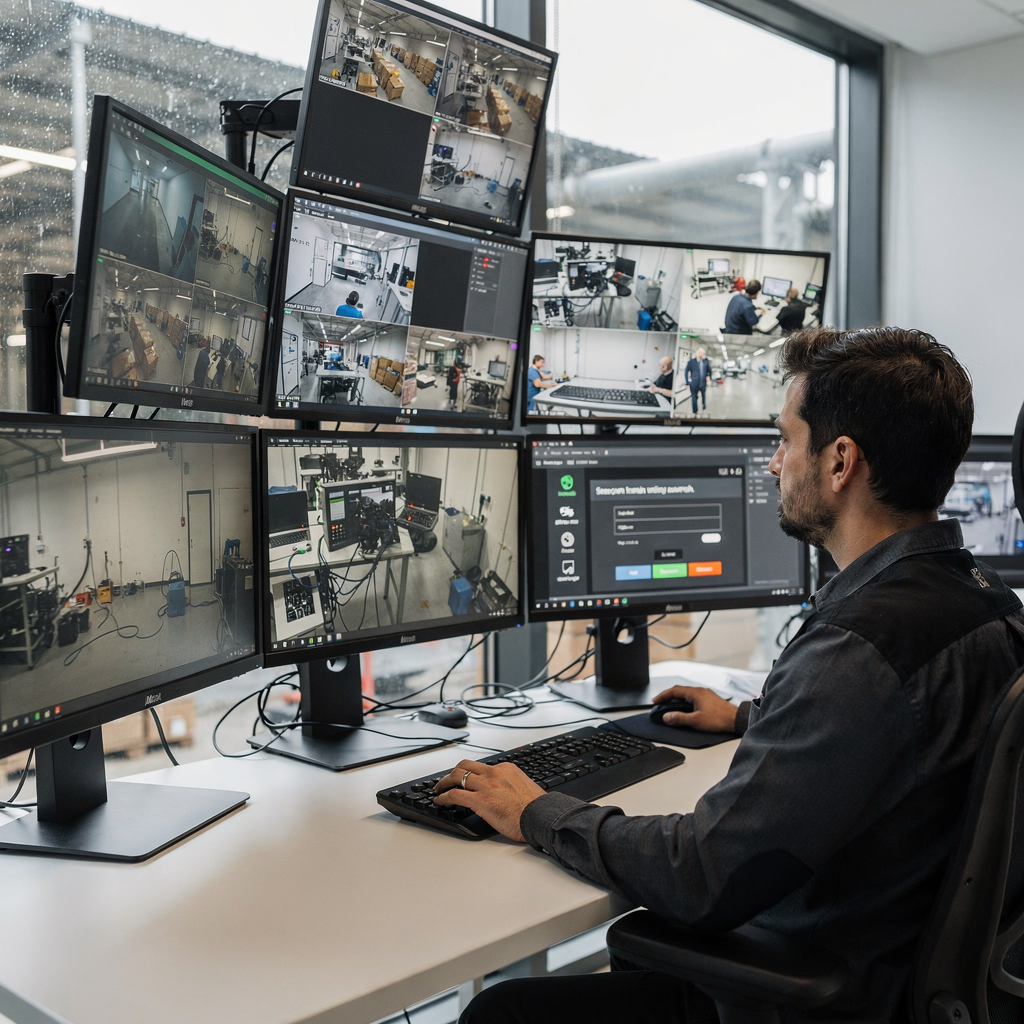
Compare traditional text-only models with multimodal systems. Text models excel at language tasks and text generation, and they remain essential for natural language understanding. Multimodal VLMS add visual information, and they enable scene-level reasoning and richer outputs. For example, a control-room operator who types a natural-language query can get a forensic answer about a past video clip when a vision-language model maps the text to the right camera segment. At visionplatform.ai we integrate an on-prem Vision Language Model so operators can search recorded video using free-form queries such as “Person loitering near gate after hours” and then verify results visually. That integration reduces time per alarm and helps teams scale.
In practice, the combined system needs labeled image-text data and robust pre-processing. Large datasets drive diversity, and models trained on image-text pairs learn to generalise across cameras and contexts. For example, ChatEarthNet provides multi‑million image-text pairs to improve geographic coverage and scene variation ChatEarthNet. The result is models that support retrieval, caption, and VQA tasks across different domains. These systems are not perfect, and they require monitoring, fine-tuning, and domain-specific workflows for safe deployment.
vision language models: architecture overview
Architectures for vision language models typically follow a few standard templates, and each template balances speed, accuracy, and flexibility. One widely used template is the encoder–decoder approach. In that design a vision encoder converts an input image into vision tokens and embeddings, and a language decoder then consumes those signals plus a text prompt to produce a caption or an answer. Another common template is the dual-encoder. Here the image encoder and the text encoder run in parallel to produce separate embeddings that a contrastive head aligns for retrieval and classification. Both approaches have strengths for different workloads and inference budgets.
Cross-attention is a crucial mechanism in many encoder–decoder designs. It lets the decoder attend to vision embeddings when generating each token. This cross-attention pattern provides fine-grained grounding of text generation in visual information, and it supports tasks such as image captioning and visual question answering. For retrieval-focused models, contrastive learning aligns vision embeddings and text embeddings in a shared space so that cosine similarity answers a query quickly. The PROMETHEUS-VISION evaluator shows how human-style scoring and user-defined criteria can judge outputs from these architectures Vision-Language Model as a Judge.
Real-world datasets used for pre-training shape what models know. Large datasets such as COCO and Visual Genome supply object-level captions and region annotations. Foundation datasets like ChatEarthNet add global coverage and scene diversity across many contexts ChatEarthNet. Pre-trained models often use a vision transformer as the vision encoder and a transformer encoder or decoder for text. The vision transformer converts the input image into patches and then into vision tokens, and the transformer then learns cross-modal relationships. These pre-trained models offer strong starting points for fine-tuning on specific tasks such as image classification or image captioning.
AI vision within minutes?
With our no-code platform you can just focus on your data, we’ll do the rest
vision-language model and zero-shot learning
Contrastive learning is at the heart of many zero-shot capabilities in vision-language settings. Models such as CLIP train an image encoder and a text encoder with a contrastive loss so that matching image and caption pairs sit close in the embedding space. This contrastive loss yields vision-language representations that generalise to categories unseen during training. When a new class appears, a text prompt describing the class can serve as a proxy label, and the model can score images against that description without task-specific retraining. This pattern enables zero-shot recognition for many computer vision tasks and reduces the need to collect exhaustive labelled data.
Image-to-text tasks include caption, retrieval, and visual question answering. In captioning the model generates a coherent text description of an input image. In retrieval the system ranks images given a text query. Systems that combine contrastive alignment with a generative decoder can perform both tasks: they use aligned embeddings for retrieval and then use a language decoder to produce a detailed caption when required. For forensic search in operations, a system can first use a contrastive dual-encoder to find candidate clips and then apply a language decoder to generate a text description for verification. For example, visionplatform.ai’s VP Agent Search converts video into human-readable descriptions so operators can find incidents quickly and then inspect the footage.
Zero-shot capabilities shine when training data lacks specific labels. When a model is trained on large datasets and exposed to many concepts, it learns generalised visual concepts. Then a new query or a text prompt describing an unseen concept becomes enough for the model to retrieve or classify relevant images. This is especially useful for edge deployments where rapid adaptation matters, and it reduces reliance on cloud retraining. Quantitatively, instruction-tuned LLMs combined with visual data have shown accuracy gains of up to 15% on image captioning compared to non‑tuned counterparts Generative AI for visualization. That improvement reflects both improved pre-training on large datasets and better fine-tuning methods.
transformer and token: building blocks
The transformer backbone underlies most modern vision language models. A transformer uses multi-head self-attention, feed-forward layers, and residual connections to model long-range dependencies in sequences. For text the transformer processes token sequences produced by tokenisation. For images the transformer processes a sequence of image patches, often called vision tokens. The vision transformer converts the input image into a grid of patches, and each patch becomes a token embedding that the transformer then processes. This design replaced many older convolutional backbones in multimodal research.
Tokenisation of text and images matters. Text token schemes break words and subwords into tokens that a text encoder consumes. Image tokenisation breaks an input image into patches and flattens them into vectors that the vision encoder ingests. The two streams then map to text embeddings and vision embeddings. Positional encoding tells the transformer where tokens sit in a sequence, and it preserves ordering for both text and vision tokens. Fusion can happen at different stages: early fusion concatenates modalities, mid-level fusion uses cross-attention, and late fusion aligns embeddings with contrastive objectives.
Multimodal fusion tokens and cross-attention let one stream condition on the other. For generative tasks a language decoder attends to vision embeddings through cross-attention layers. A language decoder can then sample tokens to produce a caption, and it can answer a visual question conditioned on the input image. Pre-trained language models often supply the decoder, and pre-trained vision models supply the image encoder. These pre-trained models speed up development because they already capture common patterns and visual information. When you train the model for a specific site you can fine-tune either the vision encoder model, the text encoder, or both. For control-room use the system often needs real-time inference, so the architecture must balance accuracy and latency.
AI vision within minutes?
With our no-code platform you can just focus on your data, we’ll do the rest
dataset and benchmark: training and evaluation
Datasets drive what vision language models learn. Key datasets include COCO for dense caption and detection tasks, Visual Genome for region-level annotations, and ChatEarthNet for global-scale image-text pairs that improve geospatial coverage ChatEarthNet. Each dataset has trade-offs in scale, bias, and annotation granularity. COCO gives strong supervised signals for image captioning and image classification, while Visual Genome helps models learn relationships between objects. ChatEarthNet and similarly large datasets expose models to varied scenes and lighting conditions common in surveillance and public-space monitoring.
Benchmarks and metrics measure performance on standard tasks. Image captioning uses CIDEr, BLEU, and METEOR to score generated captions. Visual question answering uses accuracy against a held-out test set. Retrieval and zero-shot retrieval use recall@K and mean reciprocal rank. Prominent benchmarks evolve quickly; academic tracks such as NeurIPS datasets and benchmarks push new evaluation standards NeurIPS 2025. Open evaluators that interpret user-defined scoring criteria can assess model outputs with finer granularity PROMETHEUS-VISION.
Comparing model scores on leading benchmarks helps select a model for deployment. Instruction-tuned LLMS that incorporate visual data show stronger caption performance on modern benchmarks, and they can improve downstream metrics by measurable margins instruction and visual tuning. However, benchmark scores do not capture all operational needs. For operational control rooms you must evaluate the model on site-specific footage, and you must test the model’s ability to produce verifiable text description for incidents. Forensic search, loitering detection, and intrusion detection are examples of tasks where tailored evaluation matters. See our forensic search page for how search integrates with VMS data and human workflows forensic search in airports.

vision language models work: applications in Axis contexts
Vision language models work well in spatial-axis reasoning, and they also support security and surveillance workflows. In robotics and 3D vision, reasoning about spatial axes and object orientation matters for navigation and manipulation. VLMs that combine vision embeddings with language can describe relationships such as “left of the gate” or “above the conveyor” and they can help robots follow verbal instructions. This use case links computer vision with robotics and with natural language instructions. A control-room operator benefits when a model generates consistent spatial descriptions and tags the timeline for quick retrieval.
In surveillance contexts such as Axis Communications deployments, vision language models add descriptive layers to raw detections. Instead of only flagging an object, the system can explain what was seen and why it might matter. That capability reduces false alarms and supports richer incident reports. Many organisations face too many alerts and too little context. An on-prem vision-language model keeps video inside the site, and it helps meet compliance needs while still offering advanced search and reasoning. At visionplatform.ai we provide an on-prem VLM that converts video into searchable text and then exposes that content to AI agents for context-aware decision support. This ties directly to operational benefits like faster decisions and fewer manual steps.
Challenges remain. Interpretability along temporal and spatial axes is still an open research problem, and domain generalisation requires careful site-specific tuning. Experts note that “the paradigm shift brought by large vision-language models is not just about combining modalities but about creating a unified representation that can reason across vision and language seamlessly” The Paradigm Shift. Practical deployments should include monitoring for drift, options to improve models with custom training data, and mechanisms to verify critical alarms. For organisations that need scoped video processing and EU AI Act alignment, on-prem solutions and auditable logs reduce external exposure and legal risk. To learn about how per-site detectors such as people detection or loitering detection integrate with larger workflows see our people detection and loitering pages people detection in airports and loitering detection in airports.
FAQ
What is a language model?
A language model predicts the next token in a sequence and supports tasks such as text generation and classification. It provides probabilistic scores that help rank outputs for natural language applications.
How do vision language models differ from text models?
Vision language models combine visual data and text to create joint representations that can caption images, answer questions, and retrieve clips. Text models focus only on textual input and do not directly process images.
What datasets are commonly used to train VLMs?
Common datasets include COCO, Visual Genome, and larger image-text collections such as ChatEarthNet. Each dataset contributes different annotation types and scene diversity for model training.
Can VLMs perform zero-shot recognition?
Yes. Models trained with contrastive learning can match text prompts to images without task-specific retraining, enabling zero-shot classification on unseen categories. This reduces the need for labelled examples for every new class.
Are VLMs suitable for real-time surveillance?
They can be, when designed for low-latency inference and when paired with efficient encoders and optimised pipelines. On-prem deployment often helps meet privacy and compliance constraints for surveillance use.
What is cross-attention in multimodal models?
Cross-attention lets a decoder attend to vision embeddings while generating text. It grounds text generation in visual information so captions and answers refer accurately to the input image.
How do internal agents use VLM outputs?
AI agents can consume human-readable descriptions from a VLM to verify alarms, recommend actions, and pre-fill reports. Agents then reduce operator workload by automating routine decisions under defined policies.
How does a vision encoder work?
A vision encoder transforms image patches into embeddings that a transformer processes. Those embeddings represent visual content and allow alignment with text embeddings for retrieval and generation.
What metrics evaluate image captioning?
Common metrics include CIDEr, BLEU, and METEOR for caption quality, and recall@K for retrieval tasks. Benchmark scores guide selection but practical tests on site data remain essential.
How do organisations improve VLM performance on their data?
They can fine-tune pre-trained models with labelled site data, add custom classes, and run controlled post-deployment monitoring. Training on representative footage and using domain-specific prompts improves accuracy and reduces false positives.