How vision language models work: a multimodal ai overview
Vision language models work by bridging visual data and textual reasoning. First, a visual encoder extracts features from images and video frames. Then, a language encoder or decoder maps those features into tokens that a language model can process. Also, this joint process lets a single model understand and generate descriptions that combine visual elements with textual context. The architecture commonly pairs a vision encoder, such as a vision transformer, with a transformer model for language. This hybrid design supports multimodal learning and enables the model to answer questions about images and to create event captions that read naturally.
Next, the model learns a shared embedding space where image and text vectors align. As a result, the system can compare image and text features directly. For clarity, researchers call these joint representations. These representations let a vision language model capture visual and linguistic correlations. They also let the model reason about objects, actions, and relationships. For instance, a single model can connect “person running” to motion cues detected in the image and to verbs in natural language. This connection improves event vision tasks and supports downstream capabilities like document understanding and visual question answering.
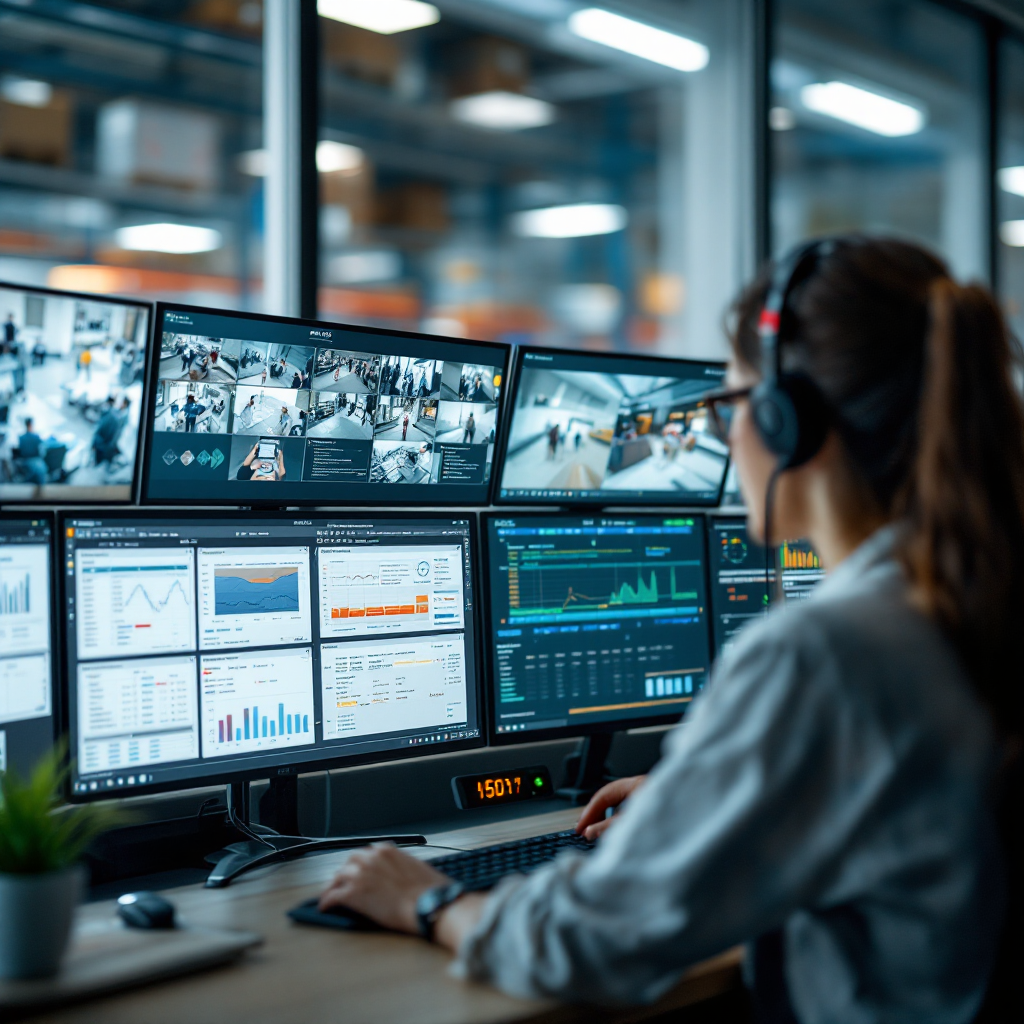
Then, the generative process converts a sequence of image-derived tokens into fluent text. During generation, the model uses learned priors from large multimodal datasets. Also, it uses attention in the transformer architecture to focus on relevant visual inputs while producing each textual token. A practical system often includes grounding modules that map visual regions to phrases. Thus, captions and event narratives stay accurate and concise. In production, engineers integrate these models inside an AI system that sits between camera feeds and operator interfaces. For example, our platform, visionplatform.ai, uses an on-prem vision language model so that control rooms can convert detections into searchable, human-readable descriptions and faster decisions. This approach keeps video on-site and supports EU AI Act compliance while boosting the reasoning capabilities of operators and AI agents.
Pretraining with large dataset for vlms
Pretraining matters. Large datasets provide the diverse examples that vlms need to learn robust event features. Common collections include COCO and Visual Genome, which supply paired image and text annotations across many scenes. These datasets teach models to map visual elements to words. In addition, larger multimodal sources mix captions, alt-text, and noisy web image and text pairs to widen the model’s exposure. Such exposure improves generalization to rare or complex events.
During pretraining, models use multiple objectives. Contrastive learning helps align image and text embeddings. Caption prediction trains the model to generate fluent textual descriptions from visual inputs. Both objectives work together. For example, contrastive learning strengthens retrieval tasks, while caption prediction improves language generation. Researchers report measurable gains: state-of-the-art vlms show accuracy improvements of over 20% on event description tasks compared to earlier models, reflecting better temporal and contextual understanding (source). Also, prompt design during later stages helps shape outputs for specific domains (source). This combination of techniques forms a strong pretraining recipe.
Models trained on diverse data learn to detect and describe complex scenes. They pick up subtle cues like object interactions, temporal order, and intent. These abilities improve event captioning and video understanding. In practice, teams tune pretraining mixes to match their use case. For example, a safety-focused deployment benefits from datasets rich in human behavior and environment context. That is why visionplatform.ai allows custom model workflows: you can use a pre-trained model, improve it with your own data, or build a model from scratch to match site-specific reality. This approach reduces false positives and makes event descriptions operationally useful. Finally, pretraining also creates foundation models that other tools can adapt via fine-tuning or prompt tuning.
AI vision within minutes?
With our no-code platform you can just focus on your data, we’ll do the rest
Benchmark vlm performance: real-world caption tasks
Benchmarks measure progress and surface weaknesses. Key evaluations for event description now extend beyond image captioning to complex narratives. For example, VLUE and GEOBench-VLM test temporal, contextual, and geographic aspects of event captions. These benchmarks use metrics that capture accuracy, relevance, and fluency. Accuracy evaluates whether the core facts match the image. Relevance measures how well the caption highlights important elements. Fluency checks grammar and readability. Together, these metrics help teams compare models fairly.
Also, the community tracks performance on visual question answering and narrative generation. Benchmarks commonly report improvements when models combine contrastive pretraining and generative caption objectives. As a case in point, recent surveys show substantial gains in event description tasks for modern vlms (source). In addition, researchers warn that alignment gaps remain. A survey notes that “Multimodal Vision Language Models (VLMs) have emerged as a transformative topic at the intersection of computer vision and natural language processing” and calls for richer benchmarks to test safety and cultural awareness (source).
Consequently, teams evaluate models not only on metrics but on operational outcomes. For real-world deployments, false positives and biased descriptions matter most. Studies show VLMs can produce contextually harmful outputs when handling memes or social events (source). Therefore, benchmark results must be read with caution. Real-world testing in the target environment is essential. For example, when we integrate vlms into control rooms, we test event captioning against operational KPIs like time-to-verify and reduction in alarms. Also, we run forensic search trials that show improved retrieval for complex queries such as “Person loitering near gate after hours” by converting video into human-readable descriptions and searchable timelines. See our forensic search documentation for more on practical evaluation forensic search in airports. These tests reveal how models perform in active workflows.
Fine-tuning multimodal language model for generative captioning
Fine-tuning adapts pretrained models to specific event captioning needs. First, teams collect curated datasets from the target site. Next, they label examples that reflect true operational scenarios. Then, they run fine-tuning with a mix of objectives to preserve general knowledge while improving local accuracy. Fine-tuning reduces domain shift and can cut error rates substantially in practice.
Also, prompt engineering plays a key role. A short text prompt steers generation. For example, a text prompt that asks for “short, factual event caption with timestamp” yields concise results. Prompt templates can include role hints, constraints, or emphasis on actions. Studies emphasize that “prompt engineering is crucial for harnessing the full potential of these models” (source). Therefore, teams combine prompt design with supervised fine-tuning for best outcomes. In addition, few-shot examples sometimes help for rare events.
Furthermore, modern fine-tuning workflows control safety and bias. Teams add adversarial examples and cultural context to the training mix. Also, they implement alignment checks to ensure captions follow policy. For instance, visionplatform.ai implements on-prem fine-tuning so that data never leaves the customer environment. This design supports EU AI Act requirements and reduces cloud dependency. The result is a model that produces clearer, context-rich captions and integrates with agents that can recommend actions. In field trials, generative models that were fine-tuned for operations reported faster verification and more useful event descriptions across scenarios such as loitering detection and perimeter breach, improving operator efficiency and situational awareness. For a practical example, see our loitering detection results loitering detection in airports.
AI vision within minutes?
With our no-code platform you can just focus on your data, we’ll do the rest
Applications of vlms and use case studies in event description
Applications of vlms span many sectors. They power automated journalism, support accessibility aids, and enhance surveillance analytics. In each use case, vlms convert visual inputs into textual summaries that humans or agents can act upon. For example, automated reporting systems use vlms to generate incident headlines and narrative starters. Accessibility tools use caption outputs to describe scenes for visually impaired users. Surveillance teams use event captioning to index footage, speed investigations, and provide context for alarms.
Also, specific deployments show measurable benefits. In security operations, integrating a vision language model into the control room reduces time-to-verify for alarms. Our VP Agent Search lets operators run natural language forensic searches across recorded footage. For example, queries like “Red truck entering dock area yesterday evening” return precise events by combining VLM descriptions with VMS metadata. That search functionality ties directly to our core platform capabilities such as people detection and object classification. See our people detection case study for airports people detection in airports.
Moreover, vlms improve decision support. VP Agent Reasoning in our platform correlates VLM descriptions with access control logs and procedures to explain whether an alarm is valid. Then, VP Agent Actions recommends or executes workflows. These integrations illustrate how a model is an AI system that fits into broader operations. Real deployments report fewer false positives, faster incident handling, and improved operator confidence. For instance, an airport deployment that combined event captioning, ANPR, and occupancy analytics lowered manual review time and improved incident triage. See our ANPR integration for more detail ANPR/LPR in airports. These outcomes show that vlms can turn raw detections into contextual, actionable intelligence across sectors.

Open-source vision language models available and new models trained
Open-source models make experimentation easier. Models like Gemma 3, Qwen 2.5 VL, and MiniCPM provide practical starting points for event captioning. These open-source vision language offerings vary by licensing and community support. Some allow commercial use, while others require care for deployment in regulated environments. Therefore, engineers should review license terms and the community ecosystem before adoption.
Also, research labs keep releasing new models. Many groups publish weights, training recipes, and evaluation scripts to help teams reproduce results. New models often focus on improved multimodal understanding and long video understanding. They integrate transformer architecture advances and efficient token handling to scale to longer visual sequences. The model architecture choices impact deployment cost and latency. For control rooms, on-prem models with optimized vision encoders and smaller transformer models provide a practical balance between capability and inference speed.
For teams building production systems, community tools and fine-tuning recipes accelerate work. However, not all open-source models are ready for sensitive real-world use. Safety, alignment, and cultural awareness require extra testing. Research highlights alignment challenges and the need to curate datasets that match operational context (source). In practice, many deployments rely on hybrid strategies: start with an open-source vision language model, then fine-tune on private data, run alignment checks, and deploy on-prem to control data flows. visionplatform.ai supports such workflows by offering custom model training, on-prem deployment, and integration with VMS platforms, which helps teams keep data inside their environment and meet compliance demands. Finally, remember that models trained on diverse datasets better handle edge cases, and community support shortens time to production when the licensing matches your needs. For best practices on training and deployment, consult current surveys and benchmark studies (source).
FAQ
What exactly is a vision language model?
A vision language model fuses visual and textual processing into one system. It takes visual inputs and produces textual outputs for tasks like captioning and visual question answering.
How do vlms describe events in video?
VLMs analyze frames with a vision encoder and map those features into tokens for a language model. Then they generate event captions that summarize actions, actors, and context.
Are vlms safe for real-world surveillance?
Safety depends on dataset curation, alignment, and deployment controls. Run operational tests, include cultural context, and keep models on-prem to reduce risk.
Can I fine-tune a vision language model for my site?
Yes. Fine-tuning on curated site data improves relevance and reduces false positives. On-prem fine-tuning also helps meet compliance and privacy requirements.
What benchmarks test event captioning?
Benchmarks like VLUE and GEOBench-VLM focus on contextual and geographic aspects. They measure accuracy, relevance, and fluency across real-world caption tasks.
How do prompts affect caption quality?
Prompts steer generation and can make captions clearer and more concise. Combine prompts with fine-tuning for consistent, operational outputs.
Which open-source models are useful for event captioning?
Gemma 3, Qwen 2.5 VL, and MiniCPM are examples that teams use as starting points. Check licenses and community support before deploying in production.
How does visionplatform.ai use vlms?
We run an on-prem vision language model to convert detections into searchable descriptions. Our VP Agent Suite adds reasoning and action layers to support operators.
Can vlms handle long video understanding?
Some models support longer context by using efficient token strategies and temporal modeling. However, long video understanding remains more challenging than single-image captioning.
Do vlms replace human operators?
No. VLMs assist operators by reducing routine work and improving situational awareness. Human oversight remains essential for high-risk decisions and final verification.