vlms: Role and Capabilities in Incident Understanding
First, vlms have grown fast at the intersection of computer vision and natural language. Also, vlms combine visual and textual signals to create multimodal reasoning. Next, a vision-language model links image features to language tokens so machines can describe incidents. Then, vlms represent scenes, objects, and actions in a way that supports decision-making. Furthermore, vlms can convert raw video into searchable textual narratives. For example, our platform converts detections into natural language summaries so control rooms understand what happened, why it matters, and what to do next.
Also, vlms are used in accident analysis, disaster response, and emergency triage. Next, they power image caption, visual question answering, and automated report generation. Then, they support forensic search across huge collections of footage. In addition, state-of-the-art vlms were evaluated on scientific tasks, and a new benchmark shows strengths and limits; see the MaCBench results here: vision language models excel at perception but struggle with scientific knowledge. Also, at ICLR 2026 a review of 164 VLA model submissions highlighted the trend toward unified perception, language, and action; see the analysis here: State of Vision-Language-Action Research at ICLR 2026.
However, vlms face interpretability issues. Also, clinical studies note that direct answers can be offered without transparent reasoning; see this clinical analysis: Analyzing Diagnostic Reasoning of Vision–Language Models. Next, the lack of traceable reasoning matters in incidents where lives or assets are at risk. Therefore, operators and security teams need explained outputs and provenance. In addition, visionplatform.ai focuses on adding a reasoning layer so vlms do not just detect, but explain and recommend. Also, this reduces false alarms and improves operator trust. Finally, vlms represent a practical bridge between detection and action in control rooms.
language model: Integrating Text for Enhanced Scene Interpretation
First, the language model ingests textual signals and generates human-readable descriptions. Also, it converts short captions into structured summaries. Next, large language and large language model hybrids can refine context, and so they improve language understanding in incidents. Then, multimodal language models align text and images so the combined system can answer queries. For example, operators can ask for an incident timeline and the system returns a coherent report.
Also, fusion techniques vary. First, early fusion injects textual tokens into the visual encoder so joint features are learned. Next, late fusion merges separate vision and language embeddings before the final classifier. In addition, unified encoder approaches train a single transformer to process text and pixels together. Then, the choice of fusion affects speed, accuracy, and traceability.
For instance, called visual question answering systems enable targeted queries about scenes. Also, visual question answering and question answering capabilities let users “ask a vlm” about objects in an image, and get concise answers. Furthermore, visual and textual outputs power automated incident reports, and they support searchable transcripts across recorded video. Also, this makes it easier to generate an image caption or a full textual investigation. However, direct outputs risk hallucination. Therefore, teams must add verification steps. For example, dual-stream methods reduce hallucinations and improve safety; see research on mitigating hallucinations here: Mitigating Hallucinations in Large Vision-Language Models via Dual‑stream approaches.
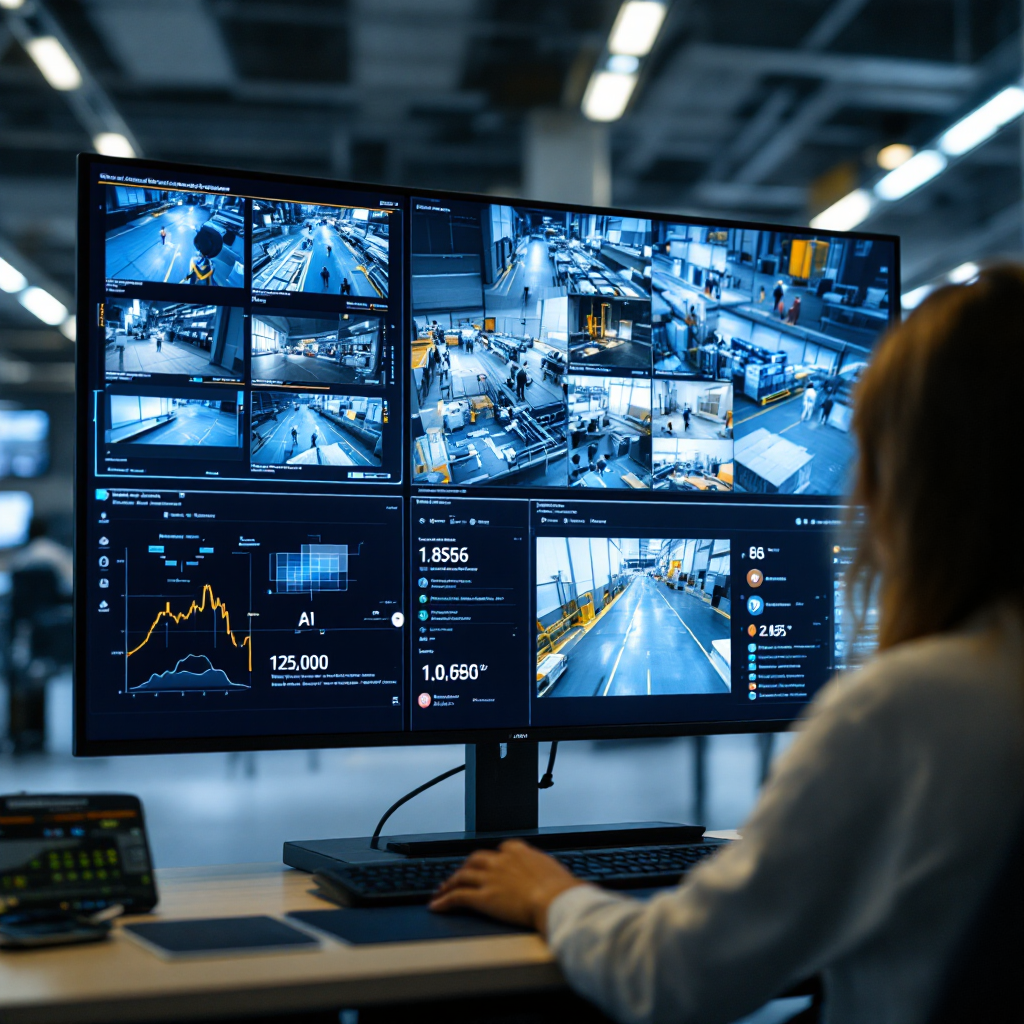
Also, integration of a language model into an on-prem pipeline helps compliance, and thus reduces cloud data egress risk. In addition, visionplatform.ai embeds an on-prem Vision Language Model to keep video and metadata inside customer environments. Next, this supports EU AI Act alignment, and it lets security teams validate outputs locally. Finally, annotation, dataset curation, and incremental fine-tuning improve system fit to site-specific reality.
AI vision within minutes?
With our no-code platform you can just focus on your data, we’ll do the rest
vision language models: Architecture and Key Components
First, vision language models rely on a vision backbone and a textual transformer. Also, traditional computer vision used CNNs as backbones. Next, transformers now dominate for both vision and text encoders. Then, a visual encoder produces vector representations and embeddings for objects in an image. Also, the text encoder models language and produces contextual tokens for language understanding. In addition, cross-attention layers connect vision features to textual tokens so the model can generate a caption or a longer incident report.
Also, architecture choices include dual-stream designs and unified encoder approaches. First, dual-stream systems keep vision and language encoders separate, and they fuse later. Next, unified encoders process visual and textual tokens together in one transformer. Then, both approaches have trade-offs in latency and interpretability. Also, dual-stream designs can make provenance easier to trace. Furthermore, unified encoders can improve end-to-end performance on reasoning tasks.
Also, researchers evaluate models using benchmarks and datasets. First, image captioning, VQA, and visual question answering benchmarks measure descriptive and question-answering capabilities. Next, MaCBench-style benchmarks probe scientific knowledge and reasoning under controlled settings; see the MaCBench study here: MaCBench benchmark. In addition, medical report generation work shows promise; a Nature Medicine study demonstrated report generation and outcome detection using a vlm-based pipeline: Vision-language model for report generation and outcome detection.
However, safety matters. Also, techniques to mitigate hallucinations include contrastive training, auxiliary supervision, and rule-based post-filters. Next, embedding procedural knowledge from policy and procedures improves verifiable output. Then, combining llm reasoning with vision encoders can boost clinical and incident reasoning; see recent work on enhancing clinical reasoning here: Enhancing Clinical Reasoning in Medical Vision-Language Models. Also, models like gpt-4o can be adapted as reasoning modules, and they can be constrained by retrieval and facts. Finally, a careful evaluation regime and benchmark suite ensure models meet operational requirements.
spatial: Scene Graphs and Spatial Data for Hazard Detection
First, scene graphs are structured representations where nodes are objects and edges are relationships. Also, scene graphs make spatial relationships explicit. Next, nodes capture objects in an image and edges capture spatial relations such as “next to” or “behind”. Then, structured scene graphs support downstream reasoning and help explain why a safety hazard is present. Also, scene graphs can be enriched with metadata such as localization, timestamps, and object IDs.
For example, in construction sites vlms can identify tools, vehicles, and workers. Also, scene graphs encode whether a worker is within a danger zone near moving machinery. Next, in traffic systems scene graphs model lane geometry and proximity to other vehicles to detect lane departure or imminent collisions. Then, scene graphs can be combined with sensor telemetry to improve accuracy. Also, this structured view helps human operators understand the presence of objects and their relations.
Moreover, real-time updates let scene graphs reflect live conditions. Also, a real-time pipeline updates node positions and relations every frame. Next, alerts are generated when relationships imply a safety hazard, and the system explains the cause. Then, our VP Agent Reasoning module correlates scene graph events with VMS logs and access control entries to verify incidents. In addition, this enables forensic search and natural language queries over past events; see our forensic search use case for examples: forensic search across recorded video.
Also, explainability benefits from scene graphs. First, structured spatial representations provide clear chains of evidence for each alert. Next, they allow security teams and operators to inspect why an alert was raised. Then, scene graphs support human-in-the-loop workflows so operators can accept, dismiss, or refine alerts. Also, teaching vlms to map detections into scene graphs improves traceability and trust. Finally, scene graphs form the spatial backbone of a proposed framework for incident understanding.
AI vision within minutes?
With our no-code platform you can just focus on your data, we’ll do the rest
spatial reasoning: Real-Time Analysis and Safety Hazard Identification
First, spatial reasoning algorithms infer unsafe proximities and potential events from scene graphs. Also, real-time pipelines track objects and compute distances, velocities, and trajectories. Next, graph-based inference flags unsafe intersections of motion vectors or rule violations. Then, heuristics and learned models combine to score the risk level. Also, the system can forecast short-term paths and issue an alert when predicted risk crosses a threshold.
For instance, a worker‑machinery proximity case uses object detection and relation extraction to compute time-to-contact. Also, lane departure systems combine detection of lane markings with vehicle pose to detect drift. Next, obstacle prediction uses temporal embeddings and trajectory models to forecast collisions. Then, embeddings from vision encoders and llms can be fused to improve contextual judgement. Also, these methods improve high accuracy detection and make outputs more actionable.
Also, research on graph embedding and dynamic hazard analysis is active. First, methods that encode temporal relations into node embeddings enable continuous risk scoring. Next, scientists and engineers, including mit researchers, publish methods that combine physics-based prediction with data-driven learning. Then, systems must validate on realistic datasets and in simulation, and afterwards in controlled live deployments. Also, our platform supports custom model workflows so teams can improve models with their site-specific annotation and dataset inputs; see the fall detection example for a related detection use case: fall detection in airports.
Finally, explainability remains central. Also, alerts include the chain of evidence: what was detected, which objects were involved, and why the system considered the situation risky. Next, this allows operators to decide quickly and with confidence. Then, for repeatable, low-risk scenarios agents can act autonomously with audit logs. Also, the ability of vlms to understand spatial relationships makes real-time safety hazard identification possible in real-world operations.

proposed framework: A Unified System for Incident Understanding
First, the proposed framework sketches an agent-based architecture that combines VLMs, scene graphs, and safety rules. Also, the proposed framework blends vision and natural language processing so agents can reason and act. Next, core components include a vision encoder, a language interpreter, a spatial reasoning module, and an alert generator. Then, each component plays a clear role: perception, contextualization, inference, and notification.
Also, the vision encoder does object detection, localization, and tracking. Next, the language interpreter converts visual features into textual summaries and captions. Then, the spatial reasoning module builds scene graphs and computes risk scores using embeddings and rule-based checks. Also, the alert generator formats actionable notifications, fills incident reports, and recommends actions. In addition, the VP Agent Actions functionality can execute predefined workflows or suggest human-in-the-loop steps. For more on agent reasoning and actions see our VP Agent Reasoning and Actions descriptions and how they reduce operator load.
Also, real-time processing flows from video input to hazard notification. First, video frames feed the vision encoder and detection models. Next, objects in each frame are converted into nodes and linked into scene graphs. Then, spatial reasoning tracks behavior over time and flags rule violations. Also, the language interpreter produces a contextual textual record for each event. Finally, the alert generator notifies operators and, when safe, triggers automated responses.
Moreover, validation and scaling matter. First, validate models on curated datasets and simulated incidents. Next, refine with site-specific annotation and incremental training so models learn to identify unusual behavior that matters locally. Then, scale by distributing real-time pipelines across edge nodes and on-prem GPU servers. Also, on-prem deployment supports compliance, and it meets the needs of organizations that cannot send video to the cloud. Finally, by combining scene graphs, vlm-based explanations, and agent-driven decision support, teams get more than raw detection: they receive contextual, actionable insights.
FAQ
What are vlms and how do they differ from traditional detection systems?
vlms are systems that combine visual and textual processing to interpret scenes. Also, unlike traditional detection systems that output isolated alarms, vlms produce descriptive textual context and can answer questions about incidents.
How do scene graphs improve incident explainability?
Scene graphs make spatial relationships explicit by linking objects and relations. Also, they provide a clear chain of evidence so operators and security teams can see why an alert was produced.
Can vlms run on-prem to meet compliance needs?
Yes, vlms can run on-prem, and visionplatform.ai provides on-prem Vision Language Model options. Also, keeping video and models inside the environment helps satisfy EU AI Act and data residency requirements.
What role do language models play in incident reporting?
Language model components convert visual detections into structured, searchable reports. Also, they enable natural language search and generate textual incident summaries for operators and investigators.
How do systems avoid hallucinations in vlm outputs?
Systems reduce hallucinations via dual-stream training, rule-based verification, and grounding in sensor data. Also, post-processing that cross-references VMS logs or access control entries improves output reliability.
Are vlms useful for real-time safety hazard alerts?
Yes, when combined with scene graphs and spatial reasoning, vlms can detect unsafe proximities and predict risky events. Also, real-time pipelines can produce alerts with supporting evidence for quick operator action.
What datasets are needed to validate incident understanding?
Validation requires annotated datasets that reflect site-specific scenarios, and diverse video collections for edge cases. Also, simulation and curated datasets help test reasoning tasks and localization performance.
How do agents act on vlm outputs?
Agents can recommend actions, pre-fill reports, and trigger workflows under defined policies. Also, low-risk recurring scenarios can be automated with audit trails and human oversight.
Can vlms handle complex scenes and negation?
State-of-the-art vlms improve at complex scenes, and methods to teach models to understand negation exist. Also, careful training and testing on edge cases are required to reach production-grade accuracy.
How do I learn more about deploying these systems?
Start by evaluating your video sources, VMS integrations, and compliance needs. Also, explore use cases like forensic search and fall detection to see how vlm-based systems deliver actionable insights; for example, read about our forensic search case here: forensic search across recorded video, and learn about fall detection here: fall detection in airports. Finally, consider a phased on-prem deployment to validate performance and refine models with your own annotation and dataset.