ai systems and agentic ai in video management
AI systems now shape modern video management. First, they ingest video feeds and enrich them with metadata. Next, they help operators decide what matters. In security settings, agentic AI takes those decisions further. Agentic AI can orchestrate workflows, act within predefined permissions, and follow escalation rules. For example, an AI agent inspects an alarm, checks related systems, and recommends an action. Then, an operator reviews the recommendation and accepts it. This flow reduces manual steps and speeds response.
Video management platforms provide core functions such as ingesting streams, recording high-resolution video, indexing events, and routing alarms. They also manage camera health and permissions. Importantly, video management connects analytics to operator tools. For example, forensic search lets teams find events using human descriptions. For more on search in operational settings see our forensic search example for airports forensic search in airports. Also, a modern platform must keep data local when required. visionplatform.ai offers on-prem VLMs and agent integration so video and models stay inside the environment. This design supports EU AI Act-aligned deployments and reduces cloud dependency.
Agentic AI adds autonomy. It can predefine monitoring routines, correlate events, and trigger workflows. It can verify an intrusion and auto-fill an incident report. In short, it turns raw detections into explained situations. The result is fewer screens and faster decisions. However, designers must balance automation with human oversight. Therefore, systems should log every action, enable audit trails, and allow configurable escalation. Finally, these systems integrate with existing security systems and VMS platforms to avoid reinventing the wheel. This layered approach moves control rooms from alarms to context, reasoning, and decision support.
vlms and vision language model fundamentals for surveillance
Vision language model technology fuses visual and textual signals. First, a vision encoder extracts spatial features from frames. Then, a text encoder builds semantic embeddings for descriptions. Often, a transformer aligns those streams and enables cross-modal attention. As a result, a vlm can see and describe a scene, classify objects and answer questions. For surveillance, vlms translate camera footage into human-friendly text that operators can act on. In practice, models use multimodal pretraining on images, video frames and captions to learn these mappings. This pretraining uses a curated dataset that pairs visual examples with captions or labels. The dataset helps models generalize to new scenes and object classes.
VLMS combine strengths of computer vision models and language models. They support vision-language tasks such as visual question answering and scene captioning. For example, a vlm can answer “what’s happening at gate B” or tag a person loitering. This capability reduces the need to predefine rigid rules for every scenario. Also, vlms improve object detection pipelines by providing semantic context about proximity, intent, and interactions. They work well with convolutional neural networks for low-level features and with transformers for alignment across modalities.
Importantly, vlms can run on edge devices or on-prem servers. That keeps camera footage inside the site while enabling nearline reasoning. visionplatform.ai integrates an on-prem Vision Language Model to convert video events into textual descriptions. Then, operators and AI agents can search and reason over those descriptions. For examples of visual detectors used in airports see our people detection materials people detection in airports. Finally, vlms make video content searchable in human language without exposing feeds to external services.

AI vision within minutes?
With our no-code platform you can just focus on your data, we’ll do the rest
real-time video analytics with temporal reasoning
Real-time video analytics demand low latency and high throughput. First, systems must process video streams at scale. Next, they must deliver alerts within seconds. Real-time systems often use optimized inference pipelines and hardware acceleration on GPUs or edge devices. For instance, real-time video analytics can analyze thousands of frames per second to enable immediate response real-time video analytics. Therefore, architecture must balance accuracy, cost, and data locality. Edge devices such as NVIDIA Jetson are useful when high-resolution video needs local processing. They reduce bandwidth use and support EU-compliant surveillance deployment.
Video analytics covers motion detection, object detection, people counting, and behaviour analysis. First, motion detection isolates regions of interest. Then, object detection classifies entities such as people, vehicles, or baggage. In crowded scenes, spatial modelling and tracking help the system follow objects across frames. Temporal modelling links observations to understand sequences. For example, a person leaving a bag and walking away creates a temporal signature that the system can flag as an anomaly. Temporal models use techniques like recurrent networks, 3D convolutions, and temporal attention. These techniques help spot patterns that single-frame methods miss.
Additionally, combining vlms with temporal reasoning gives richer alerts. A vlm can provide a textual description of a sequence. Then, analytics can correlate that text with motion patterns and external sensors. As a result, systems improve detection accuracy and reduce false alarms. Indeed, large vision-language models have reduced false alarm rates by up to 30% compared to vision-only systems survey of state-of-the-art VLMs. Finally, real deployments must monitor latency, throughput, and model drift continuously to keep performance stable.
smart security use case: ai agent for video surveillance
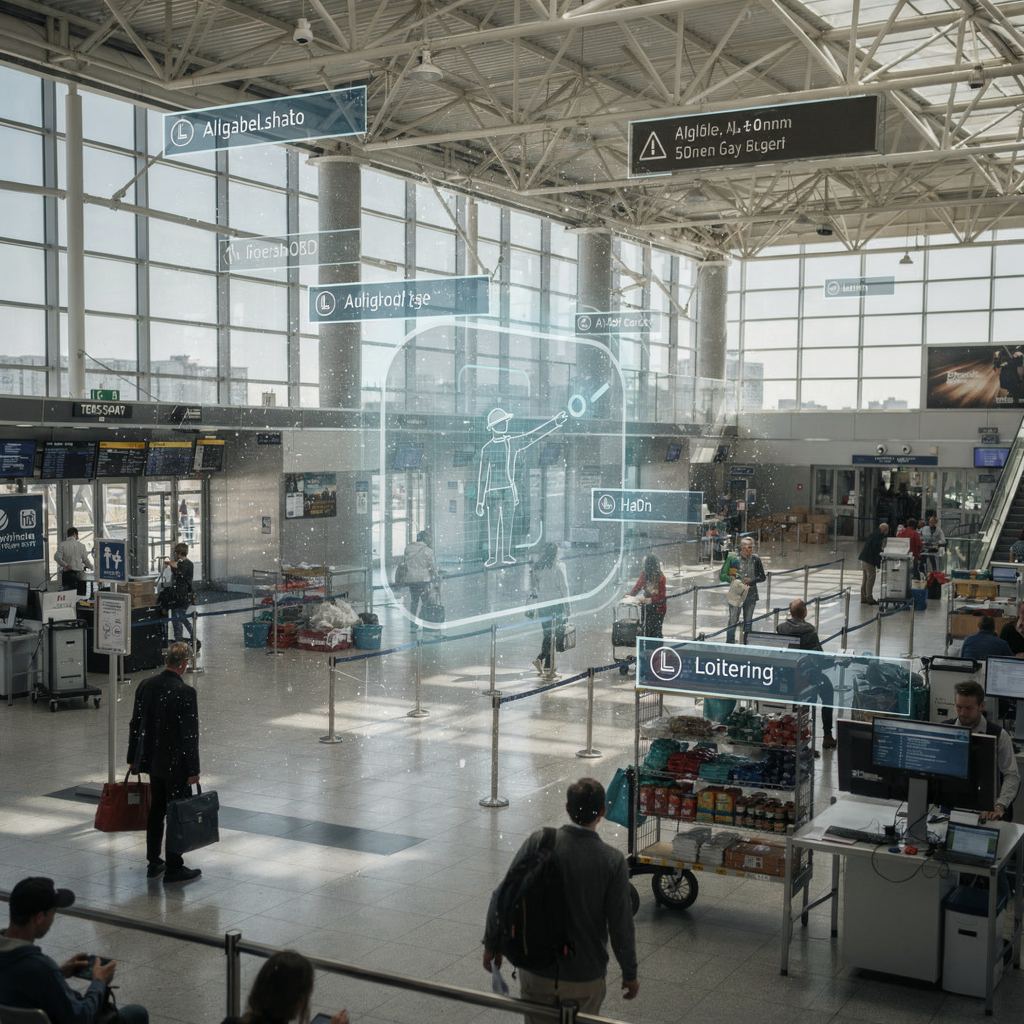
Consider a busy transit hub. First, thousands of passengers pass through daily. Next, operators must monitor crowds, gates, and perimeters. This smart security use case shows how an AI agent assists in crowded public spaces. The agent ingests camera footage, analytics events, and VMS logs. Then, it reasons over that data to verify incidents. For example, the agent correlates a motion event with a VLM caption that reads “person loitering near gate after hours.” When the caption and motion match, the agent raises a verified alarm. Otherwise, it closes the alarm as a false positive.
Deploying an ai agent reduces response time and supports consistent action. In trials, teams saw faster verification and fewer operator escalations. As a result, operators handle higher volumes of events without additional staff. The agent can also create pre-filled incident reports and suggest actions. In this way, it helps reduce the number of false alarms and the number of false operator interventions. For crowded scenes, crowd density and people counting feed into the agent’s reasoning. For instance, operators can follow up using our crowd detection resources crowd detection and density in airports. Also, forensic search lets staff retrieve past incidents quickly using plain language.
Face recognition can be integrated where regulations allow. However, the agent focuses on contextual understanding rather than only biometric matching. It explains what was detected, why it matters, and what actions it recommends. This approach supports smart surveillance and operational workflows. Finally, controlled autonomy allows the agent to act on low-risk scenarios while keeping human oversight for critical decisions. The outcome is higher situational awareness, faster response, and measurable reductions in alarm handling time.
AI vision within minutes?
With our no-code platform you can just focus on your data, we’ll do the rest
llms-enhanced analytics in ai vision language model
Large language models add semantic depth to vision systems. First, llms map short textual descriptions into richer context. Then, they help the agent answer complex questions about video. For example, an operator can ask a query like “show me people loitering near gate B yesterday evening.” The system then returns clips and explanations. This capability works because the vlm produces structured textual descriptions and the llms reason over that text. The combination supports video search and ad-hoc forensic queries in human language. For more details about prompt design and methodology see research on prompt engineering prompt engineering for large language models.
Prompt engineering matters. Clear prompts reduce ambiguity and guide the llms to focus on relevant frames and events. For instance, prompts can instruct the model to classify interactions, to explain intent, or to summarise what’s happening in a clip. Additionally, operators can request step-by-step reasoning and evidence from camera footage. This transparency builds trust. Also, generative AI helps create structured incident narratives automatically. As a result, teams gain faster reports and consistent summaries across shifts.
Importantly, systems must control data flow to protect privacy. visionplatform.ai keeps video, models, and reasoning on-prem by default. This design helps satisfy compliance requirements while enabling advanced llms-enhanced analytics. Finally, integrating llms improves accuracy and flexibility. For example, vision models enriched with language understanding can better classify objects and behaviours and can support domain-specific queries without retraining core ai models. This makes it easier for users to query video history without learning rules or camera IDs.
ethics and governance of agentic ai and vlms in video surveillance
Ethics and governance must guide deployments. First, vlms and agentic AI carry privacy risks and dual-use concerns. Indeed, a recent evaluation found that vision-language models could generate contextually relevant harmful instructions if not constrained Are Vision-Language Models Safe in the Wild?. Therefore, designers must include safety layers and content filters. Next, regulatory frameworks require data minimisation, purpose limitation, and transparent records of automated actions. For instance, public health and safety visions highlight the need for governance in future surveillance work future surveillance 2030. These policies shape acceptable uses and auditing requirements.
Human-in-the-loop controls help ensure accountability. Operators should verify high-risk decisions and be able to override agents. Additionally, structured human checks alongside AI automation increase trust and reliability Large Language Models in Systematic Review Screening. Audit trails must capture what an agent saw, why it acted, and what data informed its choice. At the same time, developers should assess model bias during lab testing and on real camera footage. They should also validate domain-specific performance and log model drift.
Finally, governance should limit data exfiltration. On-prem deployments and edge devices reduce exposure. visionplatform.ai emphasises EU AI Act–aligned architecture and customer-controlled datasets to support compliant surveillance systems. In short, ethical design, continuous oversight, and clear governance let teams benefit from advanced vlms while managing privacy, safety, and legal risk. These steps protect the public and ensure that powerful AI serves operational goals responsibly.
FAQ
What is a vision language model and how does it apply to surveillance?
A vision language model combines visual and textual processing to interpret images or video. It converts frames into descriptive text and supports tasks like visual question answering and scene captioning.
How do AI agents improve video management?
AI agents verify alarms, correlate data, and recommend actions. They reduce manual work and help operators respond faster with consistent decisions.
Can vlms run on edge devices to keep video local?
Yes. Many vlms can run on edge devices or on-prem servers to process high-resolution video locally. That approach reduces bandwidth and helps meet data protection rules.
Do these systems actually reduce false alarms?
They can. Studies report up to a 30% reduction in false alarms when language-aware models complement vision-only analytics survey. However, results vary by site and tuning.
How do large language models help with video search?
Large language models enable natural queries and contextual filtering of textual descriptions. They let users search recorded video using plain phrases rather than camera IDs or timestamps.
What privacy safeguards should I expect?
Expect data localisation, access controls, audit logs, and minimised retention. On-prem solutions further limit exposure and support regulatory compliance.
Are there risks of harmful outputs from vision-language models?
Yes. Research has shown that models can produce contextually harmful instructions without proper safeguards safety evaluation. Robust filtering and human oversight are essential.
How do temporal models help detect unusual behaviour?
Temporal models link events across frames to identify sequences that single-frame detectors miss. This enables detection of anomalies such as unattended items or evolving confrontations.
Can AI agents act autonomously in all cases?
They can act autonomously for low-risk, routine tasks with configurable rules. High-risk decisions should remain human-supervised to ensure accountability and compliance.
Where can I learn more about practical deployments?
Vendor resources and case studies provide practical guidance. For example, see our materials on crowd detection and people counting for operational examples crowd detection, and on people detection in airports people detection.